Tag Archive: kinect


Kamehameha!

Admittedly, many of us in the press (and I’m sure some of you out there as well) had the same exact reaction when we heard Dragon Ball Z Kinect announced at Global Gamers Day: instant facepalm. The track record thus far for the Kinect adapting hardcore gaming and geek franchises has been, well, less than stellar and with Dragon Ball Z being another cornerstone of geek-dom for a generation, the shoes that this game has to fill to please its intended audience are massive indeed.

Now, since this is a Kinect game, I guess this is more of a “hands free” preview, but nonetheless, at Namco Bandai’s recent Global Gamers Day, Namco had a chance to put their money where their mouth is. And so shortly after the announcement, I was able to put on an orange jumpsuit, spike my hair (Woo! Woo! Woo!), and relive some of the early moments of an anime near and dear to all our hearts when I jumped into Dragon Ball Z Kinect.

The game is supposed to follow the series from the beginning right up through the Boo Saga and so there promises to be a fair amount of depth in the final product, but we started off with an easier, early battle in Raditz vs Goku (or Piccolo if you’d prefer). Our preview time was brief, only the one battle per person, mostly because each battle was so epic and felt like running a mini-marathon. If you were to emerge victorious, the flurry of constant punches and kicks you had to throw would exhaust even some of the more stellar athletes.

The worst part about this though is that, like so many previous Kinect games before it, the game just did not seem to pick me up as accurately as I would have liked. My punches and kicks all came across fine. But when it came to charging up my Kamehameha or other super moves, the world came to a still as both myself and the computer waited for something to happen. Finally, after several tries, I guess I squatted low enough to charge up Goku’s signature move and I blew Raditz to hell, but hopefully in the six months before this game ships, Namco will be able to tweak things to be a bit more responsive.

Aside from this, the game does come across as something that Dragon Ball Z fans may enjoy as you get to relive all your favorite classic battles. And as you unlock more and more of your favorite characters like Vegeta, Piccolo, Gohan, and Krillin, you’ll get some replay value from mixing and matching story mode battles with characters who may not have been originally involved. Not to mention the art style stays true to the series and the voice acting comes straight from anime itself so the presentation at least is very strong.

In the end though, until proven otherwise, it’s going to be hard to believe that any game released for the Kinect with a hardcore fan base as its prime audience will come in at a power level of over 9000, just due to the casual nature of the system and its controls. So we will just have to wait and see if Dragon Ball Z Kinect can break out of that mold or will simply be the latest victim to this motion-sensor trend.

IT’S A TRAP!!

We can tell you the serial number on the trash compactor Luke, Leia, Han, and Chewie fall into on the first Death Star. We can give you weapon specs comparison between an A-Wing and an X-Wing. We know Han shot first. We are the diehard fans of Star Wars and many of us have been waiting for the ultimate gaming experience that will give us the level of immersion we desire into our favorite sci-fi universe. Unfortunately, this is not the Kinect game we are looking for.

Kinect Star Wars is best described as a series of party atmosphere mini-games with a Star Wars theme. The main Jedi Destiny campaign does offer a bit more length and a deeper story than the other modes at least, where you play as a Jedi Padawan to a long forgotten about Jedi Master between Episodes I and II. You can wield force powers, handle a lightsaber, ride speeder bikes, and serve as a gunner in space battles.

The idea of all these things are phenomenal, and had a full game been developed around them I could see this actually being a memorable Star Wars game. Instead, you succumb to a bevy of gimmicks that make you feel less like a Jedi and more like Bantha Poodoo. Slow, deliberate movements are required to use your lightsaber, instead of the fast frantic action we’re used to seeing, and there is almost no need to use the force aside for a handful of moments that feel like button prompt events except you’re waving your arms. The story for the main campaign was solid, but aside for the first-person on-rails space missions that might give you flashbacks to games like X-Wing vs TIE Fighter, you could never really get into a rhythm with the motion controls.

The other modes in Kinect Star Wars don’t fare much better though for the most part. The Podracing campaign only has six races in it, and although it features many familiar faces that Episode I fans will immediately recognize, the motion controls are overly sensitive. I understand that Podracing is supposed to be difficult, but you try holding your arms straight out for a 12-minute race on Coruscant or for ten minutes in Cloud City and then see how well you can steer.

The Duel of the Fates mode is even more bare bones than the Podracing though. The entire mode is only five battles with only two of which actually being worth mentioning where you can face off against Count Dooku and Darth Vader himself in Cloud City. And this may be the most gimmicky of all as the entire time all you’re doing is blocking easily telegraphed moves and waiting for an opening to strike yourself. Flailing around has never felt so crummy.

There were a couple of fun modes that I’m sure could liven up a party if given the chance and should everyone love Star Wars. The Rancor Rampage mode is basically like playing old-school Rampage in full 3D and as a Rancor. You can bulrush buildings, eat Stormtroopers, throw droids across the map, and more. This mode was also relatively responsive due to the simple movements necessary really to wreak havoc across the four maps and two modes you could play this in.

The final game mode that seemed to work was Galactic Dance-Off. Yes, now you too can be a slave girl in Jabba’s palace or see who would win the epic dance-off in the Carbonite Freezing Chamber between Lando and Han to such classics as “I’m a Princess in a Battle” (set to Christina Aguilera’s ‘Genie in a Bottle’) or “I’m Han Solo” (set to Jason Derulo’s ‘Ridin’ Solo’). It’s really just Dance Central set to a dozen or so Star Wars song spoofs, but it actually worked well and had me and my friends laughing hysterically as we proceeded to make complete nerfherders of ourselves.

At the end of the day though, this is not what Star Wars fans want. It may appeal to small children on some level with the couple of modes that work, but there is really no depth or long-lasting appeal to anyone over the age of ten. Some of the modes can be entertaining and the main Jedi Destiny campaign story has some potential, but gimmicks and poor game play hold this back. Not to mention, I think a lot of us are sick of stories that are told during or before the prequels. For many of us, the original expanded universe took place after Return of the Jedi. Grand Admiral Thrawn anyone? At the end of the day, I think we’d all be better off just retreating to Dagobah than devoting any serious time to this game.

SUMMARY:  This is not the Kinect game you’ve been looking for. A cute array of mini-games and a decent length main campaign could make this a fun party game with a Star Wars theme, but if you were looking to finally feel like a Jedi, you might want to stick to the bathrobe and flashlight a little while longer.

  • THE GOOD: Some modes provide a party game atmosphere with a Star Wars theme
  • THE BAD: Not the hardcore experience most Star Wars fans really wanted
  • THE UGLY: The very existence of spoofed pop songs with a Star Wars skew

SCORE: 5.0

Kinect Star Wars is a Xbox 360 exclusive. 

A hazy shade of winter

We’ve certainly seen a slew of motion-control sports games of late—with some definitely more worthwhile experiences than others. The latest publisher to hop on the trend? Deep Silver, the folks who turned the zombie-blasting genre on its head a couple months ago with Dead Island. But can they bring that same innovation to another genre that seems to have hit a brick wall in terms of ingenuity via little-known German developer 49Games?

With Winter Stars, we do indeed see a couple of interesting differences from other motion-based sports offerings, such as a branching story path that changes depending on your performance in various cups revolving around the main winter-themed sports. And most of these events are new to the genre, as you’ll see bobsled, figure skating, and biathlon events complement downhill skiing, which seems to be in every motion-control game franchise at this point. The story follows a team of newcomers to the world of winter sports—and their hard-luck coach, who was once one of the best in the world when it came to downhill skiing before an unfortunate accident. Now, he’s trying to turn these kids into winners and return to glory the only way he knows how; the whole thing’s got some Cool Runnings–style charm.

Unfortunately, that’s about the only enjoyment you’ll find in Winter Stars. The character models look atrocious—and that awfulness is only trumped by the abysmal voice acting in the cutscenes that push the story forward between cup events. Add this to the absolutely hideous gameplay mechanics, and you’ve got a brutal combination on your hands.

The event controls are relatively simple, but they’re either far too unresponsive or extremely sensitive. This means that if you play other motion-based sports games, it’ll take some time to get used to the minimal amount of movement required to turn your bobsled or weave down the slopes. It’s a shame that the controls are so poorly implemented, because Winter Stars really shows the potential to make sports like figure skating—which I normally wouldn’t be caught dead watching—actually seem enjoyable. Well, if the controls had actually worked, that is.

Another disappointing aspect? The pacing. Even though the cups are comprised of the four sports, you’re still sent back to the main menu screen after each event, where you have to choose to continue. While some might appreciate this if they need a bathroom break or something, only those with severe bladder-control issues need this many breaks in the action. This even happens after tutorials or multiplayer matches, so it really prevents players from getting into any sort of rhythm.

Winter Sports is a valiant effort by an obscure developer, but it feels unnecessarily rushed to compete against the other motion-based sports games of the season like MotionSports: Adrenaline and Kinect Sports: Season Two. This one definitely could’ve used some more time for some polish—or, at the very least, to make sure the controls actually work. It’s frustrating, because you can definitely see the potential here—but as it is, Winter Sports is barely worthy of the bargain bin.

SUMMARY: Tries to differentiate itself via its story mode, but in the end, it’s just another generic motion-control sports entry.

  • THE GOOD: A story mode woven into the sporting events
  • THE BAD: The controls, the look, the feel—and everything else
  • THE UGLY: Yet another generic sports game trying to get in on the casual motion-control market—and failing

SCORE: 3.0

The defending champ looks for a repeat

When Kinect launched last year, several titles showed off the possibility of the peripheral, but few had the lasting appeal of Kinect Sports. Fun when played individually—but truly appreciated with a group of friends—the game made a clear, lasting impression on the casual market. Now, Microsoft looks to see if they can reel in soccer moms again with Kinect Sports: Season Two. American football, baseball, golf, darts, tennis, and skiing are all featured in this newest iteration—and if you thought you broke a sweat before, you ain’t seen nothin’ yet.

I tried out football first—and it was easily the most grueling, as I had to run in place for receptions and kick returns. On top of this, I had to get down under center; standing signaled my virtual center to hike the ball. Though I had a lot of fun playing offense, I think I would’ve enjoyed it more if I could’ve also played defense instead of just watching the box score to see how my AI opponent did during its possession. But when it comes to picking-up, throwing, and kicking motions, the game’s almost more exciting than a real-life pick-six.

Moving to baseball, I tried my hand at a home-run-derby-style minigame before stepping into the batter’s box for a couple of quick two-inning games. Again, a lot of running was involved, as I beat out ground balls for infield singles whenever I couldn’t drive the ball into the gap or over the fence. But there was just one problem: The game seemed to have issue with my swing—because of my power-hitting demeanor, I have a big leg kick. Anyone who’s hit the diamond in real life knows that the leg kick comes first, but I guess I have a few too many moving parts in my stroke, and I’d sometimes trigger the swing a couple of seconds too early. Once I reined in my herky-jerky motion, though, the game worked a lot better.

Darts was a lot less involved physically—but also much more frustrating, because I just couldn’t seem to get my shots lined up correctly. It was also the only game where I couldn’t even beat the Rookie CPU, because I’d always just miss my mark. Skiing was also relatively simple, as I leaned left and right to make it through the series of slalom gates, but I had a lot more fun with the obstacle course, since that was a lot more involved—I jumped, ducked, and swerved on a much more regular basis.

Tennis wasn’t very involving, either, since the game controls all of your lateral movements. You’ve just got to focus on your swing, whether it’s a forehand or a backhand. In fact, the best part of tennis might’ve actually been the hot chick doing the tutorial tennis video!

Finally, it was time to hit the links, and this was the first golf game I’ve ever played where the putting mechanic worked so well that I actually ended up with a score under par. Between my practice swings, my caddy offering advice, and the Kinect sensor picking up my movements precisely, I started to realize why some people actually enjoy playing a sport that’s so horribly boring to watch on TV.

All in all, each game’s quite polished, and the sensor bar does its job throughout—which, to me, is the most critical element of a Kinect game. My only concern is that Season Two could lose its luster in single-player, so you’ll need to rely on the Xbox Live challenge mode, where you and your pals try to one-up your best scores, or get really obsessed with the new calorie counter. Also, hearing a British dude talk about American football felt weird, but I can forgive that because of the awesome licensed music. All in all, Kinect Sports: Season Two is a worthy successor to the first—and easily the premiere casual Kinect experience.

SUMMARY: A worthy successor to the first—and easily the premiere casual Kinect experience.

  • THE GOOD: Six new sports in the vein of the original Kinect Sports
  • THE BAD: Some motions—especially in American football and baseball
  • THE UGLY: Several of the sport-tutorial video models (not tennis girl, though—she’s hot!)

SCORE: 7.0

Won’t get your adrenaline pumping

The MotionSports series is Ubisoft’s attempt to give gamers a more realistic alternative to the Kinect Sports offerings while also providing a variety of different sports. Since Kinect Sports took a cue from several of the original MotionSports games and added football and skiing to their gamut of minigames this year, MotionSports decided to go a step further with Adrenaline and focus on extreme sports: mountain-climbing, kite-surfing, wingsuit-gliding, mountain-biking, kayaking, and the return of skiing. Most of the sports revolve around racing to a certain point—or, in a style more in line with Kinect Adventures, collecting various coins as you tumble down a given path.

Unfortunately, much like the original MotionSports, Adrenaline has its share of problems—and most of them lie in the fact that the sensory response just isn’t very accurate. And even more unfortunate is that instead of fixing the motion responses from the first game, Ubisoft toned down the player’s involvement to a series of cheap, basic leaning movements—and they still couldn’t get it right.

I also just have to shake my head at the game’s shameless Degree deodorant sponsorship and their “Adrenaline” line of products. Product placement in games doesn’t bother me when it’s subtle—the Verizon phones or Energizer batteries throughout Alan Wake being a prime example. After all, it’s not like you had Alan saying every five seconds, “When I need to dispose of nasty shadow creatures, I reach for Energizer to power my flashlights.” But when Adrenaline comes off as more of a subliminal commercial than a worthwhile game, that crosses a clear line for me.

One of the game’s few saving graces comes with some of the character customization. Since you can’t use your traditional Xbox 360 Avatar, you choose a base model for a character and then dress him or her up as you see fit. You can also unlock gear that boosts certain abilities as you progress by collecting “Adrenaline points” after each successful minigame run.

But that positive’s a lone buoy in the dark sea of negativity that is Motion Sports: Adrenaline. Since the events are so simplified, you lose out on a lot of potential fun—most just feel like rip-offs of other, superior, Kinect games. To not even come up with a sixth new sport and just port over the skiing experience from the first game just shows the lack of effort that seems to have gone into this title. Wingsuit-gliding and kayaking require a minimal amount of movement on your part, and you feel more like you’re just falling whenever you play—one through the air, the other through cheesy splash effects. Mountain-biking, skiing, and kite-sailing are solid enough, but since they’re on-rails and only require occasional leaning to turn, they, too, make you feel like much of the control’s been removed from the player. The only event that I remotely enjoyed in terms of controls was mountain-climbing, which requires you to actually reach in different directions and pull yourself upward. But even that felt oversimplified, with only a couple of paths laid out for you to choose from.

If it isn’t clear by now, let me say it directly: MotionSports: Adrenaline feels rushed, unfinished, and unpolished. Sure, Kinect might offer a few worthwhile casual-gaming experiences—but this isn’t one of them.

SUMMARY: Kinect offers a few worthwhile casual-gaming experiences—but this isn’t one of them.

  • THE GOOD: Several sports we haven’t seen in any form on any console before
  • THE BAD: Poor motion sensory in many instances
  • THE UGLY: Seemingly sold its soul to Degree deodorant

SCORE: 3.0

Originally Published: Sept. 20, 2011, on EGMNOW.COM

Sunday drivers not allowed

It’s always a risky proposition to turn a minigame into its own standalone title—Resident Evil: The Mercenaries 3D springs to mind. These are intended to be side courses to the main menus of the games themselves. But what if you took that side course and really pumped it up so that next time we saw it, the game really could stand on its own? Well, with Burnout Crash!, that’s exactly what the folks at Criterion and EA have been able to accomplish.

The premise of the game has always been a simple one: You drive a car into oncoming traffic or a busy intersection and attempt to wreck as many other vehicles as you can with one well-placed T-bone or head-on collision. As other cars fail to swerve away from your magnificent display of twisted metal, glass, and plastic, your score increases—and, hopefully, you build up a traffic jam reminiscent of the end chase scene of The Blues Brothers. If too many cars continue on their way without crashing, though, you lose.

But so much more’s been added to this fleshed-out incarnation: Special features and score multipliers make this feel almost like an insane version of pinball, where you actually control the ball and the bumpers are crashing into you. By using your Crashbreaker power, which causes an explosion to emanate from your car after causing enough destruction, you can also break up a pile or carefully use other cars near you as projectiles to keep cars from escaping—and keep your score, represented by how much damage you’ve cost in terms of dollars, flying into the millions. Also, as your score increases and more and more cars become disabled, you can unlock special powers depending on the stage. Whether it’s a chaotic meteor shower that can wreak havoc or a flash blizzard that can really pump up your skid bonuses, the carnage-causing possibilities are certainly plentiful.

The big question, then, comes with whether Criterion keeps the game from getting repetitive. The fun factor’s evident from the second you grab the simple controls—the A button uses Crashbreaker, while left joystick moves the car, and that’s it. Burnout Crash! might not have all the answers, but Criterion certainly made a solid attempt, and plenty of players will probably find enough reason to come back for lots more. Six themed locations with three intersections each offer a lot of mayhem, but the game also includes three modes to keep the experience fresh: Road Trip, Rush Hour, and Pile-Up. Road Trip’s your standard game where you try to wreck a certain number of cars before five are able to escape your fiery, gasoline-fueled path of destruction. Rush Hour gives you a 90-second time limit to cause as much chaos as possible before one fantastic explosion at the end. Pile-Up sees you trying to build the biggest pile-up possible to maintain a massive multiplier that comes into effect when no other cars are coming. Then, your objective is to make as much of the world continuously burn as possible. The game also offers a feature called Autolog, where you can directly see the scores of friends who’ve played the game—and issue challenges to them to try to beat your high scores. This classic arcade feature may be just enough to get the adrenaline pumping for you competition junkies out there, and it could be the saving grace that makes this a downloadable title you keep coming back to.

Despite all this, I personally did find that the game got repetitive after some time, and it isn’t something I see myself playing for long stretches of time, even though it felt great to blow up so much stuff in short spurts. Also, the Kinect controls are completely unnecessary. For a game that relies on two buttons on a standard controller, jumping up and down to activate my Crashbreaker was irritating, and the five seconds of steering I needed in the beginning before my first crash didn’t give me the control I felt with a gamepad. Still, Burnout Crash! is a slick, easy-to-pick-up-and-play (with a controller), adrenaline-fueled funfest that, when combined with bright colors, a cheesy game-show-style announcer, and some kickin’ tunes, has enough to definitely be worth your 800 Microsoft points or $9.99 on PSN.

Summary: That rare, properly fleshed-out experience spawned from a minigame—and one that’s well worth your money.

  • The Good: Autolog adds a competitive factor not seen in many games like this.
  • The Bad: Finds a way to make unbridled mayhem repetitive at times.
  • The Ugly: Kinect controls on the XBLA version. So unnecessary.

SCORE: 8.5

Originally Published: Sept 13, 2011, on EGMNOW.COM

Your revenge on Wacky Inflatable Arm Tube Man awaits!

Marking Twisted Pixel’s first foray into the retail realm, The Gunstringer also serves as the company’s first Kinect title, as they find a way to incorporate their off-the-wall humor with Microsoft’s motion-control device in a way that’s both fun and engaging. The Gunstringer sees players leap into the shoes of the titular Gunstringer, an undead outlaw who’s risen from his grave to exact revenge on his former gang—the ones who put him six feet under to begin with. The kink in the plot, though—in vintage Twisted Pixel fashion—is that our hero’s actually just a marionette. The player’s the puppeteer in front of a “real” audience that applauds your successes and groans at your failures—all while you’re putting on a stage show, with stagehands running in and out of the screen and a “live” narrator. That last element’s similar to Bastion, as The Gunstringer’s disembodied voice reacts dynamically to everything you do—for example, explaining that the Gunstringer doesn’t know where these “mysterious forces” may come from, as long as they don’t get in the way of his main goal: vengeance!

The Gunstringer’s controls are simple and also mark the only Kinect game to date where you can actually play the entire game while seated—a landmark in and of itself. Your left hand controls the marionette strings that move the Gunstringer in its third-person shooter view, swinging him left to right across the screen (the entire adventure’s on rails, so you never have to worry about moving forward) and having him “leap” over obstacles by yanking your hand skyward. Your right hand controls the aiming reticule, where you automatically lock on to up six targets at once. Pulling your arm back like you’re firing a gun causes the Gunstringer to do the same, sending lead hurtling toward whatever his targets may be. And after a quick tutorial that ends with you taking revenge upon the first member of your former gang—the dastardly Wacky Inflatable Arm Tube Man—you should be a master of the controls.

The remarkable thing about these controls is that even though they’re beyond simple, they leave you feeling very satisfied and rewarded. The lock-on feature allows you to concentrate on the occasional platforming and dodging elements thrown in to give the action variety, and you’ll find that even as you blow through the game on normal in just a few hours, a smile won’t leave your face for most of the game. This is mostly a credit, of course, to the real driving force of the game: the humor-laden writing by the Twisted Pixel guys that propels you to keep going through the game’s levels just to see what absurdity they’ll throw at you next. Whether it’s power-ups that’ll make you flash back to old-school shooters like ­Contra or the corrupt sheriffs, ninjas, or buxom temptresses that will try to get in your way, The Gunstringer’s an adventure game that needs to be seen to be believed.

Still, the game does have a couple of shortcomings. It does feature local co-op where a second player can jump in and pick up a six-shooter, but aside from leaderboards, there’s very little competitive reason to come back to the game. And the action can become somewhat repetitive rather quickly, so once you’ve seen the story and all the cutscenes, you may not be that compelled to jump into the harder difficultly levels to replay the game.

The Gunstringer’s definitely head-and-shoulders above any other Kinect release, though. It’s hilarious, it’s easy to pick up and play, and with a $40 price tag that includes a code for day-one DLC that gives the origins of Wacky Inflatable Arm Tube Man and a token to download Fruit Ninja Kinect, this is probably the best bang for your buck on the device.

Summary: The simple-yet-satisfying controls combined with classic Twisted Pixel humor makes this easily the best Kinect game yet.

  • The Good: Classic Twisted Pixel humor mixed with simple-yet-satisfying controls
  • The Bad: Repetitive—and not as challenging—as other Twisted Pixel games
  • The Ugly: Undead zombie marionettes


SCORE: 8.5

Originally Published: September 6, 2011, on EGMMAG.com

The Good: The first real “hardcore” game on the Kinect
The Bad: The lack of ever feeling in real danger, fatigue from playing too long
The Ugly: The macabre clockwork zombies you’ll face by the dozens

Rise of Nightmares is being touted as the first “hardcore” game for the Kinect as it focuses more on a single player narrative experience instead of the party or fitness games we’ve seen to date. You play as Josh, an American tourist on vacation in Romania, trying to put his marriage back together with his wife. While taking a train through the countryside, you and your wife get into another argument and she storms off towards the dining car. After some time, you pursue her, but when you finally catch up, the unimaginable is waiting for him. A Frankenstein like-monster has your wife in his arms and as you begin to give chase, the train derails and is flung into a river. When you come to, you and the other survivors come across a mansion in the woods and your instincts say that whatever that thing was, it took your wife here.

Rise of Nightmares may break ground as the first “hardcore” Kinect game, but I feel it is more limited by the technology than empowered by it. If you really want to set the mood and try to give yourself a scare by turning off the lights while playing, you can’t because then the Kinect can’t see you and you can’t progress so whether you like it or not, all the lights in the room have to stay on.

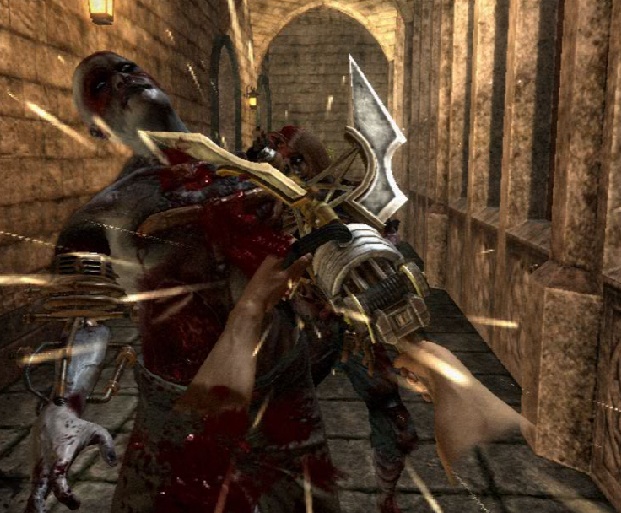
Then comes the combat. There are no guns in the game so you have to get up close and personal with nearly every foe you face. And while it does feel satisfying to punch a zombie out with brass knuckles, bash what’s left of their brains in with a lead pipe, or dismember them with a bloody chainsaw, because of all the movement that is involved with setting yourself up for the kill, the game’s A.I. is beyond simple to prevent frustration with the Kinect controls. In turn, this nullifies the fear factor because you never feel like your character is in any real danger most of the time when the zombies shuffle onto the screen. Many zombies will simply shamble right into the path of whatever weapon you are wielding and the larger challenge comes in keeping your real-life stamina up than in mowing down the constant stream of proverbial cannon fodder.

And this leads us to the fatigue factor. Although the movement and combat controls are simplified and picked up rather well for the most part once you get used to them, like shifting your shoulders to turn around, sticking one leg out to walk, and various quick time inspired events like ducking or climbing, you may become too tired to devote a long amount of time to the game per play session. I played for three hours the first time I put the disc in and didn’t realize till afterward that since movement is only controlled by one leg, that what became my pivot leg’s knee had locked up from putting my weight on it constantly for much of the game as I explored the castle grounds.

Despite what are really just minor annoyances though, the game is actually a solid experience overall. You could write off the “shambling” of the zombies to their uniquely written macabre clockwork origins, even if they aren’t that threatening, and the plot is engaging enough, with just enough cheesy B-horror movie voice acting, to make you want to push on with the story and find out the mysteries lurking in the castle. There are also some very satisfying moments sprinkled in like digging through a fresh cadaver or fishing through a blood filled toilet for items, or luring zombies into some of the mansion’s traps like giant rotating blades or electrified water. It’s just at the end of the day, although different from any other gaming experience I’ve ever had because of the Kinect controls, I can’t help but feel that I would have preferred having a traditional controller in my hand during a lot of it. Still, if you’re looking to get some more use out of your Kinect, this is a fine example of the potential for this device if developers turn themselves away from the cheesy party and exercise games and really focus on giving you a gaming experience.

Score: 7.0

Originally Published: August 9, 2011, on EGMNOW.COM

Publisher: Halfbrick Studios
Developer: Halfbrick Studios
Platforms: XBLA

Release: 08.10.11

Players: Singe Player, 2-player local vs and co-op multiplayer, online leaderboards

ESRB Rating: E – Everyone

The Good: Just as much fun as the iPhone app…
The Bad: …for the same amount of time and ten times the price
The Ugly: Me after sweating from ferociously chopping in my living room for a couple of hours

Even though it may come across as a simple game, the release of Fruit Ninja Kinect carries a lot of weight with it. Being part of the Xbox Summer of Arcade garners that the game needs to be a certain level of quality. It’s the first downloadable Kinect game made and many Kinect owners are hoping this will begin a push to see more software finally start to support the device again. And it could deal with the ire of fans of the original game for smart phones if it doesn’t translate well to motion controls. So how would a game originally designed for a touch screen feel when not touching anything at all? Pretty damn good.

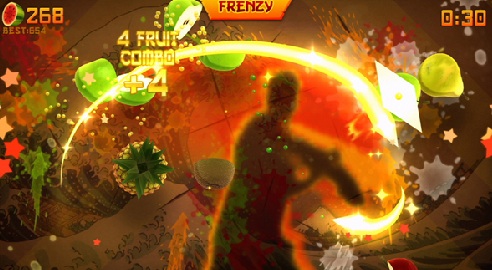
Anyone who has played the original Fruit Ninja will instantly be able to jump right into this game. After only a couple of sessions in the perfectly ported Arcade, Classic, or Zen mode you’ll be swinging your arms as proficiently as you swiped your fingers across a touch screen. The only problem players may find with the controls comes when you are swinging upward because when you bring your arms back to your sides, the game will sometimes pick that up as a downward slice and cut into something you never intended to. After a couple rounds prematurely shortened due to this though and you’ll learn to compensate as the original game overall translates very well to the Kinect. The game may actually translate a little too well.

After only an hour of play, I had matched or broken the high scores I had in the smart phone app and found myself bored with the game. Would I play it again at some point? Maybe, especially if I had a friend coming over for the local versus or co-op modes, which is the only real difference between this and some smart phone versions out there. But, swinging your arms instead of swiping your fingers just isn’t enough to sell me on this game at this price if I’m playing by myself. I could just pick up my phone or iPad, and do the same exact thing as on the TV screen with a lot less effort and for one-tenth the price. Bright, colorful, easy to pick up, and initially fun to play, Fruit Ninja Kinect is a solidly built game. But with such fast dissipating appeal and minimal replay-ability I don’t see why you’d pick this up when you can get virtually the same experience for a lot cheaper on your smart phones.

Score: 6.5

Originally Published: December 22, 2010, on youtube.com/cgrundertow

As a part of CGR Undertow, I was shakin’ my rear as I reviewed Zumba Fitness for the Xbox 360 Kinect from Majesco Entertainment.