Tag Archive: PS3


No skin, lots of bones, and a little bit of heart

It’s rare that you see a game revolving around motion controls that also attempts to feature a deep, fleshed-out story like Medieval Moves: Deadmund’s Quest. Unfortunately, you all too often see these types of games fall into the same gameplay traps that this one falls into as well—missteps that take away from the overall experience.

Medieval Moves: Deadmund’s Quest is set in a fictional medieval kingdom where a boy named Edmund lives in the castle. Although he’s an orphan, Edmund’s built up an almost King Arthur–esque mystique, and he’s now destined for great things—including inheriting the crown. But for now, Edmund’s still too young and is simply tasked with guarding a mysterious, powerful stone that contains mystical powers. Guided by the ghost of a past king, the castle chef, and several other allies, Edmund’s well on his way to being a just, beloved ruler. That is, until a nefarious necromancer attacks the castle with an army of undead skeletons. Claiming the mysterious stone and its power for his own, the necromancer curses the kingdom and adds them to his skeletal army. But Edmund’s fortuitously protected by a magical stone pendant, so although his flesh melts away, his mind’s free from the necromancer’s control. Jokingly renaming himself “Deadmund,” he sets off on a quest to save his future subjects—and himself—from the dastardly deeds of this depraved demon.

I’ll admit that some aspects of Deadmund’s Quest flat-out impressed me for a motion-controlled game. The cartoony graphics work well with the lighthearted  writing—and when you couple that with some surprisingly competent voice acting by all involved, this game’s definitely aurally and visually pleasing.

That’s why it’s such a shame that, just like many other motion-controlled adventures, Deadmund’s Quest ends up being held back by the very technology that allegedly empowers it. The most disappointing part? It’s designed almost like a pseudo action-dventure game but instead comes off like an on-rails Legend of Zelda. This is almost an oxymoron—you can’t explore your surroundings or talk to townsfolk, and you must always engage enemies head-on. You’re simply herded forward to area after area, where you slash away at more of the necromancer’s skeleton horde with your sword or fire away with your arrows. The lack of gameplay diversity makes progression a dull grind almost immediately—you just won’t find the same variety as in Zelda or other more robust fantasy experiences.

And the tedious grind’s only compounded by major control problems, as too many different actions are assigned to various Move motions. Pointing up lets you drink milk to restore health, pointing down pulls out a grappling hook for jumping over walls, pulling back brings up your shield, and swinging away unsheathes your sword. But since you need to attack some enemies vertically or horizontally, you’ll often find yourself suddenly drinking milk in the middle of battle when you don’t want to, dropping your shield when trying to defend yourself, or hacking away when trying to pull out the grappling hook.

Medieval Moves: Deadmund’s Quest has a wonderful concept, but like so many motion-controlled games before it, this one’s subject to a poorly implemented gimmick—it would’ve been much more enjoyable with both a regular controller and an open world instead.

SUMMARY: A fun, lighthearted medieval adventure held back by Move technology and on-rails design.

  • THE GOOD: Humorous characters and an entertaining plot
  • THE BAD: On-rails action and epic adventure really don’t mix
  • THE UGLY: Undead skeleton monsters everywhere!

SCORE: 6.0

Carnies—now in videogame form!

When it comes to motion-controlled games, the experiences geared at casual audiences usually end up as the most polished, user-friendly products. Of course, you’ve also got the games you typically tire of quickly and don’t pull out again unless you’ve got company over and are looking to goof off—and Carnival Island is a perfect example.

This carnival-midway simulator sees you take control of a male or female avatar tasked with bringing color and life back to long-forgotten Carnival Island. As you play classic carnival and boardwalk offerings like skee-ball, coin toss, and ring toss, you’ll unlock various variations on these classic games. If you do well enough in each variation of the eight carnival contests—over 35 technically different games in all—around the island, you’ll succeed in bringing happiness and joy back to this carny paradise. OK, so the backstory isn’t the freshest idea—though, hey, how many games involving carnies have you ever seen?—but it works as an excuse to play these games without actually having to go to a carnival or boardwalk and drop hard-earned cash on rigged games that you’ll never win. Plus, each stuffed animal you win in Carnival Island will come to life and serve as a cheerleading sidekick. Try winning something like that down at the Jersey Shore!

But even though this one’s clearly targeted at a very casual audience, Carnival Island actually offers a surprising amount of polish. The anime-inspired cutscenes that play as you unlock various sections of the island are actually very pretty—and almost enough to keep you playing once the gimmick of the cheesy carnival games wears off, just so you can see the next one…almost. But, fittingly in a game clearly geared toward the casual audience and children, the bright colors and themes really shine through.

And although the controls are probably the simplest you’ll find in even most casual of casual titles—most of these carnival showdowns are all about flicking your wrist or moving one arm around—they do their job well enough. I mean, who ever broke a sweat playing ring toss? Still, it feels good when you start racking up 100 points per ball in skee-ball or flipping the coin in the cup perfectly each time in coin toss.

The big flaw of Carnival Island—like many of these minigame-based, motion-controlled, gimmick-driven, budget, soon-to-be-bargain-bin titles—is the fact there just isn’t enough replay value. In order to try to appeal to the lowest common denominator, the difficulty’s set to preschool levels, and the rewards are few and far between. So, after a few hours of skee-ball, you’re ready to either hang up your Move controller or move on to a real game. Hey, maybe that’s why the Move is so aptly named—because, after playing most of the games that require it, you want to MOVE on to regular games.

Carnival Island certainly isn’t a bad game, but it’s just not something you’ll end up devoting a ton of time to in the long run, especially if you’re a hardcore gamer. If you’ve got a kid or a niece or nephew who really likes casual games—or maybe a grandparent on the opposite end of the spectrum—well, they probably have a Wii. But if they do, for some reason, have a PS3 and a Move, this might be more their speed.

SUMMARY: This carny simulator’s as simple as can be—but it’s surprisingly fun and definitely helps bolster the Move’s casual appeal.

  • THE GOOD: Responsive controls and fun games
  • THE BAD: Simple—and can get tiresome quickly
  • THE UGLY: The handlebar mustaches of the carniefolk

SCORE: 7.0

THE BUZZ: Sony announced today that the 2011 Gold Glove Winner at first base in the American League, Adrian Gonzalez of the Boston Red Sox, will grace MLB 12: The Show’s cover.

Gonzalez came to Beantown in the 2010-2011 off-season via a trade with the San Diego Padres and showed that the big market pressure would not faze him as he produced 27 HRs, 117 RBIs, and a .338 batting average in 159 games.

Gonzalez also marks the 3rd Red Sox to grace The Show’s cover in its 7th year after David Ortiz did it in the inaugural year of the franchise in 2006 and Dustin Pedroia did it in 2009. This selection also continues the trend that no outfielder or pitcher has ever graced the franchise’s cover.

EGM’S TAKE: This Boston bias that Sony is showing is a little ridiculous. Pedroia and Ortiz both made sense when they graced the cover, but Gonzalez will be lucky to even make the Top 5 in AL MVP voting after stellar years from guys like the New York Yankees’ Robinson Cano and Curtis Granderson, Toronto’s Jose Bautista, Texas’s Michael Young, the White Sox’s Paul Konerko, or Detroit’s Miguel Cabrera and Justin Verlander. Not to mention National Leaguers like Ryan Braun or Prince Fielder of the Brewers, Matt Kemp of the Dodgers, or World Series Champion pitcher for the St. Louis Cardinals Chris Carpenter, any of whom also would’ve been more than worthy to grace the cover.

Although Verlander was snatched up first by 2K and you wouldn’t want a pair of players from the same team to grace the only baseball games on the market so that eliminates Cabrera, there are still clearly better selections for the cover. Not to mention it is arguable that Gonzalez shouldn’t even have been in the Top 3 for the Gold Glove this year as he robbed players like the Yankees’ Mark Teixeira, the Rays’ Casey Kotchman, and Detroit’s Cabrera again, showing once more that offensive numbers somehow influence defensive awards. Heck, Gonzalez is barely in the Top 3 in the division when it comes to fielding and I’m tempted to put Toronto’s Adam Lind ahead of him.

All of this on top of the fact that he was part of the greatest collapse in baseball history blowing a nine game Wild Card lead with his Red Sox in the last month of the season.

The only explanation I might have is that Sony’s San Diego based studios have a soft spot for the guy for all the time he put in with the Padres and as long as he had a good year, this may have been planned ahead of time. It still seems fishy to me though when there are clearly better choices available to you.

What do you guys think of Adrian Gonzalez making the cover? Are you bigger fans of 2K or The Show? Is The Show showing a Boston bias? What other athletes may have been more deserving?

If only cute could be made to kill

Over the years, the handy virtual pet has offered many children the chance of owning a fantastic creature without having to clean up the mess. I remember when I was younger and I was suckered into the Tamagotchi craze. After a thrilling two hours, I was bored and gave it to my sister. A few hours more, she was bored and gave it to her best friend. And thus it continued, until half the neighborhood had a hand at raising this virtual creature that, because it wasn’t real, no one felt the need to be responsible for. And so now, many years later, we’ve seen this virtual-pet genre evolve to the point that we’ve got motion-control gimmick games that basically serve the same purpose. And so, with that, we’re looking at the second iteration of Sony’s virtual-pet time- and money-waster in EyePet & Friends.

The entire premise is that the player receives a creature that looks more like a Mogwai from Gremlins more than any real creature, and you earn points by playing with it or by playing against a friend and their Gizmo lookalike in various games. Honestly, the creatures are cute, but this game has as much appeal as a root canal. The only real positive is that at least if these critters get wet or eat after midnight, they don’t turn into horrific little monsters. If you’re planning on getting this for your children, don’t. Get a real pet, like a dog or a cat. It might make more of a mess, but your kids will thank you years down the road and might actually learn some responsibility from having to take care of the animal. All EyePet & Friends does is waste their time and offer the tiniest amount of entertainment value I think I’ve ever seen in a game.

On top of being absolutely pointless, the game actually also has a lot of technical flaws that make it even more of a gaming abomination. The responsiveness with the PS Move, which is required to play the game, is hit or miss, and you’ll often find yourself having to repeat the same simple motions over and over again just to get the creature to do a trick. Again, if I’m going to put this much time and effort into teaching something, I’d rather it be a real animal that’ll probably learn faster and respond better than these balls of fluff do on my TV.

And speaking of your TV, the entire “game world” is really just a reproduction of what the PS Eye sees with the critters superimposed over the image—but with what looks like a blue static filter over the screen the entire time. This filter ended up giving me a headache after a half hour, because even if you find a way to focus on your EyePet, they take up 10 percent of the screen at best. Sony was trying to bridge a gap between the real world and the fantasy world, but instead they should have just kept it in the fantasy world and actually provided some backgrounds to play with the creature in. Again, this is just another reason you should “keep it real.”

The worst part of the entire game, though, may come from the announcer who explains everything you can do with the EyePet. The man’s disturbingly unbridled enthusiasm for this virtual mongrel would put most game-show announcers to shame. Being forced to hear him explain every toy, activity, and feature of the EyePet made me want to jam pencils in my ears.

It has been a long time since I had such an abysmal gaming experience, and I cannot, in good faith, recommend this to anyone. Again, get your kid a real pet or watch as the money you spent on EyePet & Friends gets turned around by your kid as a traded-in game at a GameStop or Best Buy for something that might actually hold their interest for more than 15 minutes. This game doesn’t even deserve to be on the shelf and should start in the bargain bin—and that’s going easy on it. Bottom line: It doesn’t get worse than this, folks—at least I hope not.

SUMMARY: Like any other virtual pet: You’ll question why you even bothered in the first place.

  • THE GOOD: Creatures are cute as can be
  • THE BAD: Long load times and an announcer who makes you want to stab things in your ear
  • THE UGLY: Reminiscent of the Tamagotchi craze—and that’s not a good thing

SCORE: 1.0

A lifeless, zombified PS3 port

Back in 2009, an arcade classic was in desperate need of a makeover—and, of all places, it came from the Wii, surprisingly enough. The House of the Dead: Overkill served as a prequel for the immensely popular lightgun House of the Dead games and explained, sort of, both the origins of Agent G (the series’ main protagonist) and the zombie-causing formula he’s fought for 15 years—all wrapped in a ’70s B-movie setting with over-the-top voice acting, tons of sex and swearing, and cheesy moments galore. Looking to capitalize on that surprising success, Sega’s ported the game over to the PS3 with some upgrades in hopes of catching lightning in a bottle with a new audience.

Unfortunately, anyone who played through the original House of the Dead: Overkill will note Extended Cut for PS3 just feels…off. For as many problems that have been fixed from the original—like repetitive zombie skins and short game length—new ones seem to have cropped up. And the most glaring is way the game looks.

See, the poor graphics were actually part of the original’s charm. Throwing in a film grain to cover up the Wii’s weaker processing power was a masterstroke that helped give Overkill a B-movie look that fit perfectly with the depraved humor and unabashed, over-the-top moments. Bringing the game into full HD on the PS3 actually takes away from the original experience and shows that film grain and great graphics just don’t mix. But the visual changes don’t stop with the HD upgrade—Extended Cut also includes added 3D. Enemies chuck weapons in order to add a few 3D moments to the experience, but it feels forced and unnecessary the whole way through, and it’s just another knock on these new-and-“improved” visuals.

Another flaw comes with the controls, since most players don’t actually own a PS Move—and that’s how this game is meant to be played, with the Move serving as a makeshift lightgun to help re-create that arcade experience. If you don’t own a Move, the controls don’t translate to the DualShock, since you’ll more than likely try to overcompensate with the reticule and overshoot your target, making the game’s multiplier combos almost impossible. Looking back, the game worked so well for the Wii because the Wiimote’s essentially designed as a light gun to begin with.

Extended Cut includes two new levels that follow zombie-fighting stripper Varla Gunns when she’s not with Agent G and Isaac Washington, and those definitely add some replay value and extra humor—though the spotlight still shines on the relationship between Washington and G. These areas introduce new characters while also bridging what some might consider plot gaps—but I just think of them as part of the charm.

In the end, I can’t believe I actually found myself pining for the Wii version, as this PS3 incarnation found a way to use technology to suck out all the fun and charm of the original and deposit it in a steaming pile of disappointment on my living-room floor. If you’ve never played the original House of the Dead: Overkill and happen to own a Move, then this game might be worth checking out. Otherwise, I hope you’re ready to dust off your Wii—because I’d actually recommend that version, which you can probably find in the bargain bin these days, to get the better overall experience.

SUMMARY: It may sound preposterous, but you’d be better off checking out the far-better Wii version of this PS3 port.

  • THE GOOD: Two new levels extend the campy, on-rails romp
  • THE BAD: HD graphics with a film-grain effect is like a visual oxymoron
  • THE UGLY: The Mother boss in full 3D

SCORE: 6.0

Like having access to Altair’s library

For many people, what makes Assassin’s Creed so great is how it molds the story it wants to tell around actual real world events from history. In this way, Assassin’s Creed has written its own special history that parallels our own. But it can get a little confusing after a while as well just trying to keep things like who all the Borgias are straight and what the differences are between a Turkish Flanged Mace and a Florentine Mace. Well, with their fourth game in the series in Assassin’s Creed: Revelations about to come out, there is a lot more history to Assassin’s Creed than even a lot of us diehards may realize and so Ubisoft is getting ready to release the Assassin’s Creed Encyclopedia.

Set to drop the same day as Assassin’s Creed: Revelations, the Encyclopedia is the must have for every diehard Assassin’s Creed fan as you can have the entire history of the franchise up to this point at your fingertips. Along with all this information, you’ll also get never before seen art to go along with many of the entries as well as a running list in various categories like weapons, Templars, and Assassins. And it’s all opened up with a foreword by Gears of War’s Cliff Bleszinski talking about how important franchises like Assassin’s Creed is for gaming as a modern medium.

Be warned though, as tempting as it might be to just start reading the Encyclopedia from front to back, there are spoilers for both the animated short Embers, also being released on the same day as the game, November 15th, as well as for Assassin’s Creed: Revelations itself. So if you want to learn just what happens to Ezio and experience it like it is meant to, by playing the game, then I recommend you play Revelations first, then watch Embers, THEN read the Assassin’s Creed: Encyclopedia in order to keep all the surprises best in tact.

The best way in order to get the Assassin’s Creed: Encyclopedia would be to go through Ubisoft themselves by going to http://shop.ubi.com and picking it up on November 15th along with your Signature Edition copy of the game that comes with the Embers animated short.

Will you hoist Lord Stanley’s Cup?

In many northern latitudes, folks are anticipating that first cool breeze in the fall—the one that signifies that the seasons have finally changed, and with it, the sports landscape. That feeling that tells you that, finally, it’s time for hockey again. But in case you can’t wait another month or so, EA Sports is looking to give you your hockey fix a little early with NHL 12.

As always, this season sees plenty of changes, but what’s interesting is that the little tweaks are probably just as big as the overall additions. Not to say that those should be taken lightly, either, though. New modes like NHL Legends—where you can draft a legendary player like Wayne Gretzky or Ray Bourque to your real-life favorite team and play as them like you would in Be a Pro—is a nice addition if you’ve got a childhood hero you want to take back out on the ice. Of course, it might be a little shocking at first to see someone like Jeremy Roenick on the New York Rangers or Chris Chelios on the Tampa Bay Lightning, but this is your chance to see what might’ve happened if your favorite player had donned your favorite team’s sweater.

And speaking of Be a Pro, that’s seen some additions as well. The inclusion of the Canadian Hockey League allows you to play in the CHL for four seasons if you wish, which adds a bit of an RPG feel as your coach assigns you tasks each game in order to progress through your respective organization. Of course, if you don’t want to put in the time and effort to work your way up the minor-league ranks, Be a Pro features a new wrinkle where you can select your favorite current player and play with them already on your big-league club. They still get tasks from the coach, though, and because they’re already in the pros, more’s expected from them—so doing poorly could get them sent to the minors!

Beyond these new modes, though, I didn’t know a hockey game could feel so good until I got my hands on NHL 12. The puck physics have become so realistic that you’d think you were watching an actual game as shots knuckle, deflect off players, or ricochet around the boards. And with the improved AI of all computer-controlled players, you’ll rarely see someone out of position—everyone plays their role, just like they do in the real game. On top of this, NHL 12 offers the ability to hit and interfere with goalies, giving you more influence in the crease than ever before. And you know what that means: goalie fights! Throw in breaking glass, checking guys into the bench, knocking off helmets after bone-crunching checks, or shrugging off checks from smaller players, retired numbers, and even the ability to stage the Winter Classic, and you can’t help but feel satisfied with most every aspect of NHL 12.

Aside from these tweaks to improve the offline modes, another fan favorite that’s been overhauled is the online Hockey Ultimate League. Multiple lineups, stars of the week based on live player stats, a versus mode featuring you and a buddy’s Hockey League teams, and much more have been added to make this month-by-month feature even more addictive for those wannabe GMs out there.

Really, my only complaints with NHL 12 arose in Season or Be a GM when the game didn’t recognize that the Rangers’ first two regular-season games were in Europe—and that the stats were so skewed that the Rangers’ offense was a 100. I love the Rangers, but even through the Broadway Blue–tinted glasses of a fan, I don’t see how adding Brad Richards and getting some guys healthy propels the team so far past last year’s squad.

When all’s said and done, though, EA Sports has gone above and beyond in this year’s effort to give us the best videogame hockey experience yet, and NHL 12 should be more than enough to keep hockey fans satiated all year round.

Summary: NHL 12 is the most complete hockey sim to date, and the effort shows from the smallest puck bounces to brand-new game modes.

  • The Good: Improved puck physics and AI
  • The Bad: Horribly inaccurate player ratings
  • The Ugly: NHL Legends in uniforms they don’t belong in

SCORE: 9.0

Originally Published: August 30, 2011, on EGMNOW.COM

Call of Duty: Modern Warfare 3 creative strategist Robert Bowling faces one of his biggest challenges—revamping the series’ multiplayer offerings.
RC: One of the key aspects that’s made Call of Duty a smash hit is the multiplayer aspect, and you guys have pulled out all the stops in order to expand on this, including a new killstreak system where the player can choose either an Assault, Support, or Specialist path of upgrades. Tell us about the decision to incorporate specialized killstreaks to fit different players’ styles, and how you hope this may level the battlefield for the more objective-based player.

Robert Bowling: Well, the inspiration for all the different strike packages was looking directly at the feedback we’re getting from the 30 million people playing our game. Looking at the player trends that have been happening as we’ve moved from Call of Duty 4, when we first introduced killstreaks to how the dynamic then changed in Modern Warfare 2—and then how we want that dynamic to change even further in Modern Warfare 3. A lot of it’s going back to the more gun-focused gameplay of Call of Duty 4, but with what we’ve learned from the killstreak system is that, inherently, it’s all focused on getting kills. We’ve got millions and millions of players who all play so differently, but they’re not being rewarded, incentive-wise, for being good at the game in other ways—and that was the big driving factor for introducing custom strike packages, because we wanted to open up how you’re rewarded with killstreak rewards. We want to let you be in control in the type of killstreak rewards you have and give you the tools to be a better objective player and a better team player, rather than always trying to be the best team deathmatch player.

And that carries over through more than just the killstreaks. Capturing objectives, capturing a flag, capturing domination points, and blowing up a bomb site should all add to your rewards. So, regardless of what strike package you have, that now gets you one tick closer to unlocking your next killstreak reward. In addition to that, you can now focus your entire killstreak rewards on things that have nothing to do with getting you more kills—and that was the whole mentality behind giving you tools that allow you focus on things other than killing.

RC: Another new multiplayer aspect is the Spec Ops: Survival Mode. Tell us about what you’ve done with your take on what boils down to Horde mode.

RB: Well, Spec Ops: Survival Mode is really taking the traditional wave-based gameplay and putting the Modern Warfare twist on it. So, we’re bringing in all the stuff that people love from multiplayer—matchmaking, progressive ranking, killstreaks, weapon unlocks, weapon attachment systems, gear and equipment from multiplayer—and bringing all that and putting it into a much different arena in a co-op environment against AI enemies. And the benefit of the infinite-wave thing is that we can constantly be throwing different experiences at the player—so, you’re seeing enemies you’re not seeing anywhere else. You’re seeing kamikaze dogs, kamikaze infantry, chemical agents, juggernauts, juggernauts with riot shields, enemy air support—it’s such a different experience, and what I love about it is that it blurs the lines between what’s a competitive multiplayer experience and co-op multiplayer experience, and it makes experiences that were typically only reserved for that super-hardcore-competitive multiplayer guy accessible to the single-player guy. Now you have the opportunity to call in some awesome chopper gun and to be raining death down from above, or maybe you’re just not a competitive multiplayer guy, so you never got to experience that before, but now you can have that in a much different environment.

RC: Moving to the franchise as a whole, we all know that Sledgehammer and Infinity Ward are working jointly on this title. What difficulties have arisen, if any, from having two different development studios working on the same title?

RB: Early on, it’s all about logistics. So, the biggest challenge was, logistically, how do we have two teams work on such a massive experience? And so we sat down and we made the decision to be a very flat organization—to not divide the game and be like, “OK, we’ll take this, and you do that, and you just do your thing, and we’ll do ours.”. That would’ve never worked. So, what we did was focus on playing off each other’s strengths and weaknesses—and everyone has input on everything in the game. So, we’re really working as one giant team rather than dividing things up among each other. So, we’d be more like, “Your guy is really great at this; he should work with our guy on this aspect” on the same level and build up from that organically. From there, logistically, it was about setting up video-conferencing systems, setting up ways to communicate on the fly, as we would with the guy two offices down from me. And then, from a creative standpoint, sitting down and having open, honest conversations about what direction we want to go. I mean, I knew that going into it, we’re a very passionate team with very core design philosophies, and we knew what we wanted Modern Warfare 3 to be. But it was refreshing to have Sledgehammer come in with such a fresh perspective, because they brought in things and directions that we may never have gone in and brought in experiences we’ve never had before.

RC: Speaking of other experiences, do you guys ever look at other shooters out there for inspiration? Do you ever see a perk or a weapon in another game and go, “That’d be really awesome in our game”?

RB: We take inspiration from everywhere, not only in our own genre. I love when we take inspiration from things outside of our genre. Look at what RPGs are doing, and look at what MMOs are doing—specifically in regards to things like progressive rank and XP and how you reward players. We take inspiration from all that stuff, and it’s important that when you do that, you make sure you only take the core mechanic and make it work for the kind of experience that we’re looking to deliver. But, yeah, that happens all the time, and it’s great when you can do that.

RC: Let’s talk about the single-player—at this point, we’ve all seen the E3 2011 footage of the attack on New York City. Call of Duty historically takes place all over the globe, though. What goes into deciding where the games’ missions take place, and what kind of research do you do? In terms of the plot, why New York City now under attack?

RB: Well, a lot of the story and locations are dictated organically by where the story’s going and how the conflict’s escalating. Modern Warfare 3 is a payoff to this growing momentum of conflict that’s been starting since Call of Duty 4. So, in Modern Warfare 2, the state of the world changed when the invasion of the U.S. happened. That was just the beginning. The attack on Washington, D.C. was just the beginning of the turning of that type of war. And it just organically escalated up the eastern seaboard to New York, which is another major city, because the Russian navy ‘s blockaded New York by this time in Modern Warfare 3, because this is a full-on invasion. This is a military invasion by the Russian army—this isn’t some sub-splinter of a group. This is the Russian nation attacking America, and this will be pulling in other major nations and cities into this conflict, as would actually happen if America were attacked.

So, it’s really looking at how the war’s escalating, and what I love about it this time is that we’re leaving these very traditional conflict areas, and for the first ever in Call of Duty, what we started with at the end of MW2 was pulling it into the heart of these major cities, bringing the conflict to these iconic places, rather than nondescript desert town you’d expect wars to be fought in. Now you’re fighting in Paris, London, and these major cities in Germany and Africa. So, it’s really changed organically and the research that goes into that is painstaking. Because you look at like fighting in London, and we ask ourselves, “Where would we fight in London?” We have to figure out where it would not only make sense for the story, but also where it’s going to be very impactful for the player. So, we’re looking at Canary Wharf in London, and then you go into reference and pull each reference you can and look at Google Maps and get the layouts and the buildings. And then you take that—once you get it as authentic as possible—and you put it through a gameplay filter of “OK, this is authentic, but now how do we make it fun?” Because authentic’s great, but fun is king. And that’s when you start looking at player routes and cover points and sight lines and start crafting it for gameplay.

RC: From a technology standpoint, you guys have been working with the IW engine for a while now. Was there anything you were able to add into MW3 that you weren’t able to do before but now can because of the familiarity you have with the tech?

RB: Definitely. The big focus with moving into these new environments and these much bigger cities is that the length and the scale of the levels in the single-player that you’re fighting in now are so much bigger than we’ve ever done before. So, a lot of that on the back end required a lot of tech work—and, thanks to the fact that we’ve been building steppingstones. In Modern Warfare 2, we made a good leap from Call of Duty 4 in terms of just visual graphics with our streaming technology that allowed us to make that leap. And in Modern Warfare 3, we’ve done even more work with that now that we’ve mastered that streaming technology and found other ways that we can enhance what we’re streaming in, when we’re streaming it, and how we can optimize that to get to that scale, to get to that size, and still maintain that super-smooth 60 frames per second with tight controls, which is what sells the Call of Duty franchise. That’s what sells—the tight gunplay. And, at the end of the day, that’s what matters most.

RC: It wouldn’t be a first-person military shooter without plenty of weapons. So, what kinds of new goodies can players look forward to in Modern Warfare 3?

RB: Well, we’ve added a lot of really cool weapons. A ton of weapons overall, especially in multiplayer. There’s stuff that isn’t even out yet, and that’s the great thing of being at the scale that we’re at now, where we’ll actually have weapons manufacturers contact us and be like, “Hey, we have this new prototype that’ll be out in the field in a few years, but we think it would be great for your game,” and we can go look at it, or they’ll bring it to us, nd we’ll check it out. One of my favorites is the XM25 grenade launcher, which is something only Delta operators are using in the field right now. It’s a grenade launcher that “lasers” a target—like, say, someone’s behind a concrete barrier or in a doorway or window or something, and you can laser that barrier, and it’ll calculate the distance, program it into the explosive round, and when you fire it, the round is programmed to explode one meter past that distance. So, you can actually shoot it through the window, and not until after it gets through the window will it explode and take out anyone who’s hiding behind it. That’s something Delta operators are using now, and that’s something we’re going to have in multiplayer and single-player, but we balanced them very differently between the two, because single-player’s all about having fun, while multiplayer’s about having fun but having to be balanced with everything else in the game.

RC: You mentioned Delta operators before. How closely do you work with military personnel in order to give an authentic feel to the game’s combat?

RB: We work very closely when it comes to being authentic in terms of the gear that you’re using and the weapons and they operate and how they look. But, more importantly than anything, is that fun always comes first. So we do want to be as authentic and as real as possible, but we will pull back from that realism in order to be more fun and to make it actually enjoyable to have all that stuff. So we’ll sit with them from a story standpoint and say, “Hey, here’s a scenario we’re cooking up for the story. How would you approach that?” A good example is talking to our active military guys who work with Delta and saying like, “Scenario: Russian sub in a New York harbor. You are responsible for disabling the sub. What would you do?” And then we’d say what we were thinking and our gut reaction to the situation. “Plant a charge here and blow a breach in.” And then they come in and say, “Oh, no—you wouldn’t do that. You’d be afraid of disabling this, and that would force it to come above. And then you could breach it from above without having to be underwater.” And that directly influences the gameplay—like in the E3 trailer, when the SEALs assault the sub.

RC: Call of Duty seems to come across as a “guy’s guy” kind of game. But you have a surprisingly strong female audience as well. What would you attribute that to? And do you ever see Call of Duty including female soldiers as protagonists or allowing players to chose female characters in multiplayer?

RB: I’d attribute it to the fact that we’re extremely accessible to every type of playstyle. We have females in our community that are amazing at the game in every aspect, but then you also notice trends between female gamers and male gamers. Female gamers are typically more focused on teamplay and that support role and not being self-focused or lone-wolfing. They also communicate better in terms of garnering Dom points and capturing objectives. So, I think the fact that we—especially with Modern Warfare 3—cater to different playstyles and reward them has even greater appeal now to all types of audiences.

As for female protagonists, I think anything’s possible in the future. We’ve had some female characters in the past—we had a chopper gunner pilot in Call of Duty 4 who was female. So, I think anything’s possible. We really let the story dictate the characters for us, and so far, we’ve had female roles in there at different points.

RC: Finally, the controversy over violent videogames reemerged after the recent terror attack in Oslo, Norway; the perpetrator of these attacks claimed that he “trained” with Call of Duty. This has led to the franchise being pulled from some store shelves in Norway. How do you guys respond to something like that, and do you see it affecting the series either in the long- or short-term?

RB: We don’t see it affecting us from a creative standpoint, because we’re creating a fictional game with a fictional storyline that takes place completely outside of any real-world scenarios. The universe that our games live in is very unique in that sense. But our focus has always been—and will always be—on making games that are meant for entertainment, that are meant for the right audience, and making sure that we’re following and respecting all the rating guidelines that are out there and making sure that everyone can make an informed decision and that they know what the content of the game is well before purchase. We want to make sure that we’re respecting that, and that we’re open and transparent about that.

Originally Published: August 16, 2011, on EGMNOW.COM

Publisher: Konami
Developer: AQ Interactive
Platforms: PS3

The Good: Extra assassin missions in stunning 1080p HD graphics
The Bad: Still riding around Santa Destroy on your motorcycle
The Ugly: The PS Move controls are just as clunky as the Wii version’s

One of the most original and fun games I’ve played on the current generation of consoles came from one of the most delightfully twisted developer minds around in Suda 51. The first No More Heroes had flaws, but many could be overlooked by the brilliant humor and over the top situations. Include some epic and unforgettable boss battles and the original game was definitely a winner.

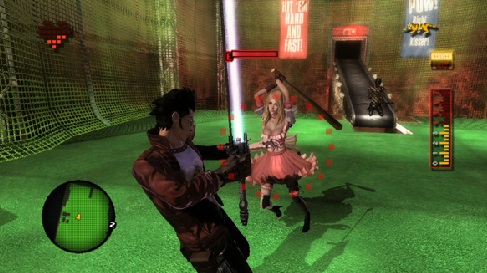
Unfortunately, this gaming gem fell through the cracks for many because it was a Wii-exclusive. Until now. No More Heroes: Heroes Paradise is not only a port of that original game to the PS3, but it includes nearly twice as many foes for Travis Touchdown, our sex with an anime girl and pro-wrestling obsessed beam katana wielding (imagine cheap lightsaber) protagonist, to assassinate as he works on becoming the number one assassin in the world.

But with this port also come many of the same problems found in the original game as well as some new ones. Set in the fictional sandbox world of Santa Destroy, Travis still spends too much time on his motorcycle, needlessly driving from objective to objective. And although the new side missions to build up cash are cute, they are really nothing more than unnecessary distractions from the main game of hacking up your foes into tiny little pieces. And if you use the PS Move, the controls to hack up your enemies with your beam katana are just as finicky as the original game for the Wii. There are moments where everything is picked up perfectly and then there are others where you have to repeat the same motion a dozen times. You can also stock up to three “Dark Side” charges now, which allow Travis to go into a blood lust rage and hack his foes apart with much greater ease and take no damage, but I felt the original mechanic of having them activate immediately when earned worked fine and this new method makes the game’s natural difficulty much simpler to overcome.

Despite these control and game flow problems, the script and boss battles are still tremendous and if you haven’t had a chance to play the original No More Heroes then to experience it for the first time in 1080p on the PS3 would be the way to go. But if you’ve already risen to the top of the assassin ranks with the Wii version, the extra bosses aren’t really enough to warrant picking up this port.

Score: 7.5

Originally Published: August 2, 2011, on EGMNOW.COM

Publisher: TimeGate Studios
Developer: TimeGate Studios
Platforms: PS3 (previously released on Xbox 360 and PC)

Release: 7.26.11

The Good: Deeper story mode than original serves as more than tutorial for multiplayer
The Bad: Dated, last-generation graphics, glitches, and horrible voice acting
The Ugly: The splatter when an orbital supply drop crushes someone

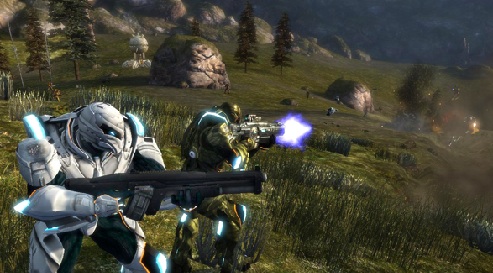
Section 8: Prejudice is a sequel to Section 8, a sci-fi shooter that revolved around space marines who would be shot from an orbital cannon into various military conflicts, and provides players with the personal challenge of trying to crush hapless opponents on impact. Although an interesting take on the shooter, the campaign served as nothing more than an extended tutorial that seemed to gear players up for the multiplayer. With the release of Prejudice though, the entire Section 8 universe has seen a re-design.

The most obvious fix to this franchise comes in the single player campaign. Although there are several parallels between the action of this new story, which continues to follow Alex Corde, the first game’s protagonist, and the original game’s campaign, the clear ramping up for the multiplayer, which remains the game’s meat and potatoes, is much better hidden through a more complex story.

The terrific multiplayer, which is what most attracted players to the first game, has only been bolstered by the new Swarm mode. Similar to Gears of War’s Horde mode, Swarm sees players team up to defend a single control point as they eliminate waves of enemy bots. Up to 32 players can also take part in the returning Conquest mode, which rounds out the multiplayer experience. In Conquest, two teams attempt to score points by killing their opponents, capturing objectives, and finishing a plethora of missions that prompt teamwork from the entire group in order to complete. This variety in a glorified death match mode really lends itself to team tactics in order for your squad to emerge victorious. Include again several customizable load outs you can pre-set before jumping into any and every fray and the multiplayer is something that most shooter fans should check out at least once.

Even with this downloadable title having more content than the disk-based original from two years ago though, there are still many flaws right on the surface of Prejudice that keep it from being elite. The paltry graphics, glitch riddled combat, and horrible voice acting makes you think this could be a game from the last console generation. And, again, even with a more involved story and much better character development and cut scenes, the single player campaign still feels like an extended tutorial to play before jumping into the multiplayer mode.

Despite this though, Section 8: Prejudice is a much richer experience than its predecessor and with the cheaper downloadable price tag, is a worthy distraction for shooter fans with itchy trigger fingers.

Score: 7.5/10