Tag Archive: ray carsillo


Originally Published: August 30, 2011, on EGMNOW.COM

Publisher: 345 Games
Developer: Backbone Entertainment
Platforms: XBLA, PSN

Release: 08.30.11

Players: Single Player, 2-4-player local and online co-op

ESRB Rating: M – Mature

The Good: Fans of the show will be laughing from the opening cut scene to the end credits
The Bad: Camera angle makes aiming difficult, game play can be repetitive
The Ugly: Huge steaming piles of manbird droppings

Based on Comedy Central’s hit TV show, Ugly Americans: Apocalypsegeddon is an original adventure featuring all your favorite characters from the cartoon. You choose to play as series protagonist Mark Lilly, his girlfriend Callie Maggotbone, bumbling wizard Leonard Powers, or the D.O.I.’s top cop, Frank Grimes. Each character has their own strengths and weaknesses, but the game features an RPG leveling-up system that can help balance them all out or really stress those advantages depending on your play style. After making your character decision, you’ll grab yourself a BSU 2000 (Blow Sh*t Up 2000, Frank’s newest toy that allows you to stick whatever isn’t bolted down into the chamber and fire it as a projectile) and start getting down to the bottom of all the trouble in New York City.

The first thing you’ll immediately notice is the game went with a less traditional side-scrolling view instead of the ceiling down view seen in most other dual joystick arcade style shooters. This was meant to try to give the gamer more of a sense as if they were watching an episode of the TV show, but it is a little difficult to get used to at first, especially in terms of aiming your BSU 2000 at the various manbirds, zombies, and demons you’ll come across. Some items have a spray effect where the aiming difficulty doesn’t seem as obvious, but with a lot of other projectiles, like the boomeranging hammer or arcing crystal ball, misjudging the aim can get tedious fast.

The game does do a lot of things right though, especially in the presentation. If you’re a fan of the show, you’ll love the fact that all the voice actors reprise their roles in the game and there is more than 20 minutes of original animation and dialogue in cut scenes, meaning that the game is just dripping with the humor that makes the show itself great and has enough animation for a stand alone episode by itself. The best part probably comes from being able to play the game with friends locally or online though as it helps to break up the redundancy that is typical of most arcade shooters.

All in all, the question you have to ask yourself is ‘are a fan of the show or not’. If so, the writing and animation will outshine the minor game play annoyances and is definitely worth your $10. If not, you may want to avoid this as knowing the show seems critical to your overall enjoyment of the game.

Score: 7.5

Originally Published: August 30, 2011, on EGMNOW.COM

THE BUZZ: IBM’s working on a new type of “cognitive computer chip” that not only performs preprogrammed functions, but can also learn and recognize elements in its environment and react to them—including play videogames—in a way similar to the human brain.

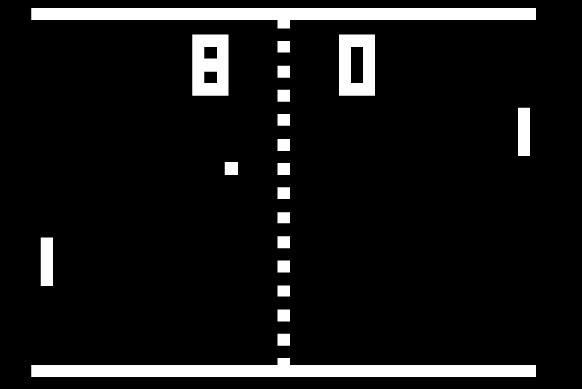
WHAT WE KNOW: IBM says their research team set up two prototype chips that “successfully demonstrated simple applications like navigation, machine vision, pattern recognition, associative memory, and classification.” One of the highlights came when they pointed out one chip in particular “taught itself how to play Pong,” which served as one of their first tests for cognitive recognition.

EGM’S TAKE: In terms of real-world applications, these chips could provide “smart” traffic signals, water-supply monitoring, or natural-disaster prediction. On a more personal note, imagine these chips in your iPad—or even your videogames—as they learn from your daily interaction. Developers could guarantee that no two gamers would have the same experience, as these smartchips could change a given game to challenge you specifically. Personally, I’d like to be the first to welcome our new computer overlords, as this is how a lot of apocalyptic science-fiction novels start: Computers that can think like humans then start to out-think humans. In all seriousness, I don’t know if it will ever get to that, but the applications for a chip like this are intriguing…if a bit frightening.

Originally Published: August 30, 2011, on EGMNOW.COM

THE BUZZ: Customer Ryan Graves, citing improper charges to many of Microsoft’s Xbox Live Gold Member accounts, has filed a class-action lawsuit against the company for “an award of appropriate equitable relief.”

WHAT WE KNOW: Graves claims that he let his Xbox Live Gold Membership expire in January; in March, he renewed his subscription with a different debit card. When he received his bank statements the following month, he found that Microsoft had double-charged him for Xbox Live. When he called Microsoft to have one of the charges removed, believing it to be a mistake, he was told that both charges were legitimate. One was for his new subscription, while the other was for the original he’d let expire—and Microsoft refused him a refund. Graves’ class-action suit demands retribution for himself and others who’ve been double-charged, and it further states that Microsoft is in breach of contract with its users and in violation of the Electronic Funds Transfer Act.

EGM’S TAKE: There’s no way to know exactly how many customers have been affected beyond Graves—or who may be joining him in this lawsuit. But if Microsoft’s forced to refund money to these individuals at $60 a person, with over 30 million Xbox Live users as of January 2011, it would only take 0.1% of the current Xbox Live audience to cost Microsoft millions—never mind the legal fees.

Originally Published: August 30, 2011, on EGMNOW.COM

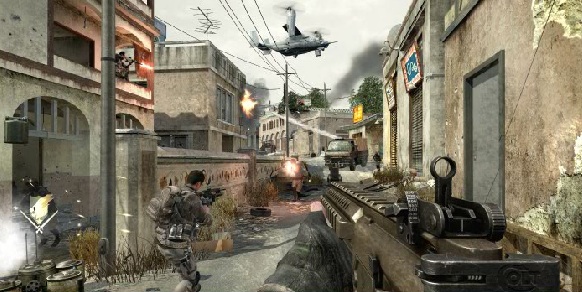
Call of Duty: Modern Warfare 3 creative strategist Robert Bowling faces one of his biggest challenges—revamping the series’ multiplayer offerings.
RC: One of the key aspects that’s made Call of Duty a smash hit is the multiplayer aspect, and you guys have pulled out all the stops in order to expand on this, including a new killstreak system where the player can choose either an Assault, Support, or Specialist path of upgrades. Tell us about the decision to incorporate specialized killstreaks to fit different players’ styles, and how you hope this may level the battlefield for the more objective-based player.

Robert Bowling: Well, the inspiration for all the different strike packages was looking directly at the feedback we’re getting from the 30 million people playing our game. Looking at the player trends that have been happening as we’ve moved from Call of Duty 4, when we first introduced killstreaks to how the dynamic then changed in Modern Warfare 2—and then how we want that dynamic to change even further in Modern Warfare 3. A lot of it’s going back to the more gun-focused gameplay of Call of Duty 4, but with what we’ve learned from the killstreak system is that, inherently, it’s all focused on getting kills. We’ve got millions and millions of players who all play so differently, but they’re not being rewarded, incentive-wise, for being good at the game in other ways—and that was the big driving factor for introducing custom strike packages, because we wanted to open up how you’re rewarded with killstreak rewards. We want to let you be in control in the type of killstreak rewards you have and give you the tools to be a better objective player and a better team player, rather than always trying to be the best team deathmatch player.

And that carries over through more than just the killstreaks. Capturing objectives, capturing a flag, capturing domination points, and blowing up a bomb site should all add to your rewards. So, regardless of what strike package you have, that now gets you one tick closer to unlocking your next killstreak reward. In addition to that, you can now focus your entire killstreak rewards on things that have nothing to do with getting you more kills—and that was the whole mentality behind giving you tools that allow you focus on things other than killing.

RC: Another new multiplayer aspect is the Spec Ops: Survival Mode. Tell us about what you’ve done with your take on what boils down to Horde mode.

RB: Well, Spec Ops: Survival Mode is really taking the traditional wave-based gameplay and putting the Modern Warfare twist on it. So, we’re bringing in all the stuff that people love from multiplayer—matchmaking, progressive ranking, killstreaks, weapon unlocks, weapon attachment systems, gear and equipment from multiplayer—and bringing all that and putting it into a much different arena in a co-op environment against AI enemies. And the benefit of the infinite-wave thing is that we can constantly be throwing different experiences at the player—so, you’re seeing enemies you’re not seeing anywhere else. You’re seeing kamikaze dogs, kamikaze infantry, chemical agents, juggernauts, juggernauts with riot shields, enemy air support—it’s such a different experience, and what I love about it is that it blurs the lines between what’s a competitive multiplayer experience and co-op multiplayer experience, and it makes experiences that were typically only reserved for that super-hardcore-competitive multiplayer guy accessible to the single-player guy. Now you have the opportunity to call in some awesome chopper gun and to be raining death down from above, or maybe you’re just not a competitive multiplayer guy, so you never got to experience that before, but now you can have that in a much different environment.

RC: Moving to the franchise as a whole, we all know that Sledgehammer and Infinity Ward are working jointly on this title. What difficulties have arisen, if any, from having two different development studios working on the same title?

RB: Early on, it’s all about logistics. So, the biggest challenge was, logistically, how do we have two teams work on such a massive experience? And so we sat down and we made the decision to be a very flat organization—to not divide the game and be like, “OK, we’ll take this, and you do that, and you just do your thing, and we’ll do ours.”. That would’ve never worked. So, what we did was focus on playing off each other’s strengths and weaknesses—and everyone has input on everything in the game. So, we’re really working as one giant team rather than dividing things up among each other. So, we’d be more like, “Your guy is really great at this; he should work with our guy on this aspect” on the same level and build up from that organically. From there, logistically, it was about setting up video-conferencing systems, setting up ways to communicate on the fly, as we would with the guy two offices down from me. And then, from a creative standpoint, sitting down and having open, honest conversations about what direction we want to go. I mean, I knew that going into it, we’re a very passionate team with very core design philosophies, and we knew what we wanted Modern Warfare 3 to be. But it was refreshing to have Sledgehammer come in with such a fresh perspective, because they brought in things and directions that we may never have gone in and brought in experiences we’ve never had before.

RC: Speaking of other experiences, do you guys ever look at other shooters out there for inspiration? Do you ever see a perk or a weapon in another game and go, “That’d be really awesome in our game”?

RB: We take inspiration from everywhere, not only in our own genre. I love when we take inspiration from things outside of our genre. Look at what RPGs are doing, and look at what MMOs are doing—specifically in regards to things like progressive rank and XP and how you reward players. We take inspiration from all that stuff, and it’s important that when you do that, you make sure you only take the core mechanic and make it work for the kind of experience that we’re looking to deliver. But, yeah, that happens all the time, and it’s great when you can do that.

RC: Let’s talk about the single-player—at this point, we’ve all seen the E3 2011 footage of the attack on New York City. Call of Duty historically takes place all over the globe, though. What goes into deciding where the games’ missions take place, and what kind of research do you do? In terms of the plot, why New York City now under attack?

RB: Well, a lot of the story and locations are dictated organically by where the story’s going and how the conflict’s escalating. Modern Warfare 3 is a payoff to this growing momentum of conflict that’s been starting since Call of Duty 4. So, in Modern Warfare 2, the state of the world changed when the invasion of the U.S. happened. That was just the beginning. The attack on Washington, D.C. was just the beginning of the turning of that type of war. And it just organically escalated up the eastern seaboard to New York, which is another major city, because the Russian navy ‘s blockaded New York by this time in Modern Warfare 3, because this is a full-on invasion. This is a military invasion by the Russian army—this isn’t some sub-splinter of a group. This is the Russian nation attacking America, and this will be pulling in other major nations and cities into this conflict, as would actually happen if America were attacked.

So, it’s really looking at how the war’s escalating, and what I love about it this time is that we’re leaving these very traditional conflict areas, and for the first ever in Call of Duty, what we started with at the end of MW2 was pulling it into the heart of these major cities, bringing the conflict to these iconic places, rather than nondescript desert town you’d expect wars to be fought in. Now you’re fighting in Paris, London, and these major cities in Germany and Africa. So, it’s really changed organically and the research that goes into that is painstaking. Because you look at like fighting in London, and we ask ourselves, “Where would we fight in London?” We have to figure out where it would not only make sense for the story, but also where it’s going to be very impactful for the player. So, we’re looking at Canary Wharf in London, and then you go into reference and pull each reference you can and look at Google Maps and get the layouts and the buildings. And then you take that—once you get it as authentic as possible—and you put it through a gameplay filter of “OK, this is authentic, but now how do we make it fun?” Because authentic’s great, but fun is king. And that’s when you start looking at player routes and cover points and sight lines and start crafting it for gameplay.

RC: From a technology standpoint, you guys have been working with the IW engine for a while now. Was there anything you were able to add into MW3 that you weren’t able to do before but now can because of the familiarity you have with the tech?

RB: Definitely. The big focus with moving into these new environments and these much bigger cities is that the length and the scale of the levels in the single-player that you’re fighting in now are so much bigger than we’ve ever done before. So, a lot of that on the back end required a lot of tech work—and, thanks to the fact that we’ve been building steppingstones. In Modern Warfare 2, we made a good leap from Call of Duty 4 in terms of just visual graphics with our streaming technology that allowed us to make that leap. And in Modern Warfare 3, we’ve done even more work with that now that we’ve mastered that streaming technology and found other ways that we can enhance what we’re streaming in, when we’re streaming it, and how we can optimize that to get to that scale, to get to that size, and still maintain that super-smooth 60 frames per second with tight controls, which is what sells the Call of Duty franchise. That’s what sells—the tight gunplay. And, at the end of the day, that’s what matters most.

RC: It wouldn’t be a first-person military shooter without plenty of weapons. So, what kinds of new goodies can players look forward to in Modern Warfare 3?

RB: Well, we’ve added a lot of really cool weapons. A ton of weapons overall, especially in multiplayer. There’s stuff that isn’t even out yet, and that’s the great thing of being at the scale that we’re at now, where we’ll actually have weapons manufacturers contact us and be like, “Hey, we have this new prototype that’ll be out in the field in a few years, but we think it would be great for your game,” and we can go look at it, or they’ll bring it to us, nd we’ll check it out. One of my favorites is the XM25 grenade launcher, which is something only Delta operators are using in the field right now. It’s a grenade launcher that “lasers” a target—like, say, someone’s behind a concrete barrier or in a doorway or window or something, and you can laser that barrier, and it’ll calculate the distance, program it into the explosive round, and when you fire it, the round is programmed to explode one meter past that distance. So, you can actually shoot it through the window, and not until after it gets through the window will it explode and take out anyone who’s hiding behind it. That’s something Delta operators are using now, and that’s something we’re going to have in multiplayer and single-player, but we balanced them very differently between the two, because single-player’s all about having fun, while multiplayer’s about having fun but having to be balanced with everything else in the game.

RC: You mentioned Delta operators before. How closely do you work with military personnel in order to give an authentic feel to the game’s combat?

RB: We work very closely when it comes to being authentic in terms of the gear that you’re using and the weapons and they operate and how they look. But, more importantly than anything, is that fun always comes first. So we do want to be as authentic and as real as possible, but we will pull back from that realism in order to be more fun and to make it actually enjoyable to have all that stuff. So we’ll sit with them from a story standpoint and say, “Hey, here’s a scenario we’re cooking up for the story. How would you approach that?” A good example is talking to our active military guys who work with Delta and saying like, “Scenario: Russian sub in a New York harbor. You are responsible for disabling the sub. What would you do?” And then we’d say what we were thinking and our gut reaction to the situation. “Plant a charge here and blow a breach in.” And then they come in and say, “Oh, no—you wouldn’t do that. You’d be afraid of disabling this, and that would force it to come above. And then you could breach it from above without having to be underwater.” And that directly influences the gameplay—like in the E3 trailer, when the SEALs assault the sub.

RC: Call of Duty seems to come across as a “guy’s guy” kind of game. But you have a surprisingly strong female audience as well. What would you attribute that to? And do you ever see Call of Duty including female soldiers as protagonists or allowing players to chose female characters in multiplayer?

RB: I’d attribute it to the fact that we’re extremely accessible to every type of playstyle. We have females in our community that are amazing at the game in every aspect, but then you also notice trends between female gamers and male gamers. Female gamers are typically more focused on teamplay and that support role and not being self-focused or lone-wolfing. They also communicate better in terms of garnering Dom points and capturing objectives. So, I think the fact that we—especially with Modern Warfare 3—cater to different playstyles and reward them has even greater appeal now to all types of audiences.

As for female protagonists, I think anything’s possible in the future. We’ve had some female characters in the past—we had a chopper gunner pilot in Call of Duty 4 who was female. So, I think anything’s possible. We really let the story dictate the characters for us, and so far, we’ve had female roles in there at different points.

RC: Finally, the controversy over violent videogames reemerged after the recent terror attack in Oslo, Norway; the perpetrator of these attacks claimed that he “trained” with Call of Duty. This has led to the franchise being pulled from some store shelves in Norway. How do you guys respond to something like that, and do you see it affecting the series either in the long- or short-term?

RB: We don’t see it affecting us from a creative standpoint, because we’re creating a fictional game with a fictional storyline that takes place completely outside of any real-world scenarios. The universe that our games live in is very unique in that sense. But our focus has always been—and will always be—on making games that are meant for entertainment, that are meant for the right audience, and making sure that we’re following and respecting all the rating guidelines that are out there and making sure that everyone can make an informed decision and that they know what the content of the game is well before purchase. We want to make sure that we’re respecting that, and that we’re open and transparent about that.

Originally Published: August 16, 2011, on EGMNOW.COM

Publisher: Konami
Developer: AQ Interactive
Platforms: PS3

The Good: Extra assassin missions in stunning 1080p HD graphics
The Bad: Still riding around Santa Destroy on your motorcycle
The Ugly: The PS Move controls are just as clunky as the Wii version’s

One of the most original and fun games I’ve played on the current generation of consoles came from one of the most delightfully twisted developer minds around in Suda 51. The first No More Heroes had flaws, but many could be overlooked by the brilliant humor and over the top situations. Include some epic and unforgettable boss battles and the original game was definitely a winner.

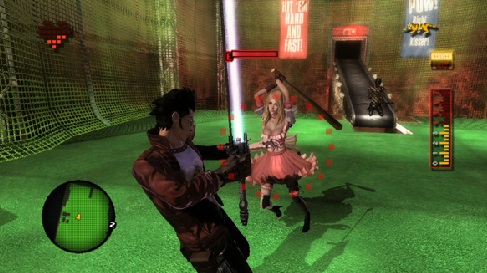
Unfortunately, this gaming gem fell through the cracks for many because it was a Wii-exclusive. Until now. No More Heroes: Heroes Paradise is not only a port of that original game to the PS3, but it includes nearly twice as many foes for Travis Touchdown, our sex with an anime girl and pro-wrestling obsessed beam katana wielding (imagine cheap lightsaber) protagonist, to assassinate as he works on becoming the number one assassin in the world.

But with this port also come many of the same problems found in the original game as well as some new ones. Set in the fictional sandbox world of Santa Destroy, Travis still spends too much time on his motorcycle, needlessly driving from objective to objective. And although the new side missions to build up cash are cute, they are really nothing more than unnecessary distractions from the main game of hacking up your foes into tiny little pieces. And if you use the PS Move, the controls to hack up your enemies with your beam katana are just as finicky as the original game for the Wii. There are moments where everything is picked up perfectly and then there are others where you have to repeat the same motion a dozen times. You can also stock up to three “Dark Side” charges now, which allow Travis to go into a blood lust rage and hack his foes apart with much greater ease and take no damage, but I felt the original mechanic of having them activate immediately when earned worked fine and this new method makes the game’s natural difficulty much simpler to overcome.

Despite these control and game flow problems, the script and boss battles are still tremendous and if you haven’t had a chance to play the original No More Heroes then to experience it for the first time in 1080p on the PS3 would be the way to go. But if you’ve already risen to the top of the assassin ranks with the Wii version, the extra bosses aren’t really enough to warrant picking up this port.

Score: 7.5

Originally Published: August 16, 2011, on EGMNOW.COM

New Survey Shows 1 out of 3 American Gamers Buy DLC

THE BUZZ: A new study of online purchasing behavior commissioned by PlaySpan, a Visa company, and undertaken by VGMarket, a research firm specializing in video game content testing, shows that the online marketplace for game add-ons is strong and is only likely to grow stronger in the coming years.

WHAT WE KNOW: The study reveals that 31% of gamers have bought digital content for their gaming needs in the past year and 57% of those people did it on a regular basis of at least once a month. The survey also showed that 72% of gamers said they are likely to spend the same amount of money, if not more, in 2011 than they did in 2010.

WHAT IT MEANS: Surveys like this show a clear movement by the gaming community into the online realm in terms of acquiring content and the industry has taken notice. Considered a drop in the bucket at the time of purchase compared to a full $60 game, you see how these online purchases can add up and may compel more developers to promise DLC for their games in the future. This might also mean less resources being put towards developing new games as it becomes more and more profitable simply to keep adding on to games that already exist. This could also compel developers and publishers to pave the way for more efficient ways of making full games digitally accessible and could be the beginning of the end for discs and retail distribution.

Originally Published: August 9, 2011, on EGMNOW.COM

Publisher: Halfbrick Studios
Developer: Halfbrick Studios
Platforms: XBLA

Release: 08.10.11

Players: Singe Player, 2-player local vs and co-op multiplayer, online leaderboards

ESRB Rating: E – Everyone

The Good: Just as much fun as the iPhone app…
The Bad: …for the same amount of time and ten times the price
The Ugly: Me after sweating from ferociously chopping in my living room for a couple of hours

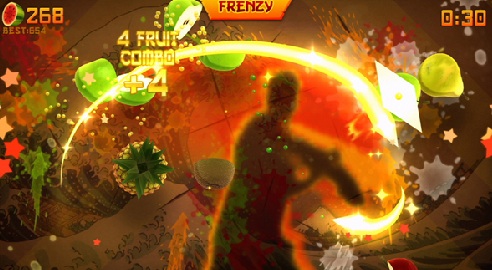
Even though it may come across as a simple game, the release of Fruit Ninja Kinect carries a lot of weight with it. Being part of the Xbox Summer of Arcade garners that the game needs to be a certain level of quality. It’s the first downloadable Kinect game made and many Kinect owners are hoping this will begin a push to see more software finally start to support the device again. And it could deal with the ire of fans of the original game for smart phones if it doesn’t translate well to motion controls. So how would a game originally designed for a touch screen feel when not touching anything at all? Pretty damn good.

Anyone who has played the original Fruit Ninja will instantly be able to jump right into this game. After only a couple of sessions in the perfectly ported Arcade, Classic, or Zen mode you’ll be swinging your arms as proficiently as you swiped your fingers across a touch screen. The only problem players may find with the controls comes when you are swinging upward because when you bring your arms back to your sides, the game will sometimes pick that up as a downward slice and cut into something you never intended to. After a couple rounds prematurely shortened due to this though and you’ll learn to compensate as the original game overall translates very well to the Kinect. The game may actually translate a little too well.

After only an hour of play, I had matched or broken the high scores I had in the smart phone app and found myself bored with the game. Would I play it again at some point? Maybe, especially if I had a friend coming over for the local versus or co-op modes, which is the only real difference between this and some smart phone versions out there. But, swinging your arms instead of swiping your fingers just isn’t enough to sell me on this game at this price if I’m playing by myself. I could just pick up my phone or iPad, and do the same exact thing as on the TV screen with a lot less effort and for one-tenth the price. Bright, colorful, easy to pick up, and initially fun to play, Fruit Ninja Kinect is a solidly built game. But with such fast dissipating appeal and minimal replay-ability I don’t see why you’d pick this up when you can get virtually the same experience for a lot cheaper on your smart phones.

Score: 6.5

Originally Published: August 9, 2011, on EGMNOW.COM

One of the most charming and long lasting impressions that you take away from Comic-Con is the pure love and devotion that people are willing to show by pouring hours on end into costumes just to go gallivanting around the Con for a few days. Some put more thought and effort in than others and some simply relish the opportunity to show off some of their finer…ummm…assets, but no matter what the reason behind it, cos-playing is one of those things that define the Con and is proof positive as to why this is the pop culture extravaganza that it is. On that note, here are some of our favorites that we saw while roaming the show floor.

1. Castle Crashers: CHARGE! When released in 2008 as part of the Xbox Summer of Arcade that year, few knew the intense following the simple side-scroller beat ‘em up Castle Crashers would encourage and these two gentlemen here are proof positive why it was a hit.

2.Catwoman: Puuurrrfect in every way, this femme fatale is a comic book staple for over 70 years now and is a favorite for female Con-goers everywhere representing the strong independent woman mindset. The authentic bullwhip also works as a deterrent for those of us who ogle too long.

3.Ghostbusters: Who ya gonna call?! Probably not these guys. It wouldn’t be a Comic-Con though without staples like Slave Leias, Stormtroopers, or a fearless foursome in brown jumpsuits. Including prop ghost traps and proton packs, these guys (and lady) are ready to believe you.

4. Black Cat: If this is what Black Cat looks like, you might have to question Peter Parker’s tastes for sticking with Mary Jane all those years when he had this waiting for him for a long while. Although rather harmless looking, this feisty feline knows where to hurt you the most.

5. Portal: Lacking in characters to cos-play as, did not act as a deterrent this year for Portal fans. This group found a way to put everyone in a costume with Chele, a pair of portals, and even a very lovely Companion Cube. They all deserve some cake for their efforts.

6. CoD Sniper: As the world rushes by him, the quiet and calm sniper stays hidden in the brush, waiting patiently for his target to finally enter his sights. Holding my breath, I quickly squeezed the trigger when this Sniper wandered into my sights due to the great effort put into his costume.

7. Waldo: Where is he? Right here. And I found his girlfriend, too. I always was very good at those books. I wonder just how much they actually blended in though once they made it through the Con doors and mingled amongst the huge crowds.

8. Army of Two: You can tell cos-players take their craft seriously when you ask them for a picture and they strike a pose relevant to the characters they are portraying. Unfortunately for them, the Call of Duty Sniper from earlier is off camera ready to take them both out.

9. Female Assassin: A huge fan favorite this year was people dressed as Assassin’s Creed characters. The fan turnout was rewarded by Ubisoft as those who dressed as AC characters and attended their Saturday panel, like our female assassin here, were promised free autographed Signature Editions of Revelations when released.

10. Princess Peach: Not the most traditional Peach, but if this is what is always awaiting Mario, no wonder why he keeps going through eight castles for her and that Bowser won’t stop kidnapping her. If your choice was this girl or weird little mushroom people, well, is it really a choice then?

11. Street Fighter: Another group shot, these folks decided to take on the guise of several protagonists from the Street Fighter series including fan favorites like Chun-Li, Ryu, and Blanka. They sure let themselves go since Super Street Fighter IV was released though, haven’t they?

Originally Published: August 2, 2011, on EGMNOW.COM

Publisher: Microsoft Studios
Developer: Shadow Planet Productions
Platforms: XBLA

Release: 08.03.11

The Good: Old school exploration and backtracking similar to Metroid
The Bad: Constantly referring back to your map and weapon wheel breaks pace of game play
The Ugly: Monstrous, screen-filling shadow creatures bent on your destruction

Cut from the mold of old-school action games like Metroid, Insanely Twisted Shadow Planet proves that fun, simple, yet engrossing game play can trump all the special effects and cut scenes of other games most any day of the week. In fact, the story of Insanely Twisted Shadow Planet can be summed up thusly: You’re an alien with a spaceship. Your home world has been invaded by a plague like shadow creature. Kill it.

And that’s all you really need as you pilot your way through a maze-like massive world with varying climates and themes and you blast away at parasitic creatures spawned from the master shadow monster. And blast away at these creatures you shall as you’ll earn an assortment of various weapons from standard missiles, blasters, and scanners, to more unique weapons like buzz saws and barrier shields. Of course, each new weapon will only make you want to explore even more as each will not only help you take down certain foes, but also open up new door ways that were once blocked off to you. Rewards ranging from concept art and more of the game’s back-story to armor and blaster power-ups await you if you choose to explore the entire map available.

The only downside that comes from having a large assortment of weapons and a map of where to explore is that you find yourself constantly referring back to the map to see where to go next, or even with four assignable hot keys, needing to go to the weapon wheel to change weapons. This tends to break the pace of game play and will slow down the experience for all the completionists out there.

Despite this minor complaint, Insanely Twisted Shadow Planet is a wonderfully addicting old-school romp that uses simple, tried and tested techniques to pull off a winner. The limited color palette works perfectly for the theme of the game and it helps put your sensory emphasis on the mood-setting music as you blast away in classic underdog style with your tiny ship against an entire world. Throw in an actually compelling 2-4 player co-op/versus mode called “Lantern Run” where you and up to three friends must work together to solve puzzles and escape the encroaching Lantern Monster, all the while competing for the high score, and Insanely Twisted Shadow Planet is another more than worthy entry into Xbox’s Summer of Arcade.

Score: 9.5/10

Originally Published: August 2, 2011, on EGMNOW.COM

Publisher: TimeGate Studios
Developer: TimeGate Studios
Platforms: PS3 (previously released on Xbox 360 and PC)

Release: 7.26.11

The Good: Deeper story mode than original serves as more than tutorial for multiplayer
The Bad: Dated, last-generation graphics, glitches, and horrible voice acting
The Ugly: The splatter when an orbital supply drop crushes someone

Section 8: Prejudice is a sequel to Section 8, a sci-fi shooter that revolved around space marines who would be shot from an orbital cannon into various military conflicts, and provides players with the personal challenge of trying to crush hapless opponents on impact. Although an interesting take on the shooter, the campaign served as nothing more than an extended tutorial that seemed to gear players up for the multiplayer. With the release of Prejudice though, the entire Section 8 universe has seen a re-design.

The most obvious fix to this franchise comes in the single player campaign. Although there are several parallels between the action of this new story, which continues to follow Alex Corde, the first game’s protagonist, and the original game’s campaign, the clear ramping up for the multiplayer, which remains the game’s meat and potatoes, is much better hidden through a more complex story.

The terrific multiplayer, which is what most attracted players to the first game, has only been bolstered by the new Swarm mode. Similar to Gears of War’s Horde mode, Swarm sees players team up to defend a single control point as they eliminate waves of enemy bots. Up to 32 players can also take part in the returning Conquest mode, which rounds out the multiplayer experience. In Conquest, two teams attempt to score points by killing their opponents, capturing objectives, and finishing a plethora of missions that prompt teamwork from the entire group in order to complete. This variety in a glorified death match mode really lends itself to team tactics in order for your squad to emerge victorious. Include again several customizable load outs you can pre-set before jumping into any and every fray and the multiplayer is something that most shooter fans should check out at least once.

Even with this downloadable title having more content than the disk-based original from two years ago though, there are still many flaws right on the surface of Prejudice that keep it from being elite. The paltry graphics, glitch riddled combat, and horrible voice acting makes you think this could be a game from the last console generation. And, again, even with a more involved story and much better character development and cut scenes, the single player campaign still feels like an extended tutorial to play before jumping into the multiplayer mode.

Despite this though, Section 8: Prejudice is a much richer experience than its predecessor and with the cheaper downloadable price tag, is a worthy distraction for shooter fans with itchy trigger fingers.

Score: 7.5/10