Originally Published: August 30, 2011, on EGMNOW.COM
Call of Duty: Modern Warfare 3 creative strategist Robert Bowling faces one of his biggest challenges—revamping the series’ multiplayer offerings.
 RC: One of the key aspects that’s made Call of Duty a smash hit is the multiplayer aspect, and you guys have pulled out all the stops in order to expand on this, including a new killstreak system where the player can choose either an Assault, Support, or Specialist path of upgrades. Tell us about the decision to incorporate specialized killstreaks to fit different players’ styles, and how you hope this may level the battlefield for the more objective-based player.
Robert Bowling: Well, the inspiration for all the different strike packages was looking directly at the feedback we’re getting from the 30 million people playing our game. Looking at the player trends that have been happening as we’ve moved from Call of Duty 4, when we first introduced killstreaks to how the dynamic then changed in Modern Warfare 2—and then how we want that dynamic to change even further in Modern Warfare 3. A lot of it’s going back to the more gun-focused gameplay of Call of Duty 4, but with what we’ve learned from the killstreak system is that, inherently, it’s all focused on getting kills. We’ve got millions and millions of players who all play so differently, but they’re not being rewarded, incentive-wise, for being good at the game in other ways—and that was the big driving factor for introducing custom strike packages, because we wanted to open up how you’re rewarded with killstreak rewards. We want to let you be in control in the type of killstreak rewards you have and give you the tools to be a better objective player and a better team player, rather than always trying to be the best team deathmatch player.
And that carries over through more than just the killstreaks. Capturing objectives, capturing a flag, capturing domination points, and blowing up a bomb site should all add to your rewards. So, regardless of what strike package you have, that now gets you one tick closer to unlocking your next killstreak reward. In addition to that, you can now focus your entire killstreak rewards on things that have nothing to do with getting you more kills—and that was the whole mentality behind giving you tools that allow you focus on things other than killing.
RC: Another new multiplayer aspect is the Spec Ops: Survival Mode. Tell us about what you’ve done with your take on what boils down to Horde mode.
RB: Well, Spec Ops: Survival Mode is really taking the traditional wave-based gameplay and putting the Modern Warfare twist on it. So, we’re bringing in all the stuff that people love from multiplayer—matchmaking, progressive ranking, killstreaks, weapon unlocks, weapon attachment systems, gear and equipment from multiplayer—and bringing all that and putting it into a much different arena in a co-op environment against AI enemies. And the benefit of the infinite-wave thing is that we can constantly be throwing different experiences at the player—so, you’re seeing enemies you’re not seeing anywhere else. You’re seeing kamikaze dogs, kamikaze infantry, chemical agents, juggernauts, juggernauts with riot shields, enemy air support—it’s such a different experience, and what I love about it is that it blurs the lines between what’s a competitive multiplayer experience and co-op multiplayer experience, and it makes experiences that were typically only reserved for that super-hardcore-competitive multiplayer guy accessible to the single-player guy. Now you have the opportunity to call in some awesome chopper gun and to be raining death down from above, or maybe you’re just not a competitive multiplayer guy, so you never got to experience that before, but now you can have that in a much different environment.
RC: Moving to the franchise as a whole, we all know that Sledgehammer and Infinity Ward are working jointly on this title. What difficulties have arisen, if any, from having two different development studios working on the same title?
RB: Early on, it’s all about logistics. So, the biggest challenge was, logistically, how do we have two teams work on such a massive experience? And so we sat down and we made the decision to be a very flat organization—to not divide the game and be like, “OK, we’ll take this, and you do that, and you just do your thing, and we’ll do ours.”. That would’ve never worked. So, what we did was focus on playing off each other’s strengths and weaknesses—and everyone has input on everything in the game. So, we’re really working as one giant team rather than dividing things up among each other. So, we’d be more like, “Your guy is really great at this; he should work with our guy on this aspect” on the same level and build up from that organically. From there, logistically, it was about setting up video-conferencing systems, setting up ways to communicate on the fly, as we would with the guy two offices down from me. And then, from a creative standpoint, sitting down and having open, honest conversations about what direction we want to go. I mean, I knew that going into it, we’re a very passionate team with very core design philosophies, and we knew what we wanted Modern Warfare 3 to be. But it was refreshing to have Sledgehammer come in with such a fresh perspective, because they brought in things and directions that we may never have gone in and brought in experiences we’ve never had before.
RC: Speaking of other experiences, do you guys ever look at other shooters out there for inspiration? Do you ever see a perk or a weapon in another game and go, “That’d be really awesome in our game”?
RB: We take inspiration from everywhere, not only in our own genre. I love when we take inspiration from things outside of our genre. Look at what RPGs are doing, and look at what MMOs are doing—specifically in regards to things like progressive rank and XP and how you reward players. We take inspiration from all that stuff, and it’s important that when you do that, you make sure you only take the core mechanic and make it work for the kind of experience that we’re looking to deliver. But, yeah, that happens all the time, and it’s great when you can do that.
RC: Let’s talk about the single-player—at this point, we’ve all seen the E3 2011 footage of the attack on New York City. Call of Duty historically takes place all over the globe, though. What goes into deciding where the games’ missions take place, and what kind of research do you do? In terms of the plot, why New York City now under attack?
RB: Well, a lot of the story and locations are dictated organically by where the story’s going and how the conflict’s escalating. Modern Warfare 3 is a payoff to this growing momentum of conflict that’s been starting since Call of Duty 4. So, in Modern Warfare 2, the state of the world changed when the invasion of the U.S. happened. That was just the beginning. The attack on Washington, D.C. was just the beginning of the turning of that type of war. And it just organically escalated up the eastern seaboard to New York, which is another major city, because the Russian navy ‘s blockaded New York by this time in Modern Warfare 3, because this is a full-on invasion. This is a military invasion by the Russian army—this isn’t some sub-splinter of a group. This is the Russian nation attacking America, and this will be pulling in other major nations and cities into this conflict, as would actually happen if America were attacked.
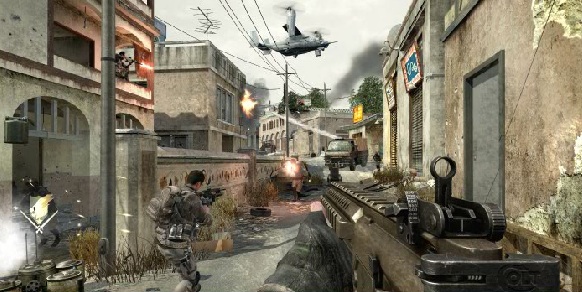
So, it’s really looking at how the war’s escalating, and what I love about it this time is that we’re leaving these very traditional conflict areas, and for the first ever in Call of Duty, what we started with at the end of MW2 was pulling it into the heart of these major cities, bringing the conflict to these iconic places, rather than nondescript desert town you’d expect wars to be fought in. Now you’re fighting in Paris, London, and these major cities in Germany and Africa. So, it’s really changed organically and the research that goes into that is painstaking. Because you look at like fighting in London, and we ask ourselves, “Where would we fight in London?” We have to figure out where it would not only make sense for the story, but also where it’s going to be very impactful for the player. So, we’re looking at Canary Wharf in London, and then you go into reference and pull each reference you can and look at Google Maps and get the layouts and the buildings. And then you take that—once you get it as authentic as possible—and you put it through a gameplay filter of “OK, this is authentic, but now how do we make it fun?” Because authentic’s great, but fun is king. And that’s when you start looking at player routes and cover points and sight lines and start crafting it for gameplay.
RC: From a technology standpoint, you guys have been working with the IW engine for a while now. Was there anything you were able to add into MW3 that you weren’t able to do before but now can because of the familiarity you have with the tech?
RB: Definitely. The big focus with moving into these new environments and these much bigger cities is that the length and the scale of the levels in the single-player that you’re fighting in now are so much bigger than we’ve ever done before. So, a lot of that on the back end required a lot of tech work—and, thanks to the fact that we’ve been building steppingstones. In Modern Warfare 2, we made a good leap from Call of Duty 4 in terms of just visual graphics with our streaming technology that allowed us to make that leap. And in Modern Warfare 3, we’ve done even more work with that now that we’ve mastered that streaming technology and found other ways that we can enhance what we’re streaming in, when we’re streaming it, and how we can optimize that to get to that scale, to get to that size, and still maintain that super-smooth 60 frames per second with tight controls, which is what sells the Call of Duty franchise. That’s what sells—the tight gunplay. And, at the end of the day, that’s what matters most.
RC: It wouldn’t be a first-person military shooter without plenty of weapons. So, what kinds of new goodies can players look forward to in Modern Warfare 3?
RB: Well, we’ve added a lot of really cool weapons. A ton of weapons overall, especially in multiplayer. There’s stuff that isn’t even out yet, and that’s the great thing of being at the scale that we’re at now, where we’ll actually have weapons manufacturers contact us and be like, “Hey, we have this new prototype that’ll be out in the field in a few years, but we think it would be great for your game,” and we can go look at it, or they’ll bring it to us, nd we’ll check it out. One of my favorites is the XM25 grenade launcher, which is something only Delta operators are using in the field right now. It’s a grenade launcher that “lasers” a target—like, say, someone’s behind a concrete barrier or in a doorway or window or something, and you can laser that barrier, and it’ll calculate the distance, program it into the explosive round, and when you fire it, the round is programmed to explode one meter past that distance. So, you can actually shoot it through the window, and not until after it gets through the window will it explode and take out anyone who’s hiding behind it. That’s something Delta operators are using now, and that’s something we’re going to have in multiplayer and single-player, but we balanced them very differently between the two, because single-player’s all about having fun, while multiplayer’s about having fun but having to be balanced with everything else in the game.
RC: You mentioned Delta operators before. How closely do you work with military personnel in order to give an authentic feel to the game’s combat?
RB: We work very closely when it comes to being authentic in terms of the gear that you’re using and the weapons and they operate and how they look. But, more importantly than anything, is that fun always comes first. So we do want to be as authentic and as real as possible, but we will pull back from that realism in order to be more fun and to make it actually enjoyable to have all that stuff. So we’ll sit with them from a story standpoint and say, “Hey, here’s a scenario we’re cooking up for the story. How would you approach that?” A good example is talking to our active military guys who work with Delta and saying like, “Scenario: Russian sub in a New York harbor. You are responsible for disabling the sub. What would you do?” And then we’d say what we were thinking and our gut reaction to the situation. “Plant a charge here and blow a breach in.” And then they come in and say, “Oh, no—you wouldn’t do that. You’d be afraid of disabling this, and that would force it to come above. And then you could breach it from above without having to be underwater.” And that directly influences the gameplay—like in the E3 trailer, when the SEALs assault the sub.
RC: Call of Duty seems to come across as a “guy’s guy” kind of game. But you have a surprisingly strong female audience as well. What would you attribute that to? And do you ever see Call of Duty including female soldiers as protagonists or allowing players to chose female characters in multiplayer?
RB: I’d attribute it to the fact that we’re extremely accessible to every type of playstyle. We have females in our community that are amazing at the game in every aspect, but then you also notice trends between female gamers and male gamers. Female gamers are typically more focused on teamplay and that support role and not being self-focused or lone-wolfing. They also communicate better in terms of garnering Dom points and capturing objectives. So, I think the fact that we—especially with Modern Warfare 3—cater to different playstyles and reward them has even greater appeal now to all types of audiences.
As for female protagonists, I think anything’s possible in the future. We’ve had some female characters in the past—we had a chopper gunner pilot in Call of Duty 4 who was female. So, I think anything’s possible. We really let the story dictate the characters for us, and so far, we’ve had female roles in there at different points.
RC: Finally, the controversy over violent videogames reemerged after the recent terror attack in Oslo, Norway; the perpetrator of these attacks claimed that he “trained” with Call of Duty. This has led to the franchise being pulled from some store shelves in Norway. How do you guys respond to something like that, and do you see it affecting the series either in the long- or short-term?
RB: We don’t see it affecting us from a creative standpoint, because we’re creating a fictional game with a fictional storyline that takes place completely outside of any real-world scenarios. The universe that our games live in is very unique in that sense. But our focus has always been—and will always be—on making games that are meant for entertainment, that are meant for the right audience, and making sure that we’re following and respecting all the rating guidelines that are out there and making sure that everyone can make an informed decision and that they know what the content of the game is well before purchase. We want to make sure that we’re respecting that, and that we’re open and transparent about that.

 August is coming to a close and with it is an incredible run by Greg Pak on The Incredible Hulk that will lead into an all new monthly for “he who likes to smash” over at Marvel and of course the universe altering Flashpoint for DC. With all these changes going on, let’s jump right into this week’s comics and get our hands on my five must haves for the week.
 1) DC – Flashpoint #5 (of 5): As mentioned in the open, this is where the entire DCU will be reset from. Although not following Flashpoint as closely as many other events over the past few years, partially due to my disappointment in the ending of Brightest Day by Geoff Johns, who is one of the main guys behind this re-launch, this issue actually left me feeling rather satisfied with how everything has drawn to a close with some tremendously heart-felt moments for many of the DCU’s powerhouses. Even if you haven’t been reading Flashpoint, if you have any interest in the DCU, you should pick this up just to have a solid idea of where things will go from here and so you can have a solid gauge of just what changes are taking place. If for some reason you’ve been staying off the DC bandwagon, then this is the perfect time to get on board with a fresh start and not as much of the weight that comes with some of publisher’s main characters’ 70-plus year histories.
  2) DC – Justice League #1: The only other DC comic to be released this week, which not only made it very easy to pick my pair of DC must haves, but also is the starting off point for the new vision of the DC Universe. A part of me really wanted to hate this issue, I admit. The whole idea of a universal re-launch kind of turned my stomach when I first heard about it, and I’m still unsure of how things will turn out, but if everything ends up like this comic, then DC will be just fine and this could mark the beginning of a newly celebrated age in comics. Starting off in a flashback to five years ago before the Justice League had formed (in comics time of course), the issue has a lot of classic crowd pleasing elements like the heroes fighting each other at first until a new threat they can’t handle alone rears its head (which I won’t spoil, but DC fans will be thrilled about what it is). My only problem from this comic comes in the Superman redesign. The all blue-suit and more toned musculature really makes me think I’m looking at Superboy and not Superman. Overall though, aside from possibly being worth something as a new #1, I can see this easily becoming one of my monthly pick up depending on where this opening arc goes.
  3) Marvel – The Incredible Hulks #635 – Again, as mentioned above, Greg Pak’s run with Hulk is coming to an end. With it, Marvel will hand over the reigns to a new creative team, with a brand new Hulk monthly, in writer Jason Aaron and legendary artist Marc Silvestri as Marvel will make sure what would otherwise be a monumental gap in their lineup stays occupied. Not surprising to see a new team come in after seeing Hulk’s main comic go through more changes in the past few years than Banner does purple pants, but the idea of ANOTHER re-launch has me shaking my head. Pak’s run was spectacular though and he added as much depth to the character than most any other writer in the Hulk’s history. So if you’re a fan of the big green gamma-irradiated monster known as The Hulk, you should pick this up to see where the character may just be going and who he’ll take with him when his new landmark monthly in October hits as this run draws to a fitting close.
  4) Marvel – Herc #6.1 – Mind you, it’s not like Greg Pak will be out of work as he will continue now with the monthly he started a short while ago since he is probably the sole reason as to why this character has seen a renaissance in recent years. Hercules, one time Avenger, now stripped of his powers, must try to find his way in the world and figures what better place than…Brooklyn? Not quite Mount Olympus, Herc decides that this New York borough is in need of a hero and so after raiding Ares’ armory, he uses some godly weapons and his god-sized heart to try to dish out a little justice. Continuing the “.1” series for Marvel, which is really just an excuse to dish out more one-shots and make some more cash, this adventure may not be as epic as the main monthly for Herc, but it does a fine job of catching you up incase you missed the first six issues and are looking for something new and fun as the Herc series has done a great job of mixing humor and action to be one of the more overall entertaining reads to launch this year.
  5) IDW – Locke and Key: Clockworks #2 – Continuing Joe Hill’s twisted story of how the Locke family are using mystical keys to keep the demon world at bay, Clockworks #2 mixes humor with some very dark and disturbing imagery that could only come from the mind of Stephen King’s son (Joe Hill is a pen name). The evil demon Dodge, who is trying to unleash his demon brethren into our realm, has possessed the youngest of the Locke children and is using his body to get close to his ultimate prize. Unwittingly, he also releases Kinsey’s tears and fears, emotions that using the Head Key she had locked away in order to do what was necessary in order to protect her family and our world. Mayhem runs abound in this issue as the countdown to the amazing conclusion to the Locke and Key series is in full swing now. If you haven’t been reading Locke and Key, go find collections of the previous story arcs and get on board while you still can with this phenomenally dark series.


 2) Marvel – Avengers Academy #18 (Fear Itself Tie-In): The possessed Titania and Absorbing Man continue their relentless assault against the infinite Avengers Mansion. With the members of the Academy cut off from the real world, they are trapped in every sense of the word with these two powerhouse villains and are outmatched in every way power wise. Even in the most action packed of sequences, Avengers Academy writer Christos Gage does a terrific job of continuing to evolve the depth of character of this first Academy class and all it does is leave you wanting more so you can see how these kids can get out of crazy situation after crazy situation. If you haven’t been reading Avengers Academy, what is wrong with you?
 4) DC – Batman: 1990s Retroactive (One-Shot): Continuing the series of one-shots that look back on DC’s history and that were done to help build up to next month’s universal re-launch, Batman: 1990s Retroactive pits the Dark Knight against a villain who gained a lot of his notoriety in the 90s due to Batman: The Animated Series, the Ventriloquist. Drawn in a style to invokes the memories of those great early 90s cartoons, this one-shot sees the Caped Crusader lured into a trap at the Gotham Museum of Natural History, but things go awry when a very unnatural visitor interrupts and the Dark Knight is left to with more opponents than even he might be able to handle! Throw in a classic mobster tale from the 90s Batman where even Gotham’s Guardian isn’t fast enough to save the day and you have a great 2-for-1 here as we get ready to launch the new DCU.




 RayCarsilloWrites.com