Latest Entries »

There are more than a half-dozen Fire Emblem games that never came to our shores, but in 2008, Nintendo released Fire Emblem: Shadow Dragon for the DS—a remake of the very first Fire Emblem game—here in North America. That decision gave me hope that we would start to see more of the Fire Emblem games we never received finally cross the Pacific in some form or another. Flash forward almost a full decade later, and I had all but given up on the idea. Naturally, then, Nintendo releases Fire Emblem Echoes: Shadows of Valentia—a remake of the second-ever Fire Emblem game, Fire Emblem Gaiden—rekindling my hopes. And—if Shadows of Valentia is any indicator—the idea of continuing to bring over old games in the series remains as sound as I thought it did almost 10 years ago.

Shadows of Valentia takes place at the same time as Shadow Dragon in Fire Emblem chronology. While Marth is freeing the continent of Archanea in the east, the continent of Valentia to the west is war-torn for different reasons. The dragon gods—Duma from the north and Mila to the south—have withdrawn their boons to the people, and the respective nations that fell under each god’s purview are crumbling because of it. Two children who bear a special brand on their hands, Alm and Celica, are unexpectedly thrust into the center of it all. Each will try to bring peace to Valentia in their own way, not realizing how connected they truly are. It’s your typical Fire Emblem tale of kings, queens, dragons, and magic.

Because Fire Emblem Gaiden never made its way to the West, it’s hard for me to compare this remake to the source material beyond obvious differences. For example, following in the footsteps of more modern games in the series, every major character has their lines fully voiced (and fantastically so). There are also fully-animated cutscenes, while each character has had a more modern redesign given to them that pops off the screens of the 3DS.

Doing some research, though, led me to find that Fire Emblem Gaiden was often described as the “Zelda II of Fire Emblem.” This is because the game introduced some drastically different gameplay like dungeons and town exploration, and even side quests from NPCs that were quickly abandoned by the series as a whole after poor reactions. All of that radically different gameplay returns here in Shadows of Valentia, but what’s interesting is that since this is a first for Westerners to experience this in Fire Emblem—with features like “My Castle” in Fire Emblem Fates helping to pave the way—it actually feels like a natural progression for the series that I surprisingly enjoyed and quickly adapted to. It may have been far-reaching in 1992; in 2017, it feels like Fire Emblem is just growing in new and wonderful ways.

Getting to towns and dungeons is done via utilizing a limited overworld map with paths laid out before you, and you can see ahead to where most of the battles that mark major chapters in your adventure will occur. While Shadow Dragon displayed a linear overworld map at times, you use Shadows of Valentia’s to actually plan your next move. It is larger, has branching paths, and allows you to bounce back and forth between Alm and Celica’s different bands of characters, each traversing their own course and occasionally interacting with the other at certain points. The overworld map helps get across the idea of the duo actually fighting a war, moving the frontlines and themselves closer to their goals with each victory, and being able to see how far they’ve come in such a simplistic way gives a sense of scale that we don’t often get in Fire Emblem games.

Once you do visit a town or dungeon, you get very different experiences from anything we’ve seen before from the series. Towns are made up of a few different locations (taverns, homes, blacksmiths, etc.) and you select where you want to go from another map. From a first-person perspective, you then can look around the room with a targeting reticule to pick up items or talk with the various townsfolk to shop, learn about the world, or potentially unlock a small sidequest. Unfortunately, the sidequests are a bit dull, and are always of the “if you get me item x I’ll give you item y” variety. Often times I wouldn’t even bother with them unless I already had the item in my possession, but they do give you something else to do beyond fighting all the time.

Dungeons, meanwhile, are explored from a third-person view as you walk around in them much more like traditional RPGs. There are often exclusive treasures to be found and secrets to be uncovered in dungeons, whether they’re abandoned caves, ancient ruins, or enemy forts. If you come across an enemy in a dungeon, you can potentially avoid it; if you touch the enemy, however, the world shifts to a more traditional Fire Emblem grid where Alm or Celica and a small contingent of their allies will have to fight a tactical-RPG battle. It took some getting used to, but I found the rewards within dungeons made them definitely worth exploring.

Dungeons are also where you now can change classes for your party members. Many dungeons have statues that, when prayed to, will bestow new classes (and higher stats) on your most experienced party members. I loved this feature, because no longer did I have to spend all my coin or search desperately on battlefields for the right items (which would trigger the all-important class increase in previous games). Certain characters listed as “villagers” also have the added benefit of changing their class to whatever you wish. If your group is mage-heavy, you can force a villager to take up a sword or lance, or vice versa. Or, you can make more mages or more soldiers, and try to dominate the landscape with one offensive dimension.

Not all the changes Shadows of Valentia introduces were welcome, though. In an attempt to keep the combat process streamlined, every unit has a default weapon that will never break. Whether it’s a lance, sword, or magic tome, the traditional Fire Emblem weapon durability remains gone like it was in Fire Emblem Fates. Also removed, however, is the ability to carry multiple weapons, so no longer can you carry a variety of gear to defend yourself with depending on the scenario. You can carry a special weapon to replace the default that will never break—like a silver lance, brave sword, or a blessed bow—but you are stuck with that weapon for the entirety of a battle no matter what gets thrown at you.

This lack of improvisation was disappointing from Shadows of Valentia, and the only thing worse than this is when certain classes do get two weapons to carry—like magic and a sword, or a bow and a sword—they will always default to their original. I prefer the old way where the last thing I attacked with is what I would now defend with. This way, if my bow-carrying soldier was attacked by a mage from a distance, they could still defend themselves (had I used the bow previously), instead of being helplessly pelted by dark magic while holding their default sword every time.

That’s not the only issue with weapons in Shadows of Valentia. One of the pillars of Fire Emblem combat has been the rock-paper-scissors, axe-sword-lance weapon triangle that has always been present in Western releases of the series—yet it is noticeably absent here. Your enemies have axes, you can acquire axes (for sidequests), but none of your units can actually use them. All that your non-magic units can use are swords, bows, and lances, and a larger focus was put on black and white magic with your mages. White heals units, black is offensive, and all magic requires some sort of HP sacrifice now. The HP sacrifice was an interesting twist that added some difficulty to the game, but the balance that came with the weapons triangle and the more simplistic use of magic in previous games is sorely missed here. Even by the time I beat the game 30-35 hours after I had started it, I was still unsure of what units did well against which others.

Speaking of how long I played this game, that’s a long time to do the same objective over and over again, and not until the last couple of battles does your objective change. It is always just obliterating your opponents—no lasting so many turns, defending objectives, or capturing objectives. I miss the variety from previous Fire Emblem games that required me to change my thinking somewhere along the line beyond “strongest units on the front lines will run roughshod over my enemies”.

If you still want a more traditional Fire Emblem experience, however, fear not. There’s nothing we can do about the missing weapons triangle—which will always perplex me about this game—but exploring towns and dungeons are optional for the most part. Although I found they added a lot of depth to the experience and the world (and characters and classes to my party), I imagine some purists out there might recoil at the dramatic shifts in gameplay. It’ll make the experience even more difficult if you avoid them, but if all you want is classic Fire Emblem grid-based tactical-RPG and unit management, then don’t worry: outside of a couple of mandatory sections, you can just move from battle to battle to battle on the overworld map.

And, in that regard, Shadows of Valentia is still very much a Fire Emblem game. The main game is broken down into five acts, and while I will say the first act was a bit of a pushover, there was a huge spike back up to what we expect from this series in terms of difficulty from there. In fact, it may be one of the hardest Fire Emblem games I’ve ever played, and the Classic mode touting permadeath will still plague you and your party if you’re not precise and careful with each move you make on the grid. Casual mode—which definitely wasn’t around in Gaiden—at least also returns from more recent iterations of the series, allowing deceased party members to return after every battle. Should Alm or Celica fall in either mode, however, it’s an instant game over.

Another new feature to help with the difficulty is the Turnwheel. Both Alm and Celica get these new artifacts early on in the adventure, and they have two purposes. The first is by inserting items called Cogs into the Turnwheel, you can rewind the game three full turns; it’s a great way to save allies who you would otherwise lose to permadeath. Turnwheels are also how you utilize Amiibo in the game.

Yes, Nintendo’s cute little figurines are compatible with Shadows of Valentia, but depending on what Amiibo you use on the Turnwheel, you’ll have different effects. The brand new Alm/Celica two-pack adds character specific dungeons and battles to the world map. Meanwhile, non-Shadows of Valentia Fire Emblem Amiibo, like Lucina, can be summoned as allies in particularly difficult battles. Finally, Amiibo not related to Fire Emblem, like Mario, will summon monster creatures to your aid. It’s a nice way for Amiibo to be used in the game without really breaking it.

Fire Emblem Echoes: Shadows of Valentia is a game more than deserving of a second chance from the East, and a first chance here in the West. It was ahead of its time when it first released as Fire Emblem Gaiden, but now comes across more as a natural evolution of the series with an audience that should be more open to the ideas it pushes in regards to Fire Emblem gameplay. Not everything is perfect—like the noticeable absence of the weapons triangle—but it is a more-than-worthy culmination of the tactical-RPG series’ life on the 3DS.

Publisher: Nintendo • Developer: Intelligent Systems • ESRB: T – Teen • Release Date: 05.19.17
8.5
It’s funny how a remake of a game that never originally hit the West can feel like such a step forward. There are a couple questionable choices, like the removal of the weapons triangle, and series purists might grumble over some other changes like dungeon exploration, but overall Shadows of Valentia feels like the next great step in Fire Emblem.
The Good New features like dungeon exploration, navigating an overworld map, and new ways to change character classes feel like the natural evolution of the series.
The Bad Lack of objective variety, and removal of the classic weapons triangle and weapon choices.
The Ugly How much HP you get from consuming raw ingredients like butter and flour. Desperate times call for desperate measures, I suppose.
Fire Emblem Echoes: Shadows of Valentia is a Nintendo 3DS exclusive. A review copy, as well as Alm/Celica Amiibo, were provided by Nintendo for the benefit of this review. EGM reviews games on a scale of 1 to 10, with a 5.0 being average.

I appeared as a special guest on the Scott Seidenberg Show on July 8 to talk Overwatch League on NBC Sports Radio.

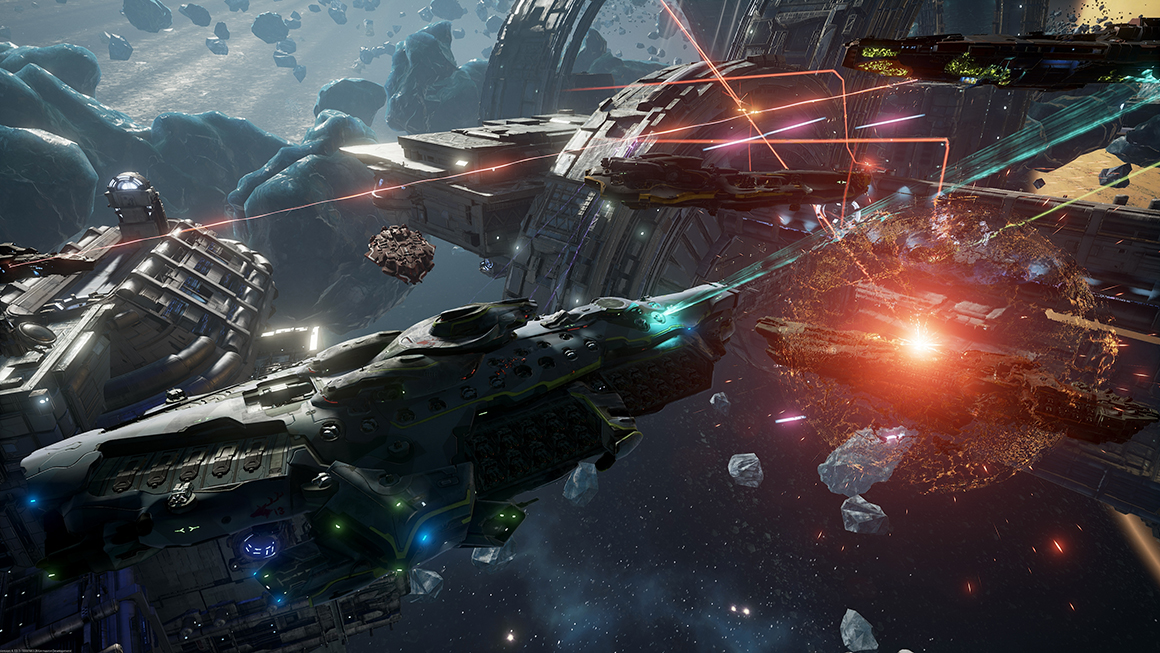
I had a chance to go hands-on recently with Yager, Six Feet, and Grey Box’s Dreadnought on PlayStation 4. It was my first time playing the game since PSX 2016 and I was able to pull down a decent K/D in this match of Team Deathmatch. Dreadnought is currently in beta on both PC and PS4 and the full game is coming sometime later this year to PC and PS4 and will be free-to-play.

Dreadnought, the long-coming free-to-play multiplayer spaceship battling game from developer Yager and publisher Grey Box—which is currently in beta on both the PS4 and PC—is bringing a new mode to that beta for fans to try out.

Havoc mode is Dreadnought‘s take on Horde mode, where up to three players can work cooperatively against wave after wave of computer-controlled space fleets intent on taking you down and conquering your little corner of the cosmos. The twist here, though, is that you don’t know what ships you’ll have at your disposal to do just that.

When the mode starts you and your friends will be given a small assortment of ships to choose from, and usually have enough choices to have a solidly put together team of damage dealers and healers. But there’s no telling that the ships offered to you will be something you might be familiar with, or even particularly inclined to using. And every three waves, you’ll have to spin the wheel all over again and choose new ships. It adds a degree of randomness that is worthy of the name “Havoc”.

I had a chance to try out the mode, and admit to only making it to wave five with some random allies (video below), but continue to be impressed by the variety of ships Dreadnought offers. And I admit I fell victim to my own hubris, which ended up costing my team before we could take on the boss ship in wave seven. I enjoyed the fact that to combat some of the randomness, and the ever-increasing difficulty of your enemies, you could purchase boosts with points earned in battle that stack as the mode continues on. Obviously, it wasn’t enough for us to overcome the enemy AI in the mode, but as you gain more experience with the game, it serves as a critical feature that could turn the tide of a potential battle. And I, for one, can’t wait to see what combinations of ships and buffs we’ll be tasked with utilizing in this new mode.

Dreadnought will leave beta and be fully available on both PC and PS4 sometime later in 2017.

Square Enix released the results of their fiscal year that ran from April 1, 2016, until March 31, 2017, today. Despite finishing in the black and reporting record net sales—with 20% growth year over year largely attributed to the releases of Deus Ex: Mankind Divided and Final Fantasy XV—the company also officially filed an “extraordinary loss” on March 31, 2017 of 4.9 billion yen ($43 million US dollars). In a separate statement, Square Enix detailed this loss came in the form of a “withdrawal from the business of” IO Interactive, the Danish developer behind the Hitman and Kane & Lynch series of games. Simply put, Square Enix is getting rid of them, not quite Agent 47 style, though.

IO Interactive began in its current form back in 1998 and released their first game, Hitman: Codename 47, with publisher Eidos Interactive in 2000. In 2003, IO became a subsidiary of Eidos, who were then in turn acquired by Square Enix in 2009.

“To maximize player satisfaction as well as market potential going forward, we are focusing our resources and energies on key franchises and studios,” Square Enix said in the press release. “As a result of this, the Company started discussions with potential new investors and is currently in negotiations to secure this investment. Whilst there can be no guarantees that the negotiations will be concluded successfully, they are being explored since this is in the best interest of our shareholders, the studio, and the industry as a whole.”

With all signs from IO Interactive up to now pointing to the first season of the episodic Hitman experiment being a success, this development might explain why they’ve been quiet since announcing season two was already in development back in November 2016. If they were on the verge of changing owners/publishers, they would want to stay quiet for as long as possible for legal reasons. Square Enix’s press release also points out they’ve been shopping IO since March 31, and the language of the release makes it sound like they’ve got some potential buyers, at least for the moment. If negotiations can be worked out, IO Interactive should, theoretically, end up no worse for wear.

Should negotiations fall through, however, Square Enix will likely shut the studio down. In that case, I would imagine Square Enix would retain the rights to IO’s IP, like Hitman, and could then sell those off individually to potential buyers, assign them to another studio, or let them languish until the time is right to potentially bring them back. Of course, even should negotiations that successfully save IO occur, there’s always the chance Square Enix tries to retain some of those key IP.

In terms of what spurred all this, we have no specifics on how profitable Hitman was for Square Enix. Although it seems to have had a solid install base with the first episode, it is hard to tell how many people carried through for the entire season, and we have no sales numbers on the full season disc release that occurred in January. This development, however, leads us to believe the game clearly underperformed, and likely did not sell as well as IO’s previous game, Hitman: Absolution, which sold over three million units in its first five months back from the end of 2012 through early 2013.

If we were to speculate on potential candidates to be IO’s new parent company, there’s definitely a few—particularly if the IP can be secured along with the studio. Surely the Hitman brand would be a great asset in most publisher portfolios. European publishers THQ Nordic and Deep Silver have both made it a habit of snatching up unwanted studios and IP in recent years, and their relatively close proximity to IO’s Copenhagen headquarters could make them very enticing. Someone like EA could also look at Hitman’s episodic nature and the potential for microtransactions and start licking their chops.

There could also be first-party interest for such a well-known brand. Square Enix has worked closely with Sony for many years, but the smart bet if first-parties got involved might be Microsoft. A second episodic season of Hitman would be a great steal away from Sony, could easily offer cross-play with PC, and serve as a potential exclusive reveal at E3 2017 for a company desperate for software this year—although that would assume Microsoft and Square Enix were actually close to an agreement considering we’re only a month away from the event. But the buzz potential that could surround the first episode of a new Hitman season launching alongside Microsoft’s new Game Pass program sure would be enticing.

Be sure to keep coming back to EGM for more as this story develops, and hopefully IO Interactive doesn’t end up like so many NPCs that have crossed Agent 47’s path. In the meantime, feel free to check out my review of the full first (and maybe only) season of the episodic Hitman.

When Knack launched alongside the PlayStation 4 back in 2013, it didn’t exactly take the world by storm. Although it was a pretty game that showed off some of the power of the system—with Knack being able to shrink and grow as he absorbed or lost relics over the course of a level—many found the gameplay severely lacking. So, when I had a chance recently to go hands-on with Knack 2—and have the game’s director, PlayStation 4 architect and legendary game developer Mark Cerny serve as my co-op buddy—I was curious to see firsthand what changes the series had undergone from its initial entry (and hear about them from the man himself).

Knack was a very different concept. I was focused on making a game that was accessible to people who had never played a video game before, and thought that would be an interesting part of the PlayStation 4 as a launch title,” explained Cerny as we loaded up the first level. “That ended up being a pretty heavy focus, which meant no platforming and a fairly small moveset. Knack 2 is very different title from that; the focus here is more squarely on gameplay.”

And Cerny wasn’t kidding about that. He ended up showing me seven sections of the game in our demo that highlighted not only a wide variety of different gameplay challenges, but also an expanded moveset for Knack punctuated by four skill trees. It should be noted that some moves are story based, and only by advancing so far in certain levels will Knack unlock them—like a super-strong punch that can shatter enemy shields. Collecting energy in each level can unlock many others, however, and then you can invest that energy into new moves or improve upon those you’ll obtain via progress.

Easily one of my favorite things I experienced in the demo was how expanded Knack’s moveset had become as a whole. Knack can now create a shield that, if timed properly, will deflect bolts and blasts back at enemies. He also has a bola-like projectile weapon that can ensnare foes, making them easy targets for a combo or removing them temporarily from a fight as you focus on other targets. Kicks, body slams, and yes, even more punches round out Knack’s repertoire. One of my favorites was a Fist of the North Star-style flurry of fists that sees Knack move super quick, rapidly punching an enemy several times.

Co-op also sees some combat improvements. Cerny mentioned in our conversation that something he and his team noticed amongst younger players is they’d often take a whack at each other as often as they would Goblins. So, a new move incorporated into co-op is if you hit your buddy, a single relic will fly off like a bullet at an enemy. This way, even if you’re simply messing around, movement isn’t wasted, and can still serve a purpose in gameplay and combat.

As great as it is to see the depth of combat now present in Knack 2, the biggest additions probably come with the breadth of gameplay now available to you. Entire sections of levels are dedicated just to true platforming, exploring, and puzzle solving. In fact, by changing sizes at will, I would have to shrink to Knack’s smallest from to fit into onto smaller ledges and platforms to reach certain areas, and then quickly switch back to a larger from for combat. Knack’s smallest from is all necessary to navigate tiny crevices in cliff sides or Goblin fortresses and discover energy for leveling up, or pieces of technology that can bestow Knack with even more in-game abilities.

There’s a bit of a lottery to the item pieces you’ll discover, however, so there’s even a social aspect added to discovering treasure. If friends of yours have received items you’d rather have from the same treasure chest in their playthrough of Knack 2, you can trade what you received to get the same item they snagged. And, if you don’t have a lot of friends playing Knack 2, don’t worry: there will be some computer explorers that can offer up some options, too.

Other levels, meanwhile, add a stealth element. For example, you’ll have to push crates around with Knack to avoid searchlights while hiding in the shadows to prevent alarms from being set off as you infiltrate a certain someone’s home. You’ll also have to use the size-changing ability—which now features the added bonus of always letting you know just how tall Knack is at a given moment thanks to a height counter in the game’s HUD (if visuals weren’t enough for you)—to shrink and hide under awnings or canopies to avoid robots on patrol.

Knack 2 even brings driving segments to the series. One section of our demo saw Knack get in a tank and drive around destroying enemies and encampments; when playing co-op, one player drives the tank while the other operates the turret. Some other levels also have turret emplacements scattered about, and Knack can climb into one to really whittle down Goblin forces with some green energy blasts.

As the demo was winding down, I admit I was sad to see my time with Knack 2 coming to an end. I hadn’t had this much fun with an action-platformer in a while; the variety of gameplay was stellar, everything handled very tightly, the game looked great, and the writing had me chuckling in my chair. Cerny was quick to point out that bringing on Marianne Krawczyk, writer of the God of War series, to write Knack 2 was a critical move. Although the game is still very much gameplay-driven, having her veteran hand come in for key narrative moments—like where an ally of Knack makes fun of him (and the first game) for only having three punches—was a big boost, and allowed Cerny to focus on directing the gameplay that has made such hugely evident strides.

Although it’s scheduled to release during what’s looking like a very busy second half of 2017, if you’re searching for a fun, high-quality action-adventure that the whole family can enjoy, don’t sleep on Knack 2. With its new depth of gameplay and tight controls, it’s like Knack has finally found all the pieces to turn itself from a pipsqueak PlayStation 4 exclusive into a game to be reckoned with—one that can hold its own with the big boys of the system.

My last review left a bad taste in my mouth, as I had been dying for a puzzle-driven adventure yet had been sorely disappointed. I needed something fast to help forget about that experience and move on—and then a voice started whispering in my ear that I should play Pinstripe. After doing a little research I was willing to give it a shot, and boy, was I glad I did.

Pinstripe puts players in the shoes of a disgraced ex-minister named Ted. When Ted’s three-year-old daughter, Bo, is kidnapped by a shady figure named Mr. Pinstripe, Ted will literally have to travel to hell and back to save her. And, maybe he’ll redeem himself in the process.

I’m amazed at how often one-man Indie devs blow me away, and Thomas Brush should be commended for being the latest to do so. Serving as designer, programmer, artist, writer, and composer, Brush has crafted a beautiful world with a touching story about life and loss, guilt and grief, repercussions and redemptions. Ted’s story is a moving one, because even in Brush’s fantastical version of hell, he finds a way to tell a relatable story about one man’s mistakes and how they have come back to haunt him in a quite literal way. It’s poignant in its simplicity, but maintains just enough mystery revolving around Ted and his past to keep you pushing forward to the end.

Part of what helps that story is the world Ted finds himself in. From the moment you start playing Pinstripe, you’ll be amazed how it visually blends gloom with serenity, begging you to explore its world, but also providing a creeping sense of dread as you never know what new obstacle Ted will have to overcome next. The only thing that tops the arresting art style used here is the voice acting of all the characters. Although the world is sparsely populated, each new inhabitant you come across reflects the dichotomy of the world around Ted, with many toeing a line between being chipper yet sad, hopeful yet defeated.

Where Pinstripe falters a bit, however, is in its gameplay. Many of the puzzles are really quite simple; while some will provide that satisfying “a-ha!” moment when you solve them, most are relatively straightforward, and shouldn’t require a lot of brainpower. There’s also the issue that some late-game obstacles will force you to backtrack to the beginning of the game just for the sake of gathering collectibles that were unobtainable at the start. Although the hell Ted finds himself in isn’t a very large world, this retracing of steps felt forced, like Brush was trying to cram in some sort of metroidvania element that really wasn’t necessary. Instead, it made it feel like he was trying to forcibly lengthen an experience that still only amounted to about a three-hour romp in the end.

Also, for an ex-minister, Ted sure gets around well. Although there isn’t a ton of platforming to be had, there are some occasions where you’ll have to use momentum to swing platforms around and Ted will have to perform some quick, crafty jumps to get to where he needs to go on his quest to save Bo. There’s even the occasional enemy that Ted will have to bop on the head with a jump in order to progress. Enemies that can’t be jumped on can be taken out by Bo’s slingshot, an item Ted finds very early on his journey, but combat as a whole is limited to only a few sections of the game—and the slingshot is mostly another tool to overcome the game’s puzzles. Combat was clearly not a major focus for Pinstripe, which makes sense given our protagonist’s religious background; this is primarily a puzzle-adventure game through and through.

This all seems pretty straightforward for this type of game, but Pinstripe had one more surprise for me at the end of my initial playthrough, and that was a shot of replayability rarely found in this genre. Typically, once you beat the puzzles in a game like this, there’s little to draw you back to it again. Pinstripe, however, makes new items and secrets available for you to collect and find only after your first playthrough of the game. This was a nice way to get me to repeat an adventure I had moved pretty quickly through the first time, and added a nice extra layer of depth to the experience.

Pinstripe was a Herculean effort by one man, and it provided one of the more interesting worlds and better stories I’ve played in quite some time. The drawback it seems of this passion project, however, comes in its length and its simplicity. Even though everything wrapped up neatly in the end, and I think the story was perfectly told, I would’ve loved if the world of Pinstripe had even more depth and characters to it, and if the complexity of the puzzles were greater. That said, you would be missing out if you passed up this narrative experience, even if the game lacks any real challenge for anyone familiar with this genre.

Publisher: Atmos Games • Developer: Atmos Games • ESRB: T – Teen • Release Date: 04.25.17
7.5
What it lacks in length and complexity, Pinstripe makes up for in narrative. It’s a compelling story set in a beautiful world full of interesting characters, and that alone should be worth a look for most—even if there’s really not much challenge to this puzzle-adventure game.
The Good An interesting world driven by a moving story.
The Bad A bit on the short and simple side.
The Ugly The thought that hell doesn’t have to be all fire and brimstone in order to be torturous to someone.
Pinstripe is a Steam exclusive, available on PC, Mac, and Linux. Primary version reviewed was for Mac. Review code was provided by Atmos Games for the benefit of this review. EGM reviews games on a scale of 1 to 10, with a 5.0 being average.

I’ve gushed over puzzle-platformers enough times at this point that it should come as no surprise that when I see a new one on the horizon, my interest is immediately piqued. So, when I saw the trailer for Little Nightmares, the same feeling of wonder and curiosity that usually comes over me again returned. Once I actually played Little Nightmares, however, any good will this game had garnered by crafting itself around one of my favorite genres was quickly lost, never to recover.

Little Nightmares follows the plight of a small girl named Six who is trapped in an underwater ship called The Maw. Six must try to escape this prison before she becomes the next snack for one of the Maw’s many hungry residents, and she will have to use all her ingenuity to outsmart her captors and earn her freedom.

I will say one thing that Little Nightmares does well—and which is evident almost from the very beginning—is the mood and atmosphere it established. The chilling music and sheer emptiness of the world that Six starts her adventure in immediately lets you know the odds are stacked against you. Her bright yellow tunic serves as a stark contrast against the mechanical, muted tones of each of the game’s five levels, providing a beacon that constantly pulls your eyes to it, similar to how Six’s singular tool—a small lighter—lights her way through some of the game’s more cramped corridors or ventilation shafts.

The cantankerous creatures that roam these oversized areas only punctuate the vastness of the Maw. Gluttonous, disgusting humanoids intended to elicit the most negative of reactions from all who glimpse their bloated forms will chase Six at the slightest hint of her presence for much of the game. Outsmarting them and, more commonly, outmaneuvering them is the only way to survive.

Unfortunately, these “people” also serve as the only form of real challenge in an overly simple game, and they are a paltry one at that. Almost no thought is required in order to overcome many of the obstacles of the Maw, with usually only a couple of well-timed jumps getting the job done, or Six sneaking by an unsuspecting denizen guarding the path. It feels like someone confused a running simulator with an actual puzzle-platformer.

The only small semblance of difficulty comes from the camera and controls, and their technical limitations. The camera feels like it’s constantly swaying, as if it’s attached to the hull of the Maw’s ship and sliding along as Six works her way up and out of its different levels. This swaying, however, is not conducive to the platforming that often needs to be carried out to get by the pits that provide Six’s most common obstacle. It also feels at times like the camera is lagging behind her, catching Six at an odd angle instead of seeing her perfectly perpendicular from the side. This causes the controls to slightly shift depending on where the camera is positioned, and walking across thin beams can become a nuisance as forward is no longer perfectly to the right or left on your joystick, and you slightly start to veer off course through no fault of your own. There’s nothing more frustrating than slipping off the edge of a small platform that you thought you were walking straight on, or making a jump that you had the distance for, but find Six hitting the edge and falling because the depth made the next platform look like it was on a different jumping line.

Well, there might be one more frustrating thing. Six has very limited abilities in the game and therefore, in order to try to fill up buttons on the PS4 controller, simple traversal abilities that are often assigned to only one button in more complex games are divided up amongst the other buttons. If you’re an Assassin’s Creed fan, you’re likely familiar with the “claw grip” of the early games, where your hands are basically locked onto the X and R2 buttons (A and RT on Xbox controllers) in order to parkour through the world. Similarly, you must hold Square and R2 with Six in order to not only climb, but also grab ledges when you make jumps across pits. If you’re not holding both, Six will hit the ledge at her waist, and instead of latching on, fall to her death. This is made all the more complicated by X being the jump button, forcing three simultaneous button presses to be made to traverse most obstacles—and I just don’t understand why run and grab are on two different inputs. It felt like it was a desperate attempt to make the simplest game controls more complex in an attempt to cover up the game’s actual lack of challenge.

Some of this could potentially be forgiven if the mystery of the Maw and Six’s plight could pull you in, but sadly it failed to do so for me. I wonder if it’s because I never felt truly in danger traversing the environment, my only failures ever coming due to the shortcomings of the controls and camera. What’s worse is when the game finally starts to feel like it’s ramping up its stakes, Six’s plight, and the game’s underlying messages, it pulls the plug. I finished the game in just under three hours; while there are plenty of experiences of comparable length more than worthy of your time out there, like last year’s Inside for example, Little Nightmares felt like it was just scratching the surface of what it wanted to be when it runs out of steam.

I believe the most obvious message the game tries to convey is the evils of modern consumerism, portrayed by the gluttony of the Maw’s patrons, and Six’s own poignant near-starvation that crops up near the end of each level. Little Nightmares could’ve gone so much further than a buffet table and a kitchen, however; gambling, alcohol, sex, and other vices could’ve all had their chances to shine on the Maw, and would’ve lent length and weight to a game that feels incomplete as is. Even the weird lord of the Maw’s seeming obsession with beauty and physical perfection is barely touched upon with more than a few symbols.

Little Nightmares tries to surround itself in symbolism and mystery, and succeeds in painting a bleak and moody atmosphere at least. At the same time, it failed to find a way to make me care about the main character’s plight. What’s worse is that its poor controls and camera, and utter lack of challenge, had lost me by the time it started to feel like it was finally going somewhere. My only relief came when the end credits began to roll on this poor attempt at a puzzle-platformer.

Publisher: Bandai Namco Entertainment • Developer: Tarsier Studios • ESRB: T – Teen • Release Date: 04.28.17
4.0
A stellar atmosphere is not enough to save such a puzzle-platformer that completely lacks any sort of challenge. While the story of Six is a sad one, it’s not for the fact that her adventure begins in a cage—but that the developer failed to find a way to make me care about it at all.
The Good Beautifully crafted, atmospheric world.
The Bad Controls poorly and the overall game lacks any sort of challenge.
The Ugly Is being eaten a really scary thing for European children? I don’t get it. That was never a thing for me as a kid.
Little Nightmares  is available on PS4, Xbox One, and PC. Primary version reviewed was for PS4. Review code was provided by Bandai Namco for the benefit of this review. EGM reviews games on a scale of 1 to 10, with a 5.0 being average.

You’d be hard-pressed to convince me that I didn’t grow up in a golden age of cartoons, as there was always animation inspired by video games, movies, comic books, and action figures to be found. Shows like Teenage Mutant Ninja Turtles, Super Mario Bros., Batman: The Animated Series, Spider-Man, GI Joe, Transformers, and more would serve as constant imagination fuel, but often only in half-hour increments at a time. Because of this, there was a clear king of the animated landscape: the Disney Afternoon block. Not only was the animation and antics top-notch, but we also got shows for two solid hours. Four different cartoons crammed back-to-back, and we didn’t have to wait until Saturday morning for it—we got it daily. Since a lot of animation at the time took inspiration from other media, it should come as no surprise that the osmosis worked both ways, and it wasn’t long before Capcom was working with Disney to crank out games based on the Afternoon shows. Those days of my childhood are long gone, and those cartoons can no longer be found on TV. But the games—the games are back.

The Disney Afternoon Collection takes six of the most beloved NES-era side-scrolling video games inspired by the Disney Afternoon block, polishes them up real nice, and presents them to us in a single package. DuckTales, DuckTales 2, Chip ‘n’ Dale Rescue Rangers, Chip ‘n’ Dale Rescue Rangers 2, TaleSpin, and Darkwing Duck all make triumphant returns on modern day consoles with an assortment of bells and whistles, including an HD coat of paint or the option to stick an old-school CRT TV grain filter over everything.

Each one of the six games is basically a side-scroller with minor variations thrown in. For example, DuckTales is primarily a platformer and TaleSpin a shooter, while Darkwing Duck is both. Whatever the case may be, I always consider myself a bit of a savant when it comes to these old-school games, and if you’re like me, you’ll be thrilled to know that all the challenge and difficulty that these titles were known for back in the day remains largely intact. Enemies will respawn when you walk off screen and then back, collapsing platforms still only give you the narrowest windows for success, and health recovery items are as hard to find as health bar extenders. But, if you’re also like me, you’re big enough to admit when you’re a little rusty, and everything might not be exactly in the same spot mentally as it was nearly 30 years ago.

Luckily, in case you’ve never played these games before, or you just need that gentle nudge in the right direction until your timing comes back, there’s a brand new “rewind” feature. By tapping a bumper button, you can reverse time and save yourself from a perilous pitfall, sharp spikes, or bouncing baddie that just won’t get out of your way. Each game also has a single save state, so you can save mid-playthrough if you need to turn the game off for some reason. Of course, both of these remove a lot of the original challenge, thereby shortening each of the six games to an under two-hour experience should you resort to using those options. And I will say, removing the challenge of these games is like sucking the life out of the games themselves, since it’s not exactly like you got a ton of story back in the days of the NES. The choice of how you play is entirely up to you, though, and that is always appreciated.

If you want your initial playthrough to be about re-learning the games without the temptation of using these tools, Time Attack mode removes all potential assists. Here, all that’s changed is the addition of a clock, pushing you and your reflexes back to the 80s and taunting you with leaderboards to see just how skilled you are. If replaying the entire game sounds like a bit of a time sink, there’s then the Boss Rush mode, which also removes assists and touts leaderboards while catapulting you right into (arguably) the most memorable parts of each level. It’s still so satisfying beating that damn Moon Rat in DuckTales.

There are a few other downsides to the rewind feature beyond the lessening of the challenge, however. Sometimes, if you don’t hold it down for long enough, or if you use it in short bursts in quick succession, the entire game you’re playing will slow down (because it’s trying to catch up to the changes you’re making, but you’re making them too quickly). I actually had Chip ‘n’ Dale Rescue Rangers 2 completely freeze up on me while rewinding during the final boss against Robot Fat Cat, because I was micromanaging the battle in preparation for my Boss Rush run (which I was going to do afterwards while the boss fights were fresh in my mind). So, that is definitely something to keep an eye out for.

If you are at all a Disney nerd, the biggest addition The Disney Afternoon Collection might bring isn’t even in any of the six games. Instead, it’s the Museum mode, where design documents, box art, never-before-seen concept art, and all the music for each game is available for you to check out at your convenience. Seeing the access Capcom had to the Disney vault, and now finally being able to share in some of that, is really something special.

Whatever served as imagination fuel for you as a kid tends to turn to nostalgia fuel as an adult—kind of like how dinosaur bones turn into oil. It’s clear that a huge part of the appeal of The Disney Afternoon Collection for a gamer such as myself is that I get the chance to relive a large part of my gaming childhood with this assortment of games, and even get to play some of them for the first time (I missed out on the sequels originally because I had already switched to the SNES by then). Besides a few hiccups with the rewind feature and the occasional crash, this is a great way to relive the past or to use it as an introduction to a new generation of Disney fans—as long as they can appreciate the 8-bit “vintage” look.

Publisher: Capcom • Developer: Digital Eclipse • ESRB: E10+ – Everyone 10 and up • Release Date: 04.18.17
7.5
It’s pure nostalgia, but if you loved these games as a kid, there’s just enough new features to bring you back to it again—and they hold up well enough if you have someone you’d like to introduce these games to for the first time
The Good New optional rewind features and save states serve as nice crutches while you shake the rust off.
The Bad Occasional crashes and lag caused by liberal use of the rewind feature.
The Ugly Your realization of how skewed time was as a child, when you find out none of these cartoons made it more than 100 episodes (DuckTales’ 100th was its final, while no others made it that far).
The Disney Afternoon Collection is available on Xbox One, PS4, and PC. Primary version reviewed was for Xbox One. Review code was provided by Capcom for the benefit of this review. EGM reviews games on a scale of 1 to 10, with a 5.0 being average.

Like many gamers around my age, my gaming prime came on the Nintendo 64. Those late adolescent/early teen years of my life were spent pouring hour after hour into the medium’s first 3D worlds, and few experiences hold as special a place in my heart as the action-platformers on Nintendo’s system. Driven to grab every collectible, I’d spend hours watching counters go up as I crossed items off, only to start a new save file and do it all over again. One of my particular favorites was Banjo-Kazooie, and so I was nothing if not intrigued when I found out many of the minds behind that classic from my youth had started a new studio, and successfully Kickstarted a throwback to that era titled Yooka-Laylee. While it was fun to walk down an updated memory lane, Yooka-Laylee is also a reminder in some ways of how far we’ve come in gaming, and how some things are better left in the past.

Yooka-Laylee follows the titular duo of a chameleon (Yooka) and his best bat friend (Laylee) as they enjoy a relaxing day at their new home Shipwreck Creek, which is just outside the corporate Hivory Towers. Meanwhile, the head honcho of the Hivory Towers, Capital B, sets in motion a plan to steal all the world’s literature as he looks for one special, magical book. It should shock no one that the book is actually in Laylee’s possession, and she and Yooka don’t take kindly to having it suddenly taken away from them. The book’s pages—dubbed “Pagies” in the game—don’t take to this idea either, ripping themselves from their bindings and scattering about the tower. Now, Yooka and Laylee must race to collect all 145 pages, put the book back together, and stop Capital B’s plans once and for all.

Yooka-Laylee is a textbook spiritual successor to Banjo-Kazooie. The names have changed, the worlds have changed, and even some of the powers have changed, but playing Yooka-Laylee is like forcing yourself to feel déjà vu for 10 to 20 hours depending on how many collectibles you go after (a one-hundred percent run took me almost 20 hours) and if you ever played those original games. For me, this was great, because I love the colorful characters, the tongue-in-cheek British humor, and the puzzle solving and platforming gameplay that served as staples for Banjo-Kazooie (and continue here). But, after wiping the nostalgia from my eyes like crud caked onto them after oversleeping, I realize there are also some problems with living in the past like Yooka-Laylee does, since the game largely ignores the 20 years of progress games development have made.

CapitalB1160

The first (and most) evident problem is the camera. Even after the day one patch, I still felt like I had to wrestle with the damn thing like it was 1998 all over again. Here I was, swearing at the TV that the angle wouldn’t let me see what I wanted to see, or that it had pulled in too close while Laylee was using her flying power, or that the perspective suddenly shifted, and so too did the controls. The good old days, right? It was a common and accepted occurrence back then, but we’ve progressed past that as an industry for the most part—yet here was this nuisance from the past cropping up once again.

The controls are also looser than all the bowel movement jokes worked into the game. While they’re rarely bad enough to ever actively get in the way of you beating the game, they can get frustrating—especially with Laylee’s flying or Yooka’s roll move that allows you to traverse steep inclines—when trying to grab collectibles as you just barely over or undershoot your target because it feels like you’re fighting the controls more than you should be.

Another favorite problem is the game-breaking glitch. Banjo-Kazooie had one that was never fixed (even when it was re-released with Rare Replay) called the Bottles Puzzle Glitch. This would make it so if you did a particular puzzle before collecting all 900 music notes in that game, some of them would magically disappear, and you’d be stuck just shy of 100-percent.

Pagies1160

In Yooka-Laylee, there seems to be a similar glitch in world four, the Capital Cashino. In order to obtain most Pagies in the level, you need to collect 10 coins on various casino-based mini-games, a fun change of pace that adds variety to the experience. I discovered late in my playthrough that by destroying out of order slot machines, you could grab a bunch of coins at once. Thanks to that, I wound up cashing in four Pagies worth of coins at one time, after which the little auto-save icon popped up and then faded away. I ran around for a few more minutes looking for (but never finding) more coins, and then I proceeded to turn my game off for the night. To my horror, when I returned to Yooka-Laylee the next morning, not only did I not have all four Pagies I had cashed in my coins for (I only was credited with two of them), but the coins and the out of order slot machines themselves were gone from the world. So, too, was every other coin I had already collected from the world.

Now, this wouldn’t stop me from beating the game, but it’s clearly a glitch that prevents you from getting 100-percent in the end (like the Bottles Glitch). I believe the autosave point happened in-between the Pagie counter increases but after I cashed in all the coins at the same time. It was unfortunate, and it’s—admittedly—a lot of speculation on my part to the hows and whys of the matter, but after several hours I resigned myself to starting a new game, beginning from scratch, and cashing in 10 coins as soon as I got them every time in Capital Cashino—then getting my full clear on that playthrough.

Yooka-Laylee does do a fine job of following in its ancestor’s footsteps on the positive side of things as well, however. The worlds are absolutely gorgeous, with colors that you didn’t even know existed just popping off your screen. As well, the soundtrack is amazing; I’m still humming the opening theme while writing this, and honestly you’d be hard-pressed to get the Capital Cashino theme out of my head.

Glide1160

The worlds are also absolutely massive. There may be only five of them—six if you count the main hub—and they may start out at a size comparable to what we were used to in the N64 days, but Yooka-Laylee adds variety by allowing you to spend Pagies to quadruple the area of each world, offering up hours of additional puzzle-solving and keeping each world from growing stale as a new cavalcade of characters are introduced with even more quests to complete.

And, my glitch notwithstanding, each collectible feels challenging, but not ever unobtainable. This is a difficult balance to strike to get people to keep playing and not be bored of the collection process, yet Yooka-Laylee makes it feel effortless. There’s also a great open-endedness to each challenge, which is something I had forgotten I loved about these games. You can bend the rules once you have the proper tools at your disposal in order to circumvent some of the difficulty. In fact, I’d recommend doing the bare minimum to open up each basic world and concentrate on obtaining the full repertoire of Yooka and Laylee’s moveset. Once you unlock all their abilities, you’ll be able to find faster, more efficient ways of solving puzzles and beating bosses when you subsequently backtrack.

Speaking of powers, Yooka and Laylee also have a bevy of transformations courtesy of a character named Dr. Puzz that would put Mumbo Jumbo’s magic to shame. Plant, animal, and even vehicle forms allow the duo to explore every nook and cranny of each world. There’s also an additional power you can utilize over the course of the game called Tonics that offer everything from more health to more special ability meter, or even just fun stuff like giving Yooka familiar-looking blue pants to wear—but you can only ever have one active at a time.

Trowzer1160

One other minor addition sees Yooka-Laylee borrow something from the modern era: multiplayer. A polygonal dinosaur character named Rextro is the purveyor of old-school arcade games inside the main campaign, and he also offers up some local co-op and versus multiplayer options for up to four players on one couch. It’s a nice touch from a crew that supposedly always wanted to add a multiplayer component to the Banjo games, but could never do it back in the N64 days.

Finally, there’s the writing. Personally, I loved much of the tone of this game. It never takes itself too seriously, and the toilet humor finds an interesting sweet spot between what we saw in Conker’s Bad Fur Day and Banjo-Kazooie—including in the very first level, where you need to loosen the bowels of a talking cloud in order to get it to rain or snow in the world to unlock new challenges. I also liked many of the characters, like the aforementioned Rextro, and Trowzer, the special move-selling snake. Heck, even the loading screens make fun of the game itself, or how games used to be back in the N64 era. You could potentially alienate some of your younger audience with references back to the days of memory cards and cartridges, but I found it to be charming.

Yooka-Laylee was a fun stroll down memory lane, but it also serves an unintentional purpose: It reminds us how much better things have gotten in games over the years. While still being solid in its own right as an action-platformer, its humor and style won’t resonate with everyone, and there are definitely some technical issues holding it back. However, for those of us who grew up with Banjo-Kazooie, our rose-colored glasses can remain mostly intact as we hunt for countless collectibles, even as our tastes have matured along with the industry. Hopefully, those unfamiliar with the roots of this game will be able to forgive that, sometimes, we older gamers just wanted a talking, constipated cloud to change the world around us, and focus on the platforming instead.

GlacierRoll1160

Publisher: Team17 • Developer: Playtonic Games • ESRB: E10+ – Everyone 10 and up • Release Date: 04.11.17
7.0
Some long-forgotten issues from way back in the day crop up again in this throwback action-plaformer, but even if you aren’t playing it through the nostaliga of someone who grew up with Banjo-Kazooie or other adventures like it, you’ll still find a solid game to play in Yooka-Laylee.
The Good It’s a love-letter in every imaginable way to classic 3D platforming adventures of the N64 days.
The Bad It stays too true to form from the N64 days, and carries over a lot of the issues with those games as well.
The Ugly The save glitch in the Capital Cashino world that required me to start my entire game over if I wanted to make a one-hundred percent run.
Yooka-Laylee is available on Xbox One, PS4, and PC and coming later for the Switch. Primary version reviewed was for Xbox One. Review code was provided by Team17 for the benefit of this review. EGM reviews games on a scale of 1 to 10, with a 5.0 being average.