
This was an interview I did back at E3 for Injustice: Gods Among Us and forgot to post here. Sorry folks! Expect a more recent interview with the main man himself behind Injustice, Ed Boon, to be posted in the next day or so!
Tag Archive: interview

Set in a world just like ours, The Secret World asks what would be if all the monsters, myths, and legends we’ve told over the years were actually true…and gives you a chance to kick their butts. We sat down with Martin Bruusgaard, Lead Designer on The Secret World to pick his brain about it all as the game launches today.
EGM: Instead of your typical class or level systems, The Secret World touts being ‘highly customizable’ when it comes to your characters so there isn’t the standard level grind of a lot of other MMOs. How do you think this will affect the draw of your game to the more hardcore MMO player who is used to these systems and how does this customization feature work in powering up your character?
Martin Bruusgaard, Lead Designer: I think hardcore MMO-ers will find this as a very welcomed break from the norm. I think players have been waiting for a game where they’re not locked down to a class, but rather let the players forge their own play style. Remember that when you play a class, you are locked down to that class forever. If you want to try a new class you have to start a new character and then play through all the content you played before, while your friends are all in the endgame. In The Secret World you can swap out abilities whenever you want, except for when you’re in the middle of combat. This means that the different strategies to take down a difficult encounter multiplies thousand fold, and this has always been the design intent; To give players the freedom to make smart decisions, and reward them for it.
EGM: The game takes place all over the world in both real world locales and fictional settings. With the real world settings it is easy to draw inspiration from, but where did you get your designs for the mythical places your adventure in The Secret World will take you?
MB: What do you mean by fictional setting? Everything is true! Hehe, joke aside, we have a fantastic team who have investigated all types of myths and legends all around the world. We developed many different concepts for the different locations, and went with the ones that seemed most plausible in our real world setting. Since we are mimicking the real world, OUR real world, it’s very important that even the fictional locations are believable. We are trying hard to make it feel just like another place you can visit. What does El Dorado look like today? What is all this machinery doing in Hell? Play the game and find out!

EGM: Aside from these mythical locations, much of the game draws from various mythologies, local legends, and pop culture and even features time travel. How was it to try to strike a balance between these creative elements to make them still feel new and refreshing to players?
MB: As I mentioned, we have a great team that investigates all these different elements of our world, and a lot of the challenge are incorporating this into the game world in a believable fashion. I really hope players will appreciate the amount of research that has gotten into the game. Everything from NPC names, to item names to little snippets of information you can pick up through the lore system. Some players will probably enter our travel hub, and think “Cool, they have a travel hub”, but I hope most of our players will actually Google why it’s called Agartha…
EGM: A key to any MMO is PvP. Talk to us about how The Secret World‘s PvP works in a world without leveling and what makes it stand out from the competition.
MB: First of all I should mention that we have 3 factions, The Templars, The Illuminati and The Dragon. Having three sides in PvP always creates more interesting gameplay. There’s never 2 sides just butting heads, but one always have to look out for that joker in the mix.
We have 3 different kinds of PvP. In each hub, we have a fight club, which is a free for all PvP arena. This is a perfect spot for players to practice dueling, or just to test out their builds. Players are also already making plans to host PvP tournaments there. In addition to that we have the Battlefields. These are legendary locations all over the world, which the secret societies fight over. The two locations we launched with are Stonehenge, and Eldorado. Stonehenge is a king of the hill type of match, where each of the three secret societies has sent a team of five players to battle over who gets to control the power of Stonehenge. In Eldorado, the secret societies have sent a team of 10 to battle over some ancient Mayan artifacts. This is a capture the flag type of gameplay, but the twist is that instead of bringing the flags back to your base, you have to pick a spot on the map and defend them with your life.
Finally we have the Warzones, which are persistent PvP playfields that can hold up to 275 players simultaneously. Players fight over control of different facilities, and the cool thing is that the bonus for controlling these facilities is distributed across the whole secret society, not just the ones fighting. So you can basically go in there, kick ass, and become the hero of your secret society, since they all benefit from your efforts.

EGM: Another thing that we noticed makes The Secret World stand out a bit is the audio. From the moans and groans of the undead to the citizens you try to help, it sounds like there is a voice actor for every character in the game! What went into the audio production in the game and how important do you think it is to setting the supernatural mood?
MB: We are putting huge emphasis on the sound in our game. We have gotten some fantastic music composed that really sets the tone perfectly if you’re walking in a back alley in London, exploring the forest in Transylvania or traversing the desert in Egypt. We have also gotten some world class voice actors to give life and soul to the various characters the players will encounter. We give out quests or missions as we call them, a bit differently in our game. The characters the players will meet in the game world will never ask for anything specific from the player, but rather tell them a snippet of their own life and the situation they’re in. Therefore it’s very important that their voices are first class, and that the players believe and empathize with them.
EGM: The elephant in the room is obviously you guys have a subscription base going in. You’re starting to see a lot of MMOs move towards the Free-to-play route. Was this ever an option for you guys? Is there a possibility of that happening in the future? What made you stick to this route?
MB: We’ve obviously considered several business models, and we concluded that the subscription model was the right one for The Secret World. There is definitely still room for the subscription MMO provided you can supply the level of quality both in the launch version as well as in the ongoing updates after launch.

EGM: You’re wrapping up the beta here as the game prepares to drop July 3rd. How important has the beta been towards making the push to the final product and making those last tweaks to the game world, especially so close to launch?
MB: It’s been incredibly valuable. We have had some fantastic testers, which actually focused on testing, instead of just playing the game for a couple of hours to see if they will buy the game at launch. We have reacted to their feedback continuously, and have patched very frequently. We have also set up runs with the testers where the developers went in as observers to see what issues the players were facing, what they could potentially exploit, measure the difficulty rating, etc. It has been a very successful beta in our views, and we are very grateful to all our testers.
EGM: The game’s story does come to an end after a long and winding road, but are there any plans in the future for add-ons possibly already in the works or a fourth faction maybe to play as aside from the Dragons, Illuminati, or Templars?
MB: We have lots of plans for the coming years! The story does not end, but a chapter finishes. It will give the players some closure and more understanding of The Secret World universe, but there are still questions to be answered. As the players play the game, they will realize that there are definitely other factions at play here, but if the players get to play as them remains to be seen. We will release our post launch plans, and our content update info relatively shortly after launch.

EGM Associate Editor Ray Carsillo had a chance to talk to skateboarding pioneer Tony Hawk shortly before the Birdman let the world know on the 2011 SpikeTV VGAs about the upcoming releases of Tony Hawk Pro Skater HD in the summer of 2011.

THE BUZZ: Hollywood director/screenwriter James Gunn walked the red carpet at the 2011 Spike TV VGAs and talked to EGM Associate Editor and Resident Supernerd Ray Carsillo about his experience co-directing/writing Lollipop Chainsaw with Suda51. He also let slip a little new information about the highly anticipated game in regards to Nick, Juliet’s decapitated head of a boyfriend, and his part in the game.
Gunn says in the interview (which you can watch the video of below) that an ability that Nick possesses is that if Juliet beheads certain zombies, she can place Nick’s head in place of the zombie’s head and have Nick pilot the zombie’s body and fight along side her for when the odds really get tough.
EGM’S TAKE: Well, we figured Juliet wasn’t just carrying Nick’s head around for sentimental reasons and this new ability reveal definitely should add an interesting new dynamic to the game play along with the rainbows, hearts, and, of course, Juliet’s chainsaw and pole dancing related abilities. The big question we will have to wait to find the answer to now though is how good is the friendly A.I. and how much of an effect will it really have in combat?
Unfortunately, due to the rapid nature of the red carpet, we couldn’t talk more in depth with James Gunn about the game at that moment, but it was also nice to see his enthusiasm for the project come off rather clearly and has me looking forward to this game even more.
What do you folks think? Are you pumped for Lollipop Chainsaw? What do you think about this new ability? How about the rest of Juliet’s zombie bashing repertoire? Let us know your thoughts with comments below!
Originally Published: August 30, 2011, on EGMNOW.COM
Call of Duty: Modern Warfare 3 creative strategist Robert Bowling faces one of his biggest challenges—revamping the series’ multiplayer offerings.
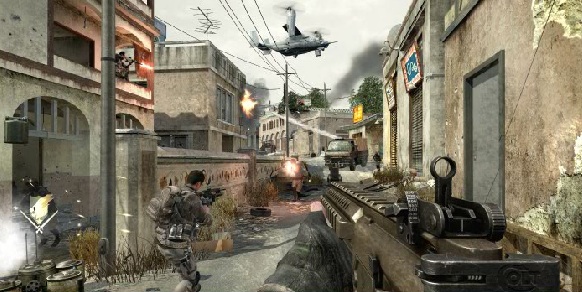 RC: One of the key aspects that’s made Call of Duty a smash hit is the multiplayer aspect, and you guys have pulled out all the stops in order to expand on this, including a new killstreak system where the player can choose either an Assault, Support, or Specialist path of upgrades. Tell us about the decision to incorporate specialized killstreaks to fit different players’ styles, and how you hope this may level the battlefield for the more objective-based player.
Robert Bowling: Well, the inspiration for all the different strike packages was looking directly at the feedback we’re getting from the 30 million people playing our game. Looking at the player trends that have been happening as we’ve moved from Call of Duty 4, when we first introduced killstreaks to how the dynamic then changed in Modern Warfare 2—and then how we want that dynamic to change even further in Modern Warfare 3. A lot of it’s going back to the more gun-focused gameplay of Call of Duty 4, but with what we’ve learned from the killstreak system is that, inherently, it’s all focused on getting kills. We’ve got millions and millions of players who all play so differently, but they’re not being rewarded, incentive-wise, for being good at the game in other ways—and that was the big driving factor for introducing custom strike packages, because we wanted to open up how you’re rewarded with killstreak rewards. We want to let you be in control in the type of killstreak rewards you have and give you the tools to be a better objective player and a better team player, rather than always trying to be the best team deathmatch player.
And that carries over through more than just the killstreaks. Capturing objectives, capturing a flag, capturing domination points, and blowing up a bomb site should all add to your rewards. So, regardless of what strike package you have, that now gets you one tick closer to unlocking your next killstreak reward. In addition to that, you can now focus your entire killstreak rewards on things that have nothing to do with getting you more kills—and that was the whole mentality behind giving you tools that allow you focus on things other than killing.
RC: Another new multiplayer aspect is the Spec Ops: Survival Mode. Tell us about what you’ve done with your take on what boils down to Horde mode.
RB: Well, Spec Ops: Survival Mode is really taking the traditional wave-based gameplay and putting the Modern Warfare twist on it. So, we’re bringing in all the stuff that people love from multiplayer—matchmaking, progressive ranking, killstreaks, weapon unlocks, weapon attachment systems, gear and equipment from multiplayer—and bringing all that and putting it into a much different arena in a co-op environment against AI enemies. And the benefit of the infinite-wave thing is that we can constantly be throwing different experiences at the player—so, you’re seeing enemies you’re not seeing anywhere else. You’re seeing kamikaze dogs, kamikaze infantry, chemical agents, juggernauts, juggernauts with riot shields, enemy air support—it’s such a different experience, and what I love about it is that it blurs the lines between what’s a competitive multiplayer experience and co-op multiplayer experience, and it makes experiences that were typically only reserved for that super-hardcore-competitive multiplayer guy accessible to the single-player guy. Now you have the opportunity to call in some awesome chopper gun and to be raining death down from above, or maybe you’re just not a competitive multiplayer guy, so you never got to experience that before, but now you can have that in a much different environment.
RC: Moving to the franchise as a whole, we all know that Sledgehammer and Infinity Ward are working jointly on this title. What difficulties have arisen, if any, from having two different development studios working on the same title?
RB: Early on, it’s all about logistics. So, the biggest challenge was, logistically, how do we have two teams work on such a massive experience? And so we sat down and we made the decision to be a very flat organization—to not divide the game and be like, “OK, we’ll take this, and you do that, and you just do your thing, and we’ll do ours.”. That would’ve never worked. So, what we did was focus on playing off each other’s strengths and weaknesses—and everyone has input on everything in the game. So, we’re really working as one giant team rather than dividing things up among each other. So, we’d be more like, “Your guy is really great at this; he should work with our guy on this aspect” on the same level and build up from that organically. From there, logistically, it was about setting up video-conferencing systems, setting up ways to communicate on the fly, as we would with the guy two offices down from me. And then, from a creative standpoint, sitting down and having open, honest conversations about what direction we want to go. I mean, I knew that going into it, we’re a very passionate team with very core design philosophies, and we knew what we wanted Modern Warfare 3 to be. But it was refreshing to have Sledgehammer come in with such a fresh perspective, because they brought in things and directions that we may never have gone in and brought in experiences we’ve never had before.
RC: Speaking of other experiences, do you guys ever look at other shooters out there for inspiration? Do you ever see a perk or a weapon in another game and go, “That’d be really awesome in our game”?
RB: We take inspiration from everywhere, not only in our own genre. I love when we take inspiration from things outside of our genre. Look at what RPGs are doing, and look at what MMOs are doing—specifically in regards to things like progressive rank and XP and how you reward players. We take inspiration from all that stuff, and it’s important that when you do that, you make sure you only take the core mechanic and make it work for the kind of experience that we’re looking to deliver. But, yeah, that happens all the time, and it’s great when you can do that.
RC: Let’s talk about the single-player—at this point, we’ve all seen the E3 2011 footage of the attack on New York City. Call of Duty historically takes place all over the globe, though. What goes into deciding where the games’ missions take place, and what kind of research do you do? In terms of the plot, why New York City now under attack?
RB: Well, a lot of the story and locations are dictated organically by where the story’s going and how the conflict’s escalating. Modern Warfare 3 is a payoff to this growing momentum of conflict that’s been starting since Call of Duty 4. So, in Modern Warfare 2, the state of the world changed when the invasion of the U.S. happened. That was just the beginning. The attack on Washington, D.C. was just the beginning of the turning of that type of war. And it just organically escalated up the eastern seaboard to New York, which is another major city, because the Russian navy ‘s blockaded New York by this time in Modern Warfare 3, because this is a full-on invasion. This is a military invasion by the Russian army—this isn’t some sub-splinter of a group. This is the Russian nation attacking America, and this will be pulling in other major nations and cities into this conflict, as would actually happen if America were attacked.
So, it’s really looking at how the war’s escalating, and what I love about it this time is that we’re leaving these very traditional conflict areas, and for the first ever in Call of Duty, what we started with at the end of MW2 was pulling it into the heart of these major cities, bringing the conflict to these iconic places, rather than nondescript desert town you’d expect wars to be fought in. Now you’re fighting in Paris, London, and these major cities in Germany and Africa. So, it’s really changed organically and the research that goes into that is painstaking. Because you look at like fighting in London, and we ask ourselves, “Where would we fight in London?” We have to figure out where it would not only make sense for the story, but also where it’s going to be very impactful for the player. So, we’re looking at Canary Wharf in London, and then you go into reference and pull each reference you can and look at Google Maps and get the layouts and the buildings. And then you take that—once you get it as authentic as possible—and you put it through a gameplay filter of “OK, this is authentic, but now how do we make it fun?” Because authentic’s great, but fun is king. And that’s when you start looking at player routes and cover points and sight lines and start crafting it for gameplay.
RC: From a technology standpoint, you guys have been working with the IW engine for a while now. Was there anything you were able to add into MW3 that you weren’t able to do before but now can because of the familiarity you have with the tech?
RB: Definitely. The big focus with moving into these new environments and these much bigger cities is that the length and the scale of the levels in the single-player that you’re fighting in now are so much bigger than we’ve ever done before. So, a lot of that on the back end required a lot of tech work—and, thanks to the fact that we’ve been building steppingstones. In Modern Warfare 2, we made a good leap from Call of Duty 4 in terms of just visual graphics with our streaming technology that allowed us to make that leap. And in Modern Warfare 3, we’ve done even more work with that now that we’ve mastered that streaming technology and found other ways that we can enhance what we’re streaming in, when we’re streaming it, and how we can optimize that to get to that scale, to get to that size, and still maintain that super-smooth 60 frames per second with tight controls, which is what sells the Call of Duty franchise. That’s what sells—the tight gunplay. And, at the end of the day, that’s what matters most.
RC: It wouldn’t be a first-person military shooter without plenty of weapons. So, what kinds of new goodies can players look forward to in Modern Warfare 3?
RB: Well, we’ve added a lot of really cool weapons. A ton of weapons overall, especially in multiplayer. There’s stuff that isn’t even out yet, and that’s the great thing of being at the scale that we’re at now, where we’ll actually have weapons manufacturers contact us and be like, “Hey, we have this new prototype that’ll be out in the field in a few years, but we think it would be great for your game,” and we can go look at it, or they’ll bring it to us, nd we’ll check it out. One of my favorites is the XM25 grenade launcher, which is something only Delta operators are using in the field right now. It’s a grenade launcher that “lasers” a target—like, say, someone’s behind a concrete barrier or in a doorway or window or something, and you can laser that barrier, and it’ll calculate the distance, program it into the explosive round, and when you fire it, the round is programmed to explode one meter past that distance. So, you can actually shoot it through the window, and not until after it gets through the window will it explode and take out anyone who’s hiding behind it. That’s something Delta operators are using now, and that’s something we’re going to have in multiplayer and single-player, but we balanced them very differently between the two, because single-player’s all about having fun, while multiplayer’s about having fun but having to be balanced with everything else in the game.
RC: You mentioned Delta operators before. How closely do you work with military personnel in order to give an authentic feel to the game’s combat?
RB: We work very closely when it comes to being authentic in terms of the gear that you’re using and the weapons and they operate and how they look. But, more importantly than anything, is that fun always comes first. So we do want to be as authentic and as real as possible, but we will pull back from that realism in order to be more fun and to make it actually enjoyable to have all that stuff. So we’ll sit with them from a story standpoint and say, “Hey, here’s a scenario we’re cooking up for the story. How would you approach that?” A good example is talking to our active military guys who work with Delta and saying like, “Scenario: Russian sub in a New York harbor. You are responsible for disabling the sub. What would you do?” And then we’d say what we were thinking and our gut reaction to the situation. “Plant a charge here and blow a breach in.” And then they come in and say, “Oh, no—you wouldn’t do that. You’d be afraid of disabling this, and that would force it to come above. And then you could breach it from above without having to be underwater.” And that directly influences the gameplay—like in the E3 trailer, when the SEALs assault the sub.
RC: Call of Duty seems to come across as a “guy’s guy” kind of game. But you have a surprisingly strong female audience as well. What would you attribute that to? And do you ever see Call of Duty including female soldiers as protagonists or allowing players to chose female characters in multiplayer?
RB: I’d attribute it to the fact that we’re extremely accessible to every type of playstyle. We have females in our community that are amazing at the game in every aspect, but then you also notice trends between female gamers and male gamers. Female gamers are typically more focused on teamplay and that support role and not being self-focused or lone-wolfing. They also communicate better in terms of garnering Dom points and capturing objectives. So, I think the fact that we—especially with Modern Warfare 3—cater to different playstyles and reward them has even greater appeal now to all types of audiences.
As for female protagonists, I think anything’s possible in the future. We’ve had some female characters in the past—we had a chopper gunner pilot in Call of Duty 4 who was female. So, I think anything’s possible. We really let the story dictate the characters for us, and so far, we’ve had female roles in there at different points.
RC: Finally, the controversy over violent videogames reemerged after the recent terror attack in Oslo, Norway; the perpetrator of these attacks claimed that he “trained” with Call of Duty. This has led to the franchise being pulled from some store shelves in Norway. How do you guys respond to something like that, and do you see it affecting the series either in the long- or short-term?
RB: We don’t see it affecting us from a creative standpoint, because we’re creating a fictional game with a fictional storyline that takes place completely outside of any real-world scenarios. The universe that our games live in is very unique in that sense. But our focus has always been—and will always be—on making games that are meant for entertainment, that are meant for the right audience, and making sure that we’re following and respecting all the rating guidelines that are out there and making sure that everyone can make an informed decision and that they know what the content of the game is well before purchase. We want to make sure that we’re respecting that, and that we’re open and transparent about that.
Back in December I had the chance to attend the 2010 SpikeTV VGAs and work the red carpet. Here I had a chance to speak with the only version of Commander Shepard for most people, Jennifer Hale, the female version of Commander Shepard for Bioware’s Mass Effect series. We chatted about how more people should look at her as the only Commander Shepard and how it is to be in such a widely popular series.
Back in December I had the chance to attend the 2010 SpikeTV VGAs and work the red carpet. It was here that I got a chance to speak with the man behind Call of Duty: Black Ops’s Sgt. Frank Woods, Mr. James C. Burns. We talked about how it was to voice a character who has quickly become somewhat iconic in the Call of Duty mythos and doing voiceover work in general.
Back in December I had the chance to attend the 2010 SpikeTV VGAs and work the red carpet. Here I got to catch up once again with old friend and Oscar winning director Guillermo del Toro. Instead of talking about vampires this time around, Guillermo, Danny Bilson, and I chatted about THQ’s new game that Guillermo is working on called Insane.
Back in December I had the chance to attend the 2010 SpikeTV VGAs and work the red carpet. It was here that I got a chance to chat with the man behind the music for all of the God of War games, Gerard K. Marino.
Back in December I had the chance to attend the 2010 SpikeTV VGAs and work the red carpet. Here I caught up with my old friend and host of GameTrailersTV Geoff Keighley to talk to him about putting on the show year after year and what we could expect from that year’s show.
 RayCarsilloWrites.com