Originally Published: February 26, 2011, on PlayerAffinity.com and Original-Gamer.com
 Most of us single guys out there (and maybe even some of us with significant others) saw only one significance with February 14th this year: Pitchers and Catchers are officially reported. And with the crack of the bat and the smell of fresh cut grass soon to be once again bombarding our senses, we know that baseball season is right around the corner.
Something else that’s right around the corner that also comes as a harbinger of the upcoming glorious baseball season is Sony adding another chapter to their premiere baseball series MLB The Show.
MLB 11 The Show will hit store shelves on March 8th, 2011, and so as spring training really starts to get underway, I had a chance to talk with Jason Villa, the Senior Producer for MLB 11 The Show, about just what will separate this year’s version from previous incarnations and just who The Show predicts will win it all this year!
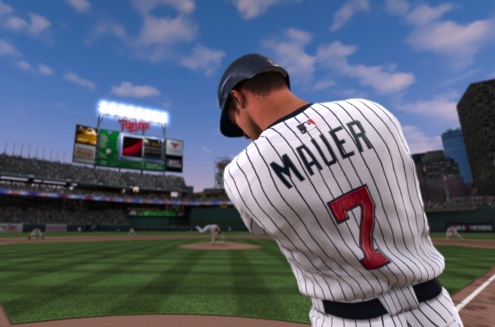
Ray Carsillo: The first thing most people notice with a game is the game cover. There’s always a lot of hype surrounding the cover athletes for sports games, but The Show broke the tradition of having a different cover athlete every year with this year’s return of Joe Mauer after gracing last year’s cover. Joe is clearly an elite player in the game, but what made you want to bring him back again?
 Jason Villa: Well, to your point, Joe Mauer continues to be a driving force in Major League Baseball as the premier all around player in the game. Year in and year out, MLB The Show delivers the best baseball gameplay experience available, truly in a class of its own, so I could not think of a more worthy ambassador to once again represent the highest rated, best selling baseball video game franchise of all time.
RC: The first of the new features I want to delve into is the new Co-op mode. Baseball is probably the most individualistic of the team sports as the game revolves around the very base match-up of the pitcher vs. the hitter. How was it that you were able to integrate a co-op mode and explain how it works?
JV: Yes, I agree that the one-on-one element between the pitcher and the batter is probably the most important element of the game. If you have a Roy Halladay on the mound, sometimes you wonder if the fielders are even going to bother bringing their gloves with them out to their positions. But when you have a sport like baseball where only one team averaged a winning margin of over 1 run a game (Yankees +1.02), there is something to be said for the little things that come from good teamwork. A well timed hit and run, sacrificing a runner into scoring position, or hitting your cutoff man and him making a strong relay throw could really make a difference in a game. While our regular exhibition, season, and Road to the Show modes focus on what the individual can do, Co-op stresses the importance of playing more of a team game.
Co-op is set up to allow you to play 2 players vs 2 players, 2 players vs 1 player, or 2 players vs the CPU. When you first select to play Co-op, you will be given a variety of player control options. Defensively, you choose who will handle the outfielders, the infielders, the catcher, and the pitcher. With the pitcher, you have an option to alternate, meaning you will switch control each inning between the two teammates. Offensively, you also have the choice to give all the hitting to one teammate or alternate each at-bat. When you alternate batters, whichever teammate is not at-bat, will be responsible for controlling the base runners if there are any. At the beginning of each at-bat, a Player Control OSD will appear from the scoreboard in case you need a quick reminder of who is responsible for what. Although, we love to give everyone the ability to customize the control to their liking, we have defaulted the options to a way that best promotes the focus of playing as teammates. Without defaults, both teammates will be responsible for different parts of a relay throw from the outfield. Both teammates will be responsible for different parts of a sacrifice or a hit and run. Co-op adds a new level of realism that exists in baseball by making more than one person responsible for making smart decisions on a single play. It also adds a new level of trash talk as well when your partner fails to deliver. Hopefully it doesn’t ruin friendships.
RC: Baseball video games do a great job of eliminating a lot of the inherit downtime that occurs in the game, but are you afraid of co-op players getting bored incase there are three ground ball outs in an inning and they’re playing the outfield or they choose to play as the 4, 5, 7, and 8 hitters in a line-up and their friend starts the game off by going down 1-2-3?
JV: When we initially started designing this mode, we considered this question a lot. This is how the idea of alternating came about. Instead of allowing the user to choose specific batters to control in the lineup, choosing to alternate means if you are not batting, then you are on-deck. You will never have to wait more than one batter to participate. And even more importantly, if you are on-deck, you are controlling the base runners so you may still be busy. As for fielding, we divided up the responsibilities as much as we could while still trying to keep the user from feeling uninvolved. But you are right, there is only so much we can do. If the pitcher dominates, the fielders aren’t going to see much action. But that is baseball. Fortunately, that option to alternate the pitching helps with this as well.
One cool element that you might not be aware of is that we have given the users the ability to “call off” a teammate. Let’s say that there is a shallow fly ball to left field and the SS is chasing it down. If your teammate in LF is within range and has a play on the ball, he can take control of the fielding responsibility with a simple button press. We set it up to work how it works in real baseball. Infielders can call of the pitcher. Outfielders can call off the infielders, but not the other way around. Just another smaller detail that makes the game feel more realistic. It is going to be pretty tough to feel bored unless you change the settings to exclude one teammate from doing things. But with the default settings, everyone is going to have plenty of work to do.
RC: Moving away from the co-op, if you’re like me, you don’t want to be weighed down by your friends and will probably be playing more games versus people or the computer by yourself. For some of us Show veterans though, the control scheme this go around has changed and now features the Pure Analog Control System and is supposed to provide the most accurate experience to date. Tell us how the Pure Analog Control System works and just what aspects of the game we can see this pinpoint accuracy in.
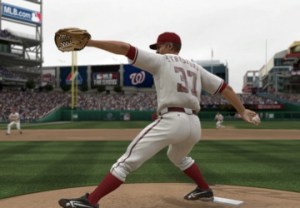 JV: Pure Analog Pitching allows users to control pitch height, location, and velocity with the right analog stick. Pulling down on the right analog stick begins the pitcher’s delivery as a ball icon moves gradually downward towards a yellow line that represents your ideal pitch height. Time it such that you push the stick upward at precisely the time the ball icon hits this yellow line. Inside-outside pitch location is a result of the direction you push the right analog stick up. How hard you flick the right stick up will determine how much effort the pitcher will put into the throw. Your timing, accuracy, and speed are all taken into account when delivering a pitch with Pure Analog Pitching.
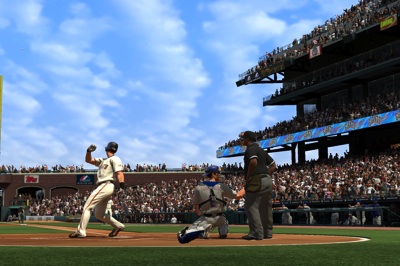
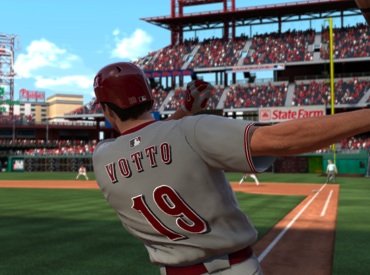
To use the new Pure Analog Hitting system, simply pull back on the R-stick to stride and push forward in the direction of the incoming pitch to drive through the ball. Be sure to time your stride just as the pitcher releases the ball, a poorly timed stride will result in a less powerful swing. Don’t try to hold you’re stride back just waiting for the pitch – you’ll loose power! Time it like a real swing and begin your stride as the pitcher’s getting ready to deliver! Getting that solid hit has never been so rewarding!
Pure Analog Throwing offers a new way to experience fielding in The Show, as you can now control both the accuracy and power behind your throws. Push the analog stick towards any base to release your throw, or hold L1 while pushing the stick in any direction to throw the ball from the outfield to the cutoff man. Holding the stick longer will put a little extra mustard on the ball, but make sure to keep your throws accurate by pushing the analog stick in a straight line. Keep in mind that you can adjust Analog Throwing difficulty to make your experience more enjoyable. With a little practice, you’ll be filling up your trophy cabinet with gold gloves in no time!
RC: Speaking of the controls, MLB The Show 11 is compatible with the PS Move controller, but only in the HR Derby mode. Why limit the Move to only the Derby mode?
JV: The PS Move is going to be a big part of our plans going forward, but it will take some time to make sure it works the best it can within all areas of gameplay (batting, pitching, fielding, base running) and at the high level that we expect from our features. For this year, however, we were only able to include Move functionally with Home Run Derby.
RC: A returning feature and a staple of the series, Road to the Show, comes with a complete facelift, which is saying something considering how it is already one of the most in-depth experience simulators out there. What new features did you add this year to Road to the Show while also maintaining a balance with the authenticity and detail that the mode is known for?
JV: We started out this year’s design by looking at what we had already done with the mode, and what areas we felt maybe were lacking or needed the full facelift. After analyzing the mode, we determined one area that needed a tweak was the create player process. We’ve heard lots of community suggestions regarding creating more realistic player abilities right out of the gate. This was the overall goal we had when creating the new interactive create player sliders. We evaluated the types of skills player posses, and determined that most skills come at a price to another. This was the approach we took for the new sliders. So if you want to create a power hitter, your sacrifice comes from your initial contact abilities. Or for pitchers, establishing yourself as a control pitcher comes as a sacrifice to your initial movement. While we created this new system, we also kept in some of the old elements that limit your abilities based on position as well. So if you want to create a fast catcher, he’ll be exactly that, not necessarily a fast player. Of course all areas are still trainable so even though you picked to be a power hitter, if you work on your contact over time, you can be a double threat.
From there we examined the advancement goal process and found that improvements were needed more-so than a facelift. We’ve altered our evaluation logic to now compare your stats versus the players around you. In the past, you were evaluated separately, but now you will be in full competition to the players around you. This opens up the ability to fast track to the MLB if you overachieve in an organization that may be lacking in your position, while it also means you can lose your spot if an up and coming player is playing at a higher level than you. Along with this addition, we’ve also adjusted our expectations to be more in-line with your abilities. The goals themselves are still challenging, but we’ve modified our expectations based on data from real players. Your target attribute levels are completely in-line with your real-life counterparts.
 The last big change in the mode is how we award training points. We’ve completely remodeled this area by creating a new Performance Evaluator system. This system analyzes your plate appearances, or batters faced, and then grades you based on a number of factors. The system looks at how many pitches you saw (or threw), the type contact of the hit, and the play result to then award you a grade and training points. Not only does it summarize the at-bat, but we also evaluate things during that at-bat to determine areas you excel or fall short in. We evaluate your swing timing, pitch recognition ability, percentage of strikes versus balls thrown, etc… and use that data to then trigger trainings. The training modes themselves have been overhauled as well to now focus on specific areas to improve on. As mentioned before, we trigger specific training types based on areas of the game you need to improve on. These trainings include contact, plate discipline, pitch location, specific pitch type trainings, a few others. The trainings also have levels of difficulty where you will start at level 1 and progress through the levels as you achieve the target success ratings.
A few smaller changes that add to the facelift of the mode include: New minor league playing time logic that focuses on developing your player. This means as a position player, the majority of your appearances will be starting and playing the whole game. Manager interactions have been updated to refine the logic for what is available and when, as well as the types of results you get should you initiate an interaction. A new playing time screen appears before each appearance to give you the ability to decide if you want to play that game or not. This screen lets you know if you are starting that day or not, and if not, it tells you the situation you are being brought into giving you the choice to play or sim that game. Finally, we removed the goals you would be given during the course of the game as simply these were just too obvious. You will no longer be told to take a strike, or drive the runner in. We felt these situations were just too obvious and disrupted the flow of the game.
RC: Another returning feature that will probably get a lot of diehard fans’ revved up is the return of the online leagues and this has also gotten an upgrade. Talk about what all those pseudo-commissioners will be able to tinker with in the revamped Online League.
JV: This year, we’ve finally been able to add and tighten up the loose ends we’ve been wanting to for years. Just to run down a quick list… New Create League process (with more customization), Leagues and Divisions (both able to be named), custom division amounts and sizes, ability to use a custom roster in leagues, CPU controlled teams (to fill up and play vacant spots), user management (to move users from divisions to others, set teams, etc..), Role Management (to give other users commish rights), ability to Reset and Simulate games, ability to change sliders and league settings throughout the league, and an all New Schedule Generator.
RC: Continuing with the online features, there is also a new mode called Challenge of the Week, that just in the title sounds a lot like the Left 4 Dead 2 Mutations. What exactly does the Challenge of the Week entail and give us a couple of examples of what players will have to do?
JV: Challenge of the week is designed to be a pick up and play, fast paced arcade batting skills challenge. The entire mode centers around a scoring system that rewards quality hits and increases in difficulty with each consecutive success. There is a Bonus system where users can gain momentum and/or point boosts for achieving them within a given time frame, the Bonuses change for each new challenge and are a key piece for success in Challenge of the Week. Each weekly challenge will be based on real events in the previous week of Baseball. For example, let’s say in the 2nd week of the season, Strasburg throws his first perfect game and he does so facing the Mets. In another game of the Nats/Mets series, Wright hits for the cycle. The next week you might see Strasburg face Wright with Bonuses for “cycle like” performance.
 RC: What are some of the rewards players can get by completing these challenges? Is there a bank system that keeps tracks of how many challenges you complete? Are certain challenges worth more than others?
JV: The Challenge of the Week “weekly” prizes range from autographed balls/bats/jerseys to trips to a ML game of your choice. We also have a Monthly and two Grand Prize winners. Monthly winners are the combined total of a 4 week period, and the two Grand Prize winners are the totals of the 12 weekly scores. Our goal is to have each challenge VERY close in points each and every week.
RC: Now, something The Show has always been head and shoulders above the competition with has been the A.I. that it features, from Umpire Personalities, to proper situation intelligence from the CPU. This has also led to The Show making some great predictions for the season ahead. So, with spring training right around the corner, does The Show say the Philadelphia Phillies will be as good this year as they seem to be on paper and if not, then who is going to win it all?
JV: In all of my simulations, there are few surprises… Surprise 1: The Dodgers win the west / wild card around 70% of the time. Surprise 2: The White Sox are in the playoffs 80% of the time. Surprise 3: Ok, maybe this isn’t a surprise, but the Red Sox are GOOD. Philly beatin’ good!
RC: As a Yankees fan, that wasn’t what I was hoping to hear. Thanks to Jason Villa for taking the time to answer my questions. MLB 11 The Show will be available as a Sony exclusive for baseball fans everywhere on March 8, 2011.







 RayCarsilloWrites.com