Tag Archive: ray carsillo


Chew on this Galactus!

Originally Published: February 27, 2011, on my StrongProtector account on GiantBomb.com

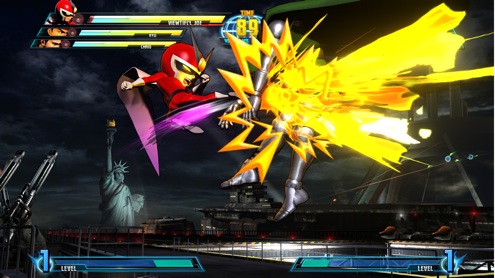
In high school and even later in college, my friends and I back in Jersey would head over to the mall arcade maybe once a week and feed a ton of quarters into our favorite machines. A couple guys would settle into the chair of a racer like Initial-D, but I would always head over to the Marvel vs Capcom 2 cabinet. This went on until I graduated college and the arcade, like many others in Jersey, closed down.

Fortunately for me, shortly after that, Capcom would give us Marvel vs Capcom junkies a downloadable version for current generation consoles. Instead of placating us though, all this ended up doing was feed the fires for myself and others like me who wanted another sequel to this beloved brawler. And now, after a decade of waiting, its finally here. But with so much hype and anticipation surrounding it, could Marvel vs Capcom 3: The Fate of Two Worlds live up to the lofty expectations of addicts like me?

The basic plot of the game is that Doctor Doom has tampered with his dark magic a bit too much and has discovered a parallel Earth populated by the characters of our favorite Capcom games (and a future Earth with Zero). Tempted with the thought of conquering multiple worlds, Doom teams up with not only the greatest threats of his Earth like Dormammu and M.O.D.O.K., but also with the greatest of the Capcom universe, Albert Wesker. Unfortunately, this wormhole into other dimensions has also stoked the hunger of the greatest nemesis anyone, hero or villain, has ever faced, the cosmic being Galactus. With a smorgasbord of planets to possibly quell his insatiable hunger, Galactus has begun his approach and now heroes and villains will have to unite to save all universes threatened by his cosmic power.

Right off the bat, this is probably the best plot of the series as it has more of traditional Marvel comics feel and you can credit veteran comic writer Frank Tieri for that. On top of the plot being heavily influenced by comics, the entire art direction of the game seems to be ripped from comics as well. Bright, stylized, cel-shaded graphics with beautifully drawn paneled cut scenes, much like a comic book page, has the game seem more like a fan service for loyal Marvelites out there. All you need is Stan Lee to yell “Excelsior!” before every match. Even the character select screen sees the chosen characters placed onto a graphic novel style tablet as you choose their assists before a battle.

The audio is also very strong as instead of each level having a set theme, now each character has their own theme and you’ll hear the theme of whomever you may be facing. From a more patriotic ballad for Captain America to the classic Bionic Commando and Street Fighter themes for when Spencer or Ryu jump on screen, the music is tremendous. It’s not the only part of the audio that shines though as the voice acting is also well done. With each character having specific taunts both in battle and after every victory depending on whom they’re facing, like Captain America yelling at Iron Man “That was for the Civil War!”, the audio is simply top notch all around for Marvel vs Capcom 3.

Marvel vs Capcom 3 isn’t perfect though. The standards of the series return such as three member tag-teams and huge hyper combos that can be done singly or with your team if you have enough power bars. But other diehards of the series might be a little put-off by the fact that the combat system has been simplified in many ways. Instead of having the standard six attack buttons like the old arcade cabinets (high punch, med punch, low punch, high kick, med kick, low kick), now there are only four comprised of a low, medium, high, and special attack that can be used to launch foes into the air. This offered me a lot of confusion when I first started playing the game and was trying to perform a low kick with Iron Man.

To help remedy this, there is a new missions mode reminiscent of some of the later Mortal Kombat games which serves as a chance for you to learn some basic combos and special moves to get the feel of the game if you wish. Each character has 10 missions and so this lets you either become well-rounded with many characters, or really specialize in two or three.

One positive to the new button layout is that it is much easier to switch characters in and out, call for assists, or perform your hyper combos as now each one of those maneuvers has been assigned their own button on the controllers. This does allow for more rookie fighters to jump right into it and level the playing field with more veterans, but there are plenty of new maneuvers that have been added to help separate the rookies from the veterans as well like the brand new team air combos and new reversal systems.

Another new aspect added is the “X-Factor” where by smashing the four attack buttons at the same time, you can increase the attack power and heal your active character. This new feature does give an interesting strategic twist, but again diehards of previous titles in the series probably won’t even remember to use it as it just feels so gimmicky and foreign to this series.

The biggest disappointment probably for the game is the lack of characters though, both old and new. There are only 36 characters total at launch, with more coming in DLC to sap you of more money. Sure new characters like Deadpool, Super-Skrull, Viewtiful Joe, and Amaterasu are great original additions to the series, but others are just rip-offs of characters who were removed or are still in the game. Haggar is just a Zangief rip-off with a steel pipe, X-23 replaces the “bone claw” version of Wolverine, and Zero is Mega Man with a sword.

I understand that Capcom wanted to streamline the 56 characters that were in Marvel vs Capcom 2, but to cut out 20 characters including a lot of fan favorites? Just to re-package them as DLC later? Of course fans will still buy it, but I think I speak for a lot of people when I say how disappointing that is. Cutting out half the roster when making a fighting game sequel is not usually the way to go because by pure definition that is not bigger nor better.

Despite all this, Marvel vs Capcom 3 is still a very good fighting game. Technically it is very sound and it is easy to pick up but hard to master with a great storyline that will make any and every Marvel fan squeal in delight. If you are a fan of the franchise, Marvel, Capcom, or just fighters in general, then this is a game you should add to your collection even if you’ll walk away feeling it is a bit more generic than you’d initially expect.

Ratings are based on a scale of 1 to 10 with 10 being the best.

Graphics: 10.0: The visuals for MvC3 are absolutely tremendous done in a stylized cel-shading that really stresses the comic book feel that is persistent throughout the game as you are bombarded by bright and vibrant colors all day long.

Audio: 10.0: Redone classic video game themes for all the Capcom characters and fitting original themes for the Marvel characters is one of the great highlights of this game. Coupled with great voice acting from all those involved and the audio is as perfect as can be.

Plot/Plot Development: 4.0: Most fighting games truly lack a compelling plot, and MvC3 may have the most piss poor of them all. Never even properly explained, all you have to go on is a stylized opening sequence and a solid boss battle with Galactus to put together that Wesker and Doom have partnered together. Solid comic book plot, but it needed to be explained a lot better than it was.

Gameplay: 7.0: Many diehards will be irritated with the button changes and new features added, but at the end of the day, they work and will appeal to a mass audience. Too bad for this review, I’m representing the diehards.

Replay Value: 6.5: Like any good fighting game nowadays, the replay value really comes in the online play, especially since you can blow through the single player offline mode in a weekend if need be. Unfortunately, it may take you 20 minutes to find an opponent to play online and therefore make the online play moot because who wants to play three matches in an hour? So if you don’t have some friends to form a lobby with, then you might think twice about the worth of MvC3.

Overall (not an average): 8.0: MvC3 is a very solid fighter on a technical level, but fans of the series will be put off by the gimmicks added and the arcade style of play that is the true staple of this series. More bells and whistles are all well and good, but it felt like Capcom sold the soul of this game. So even with it being technically perfect, this game falls just short of being put into elite status in my mind.

Originally Published: February 27, 2011, on my StrongProtector account on GiantBomb.com

They had us save a world of metal and then showed us that there is still a little magic left in Halloween. So what would the folks at Double Fine Productions have for us next? Well, they felt we needed a little bit of a break and could play with some dolls. Specifically, Russian matryoshka, or babushka, dolls.

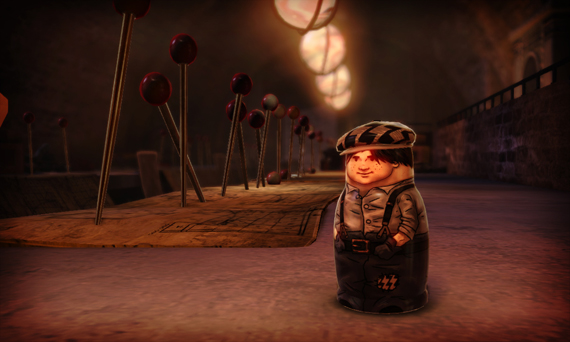
In Stacking, you are in a world similar to ours during the industrial revolution near the turn of the 20th century, but the entire population is made up of babushka dolls of varying sizes and you play as the smallest one of them all, Charlie Blackmore Charlie and his family have fallen on hard times when an industrialist named The Baron hires Charlie’s father to be his chimney sweep. But then days turn into weeks and then into months and Charlie’s father is nowhere to be found. In order to pay the rising debt the family owes, the Blackmore children are all then forced into slave labor by The Baron and his men. All that is except Charlie, who is deemed too small to be of any worth in the labor force.

Determined to save his siblings and put a stop to The Baron and his child labor schemes once and for all, Charlie sets out ready to show that it isn’t the size of the doll in the fight, but the size of the fight in the doll, or doll within a doll within a doll.

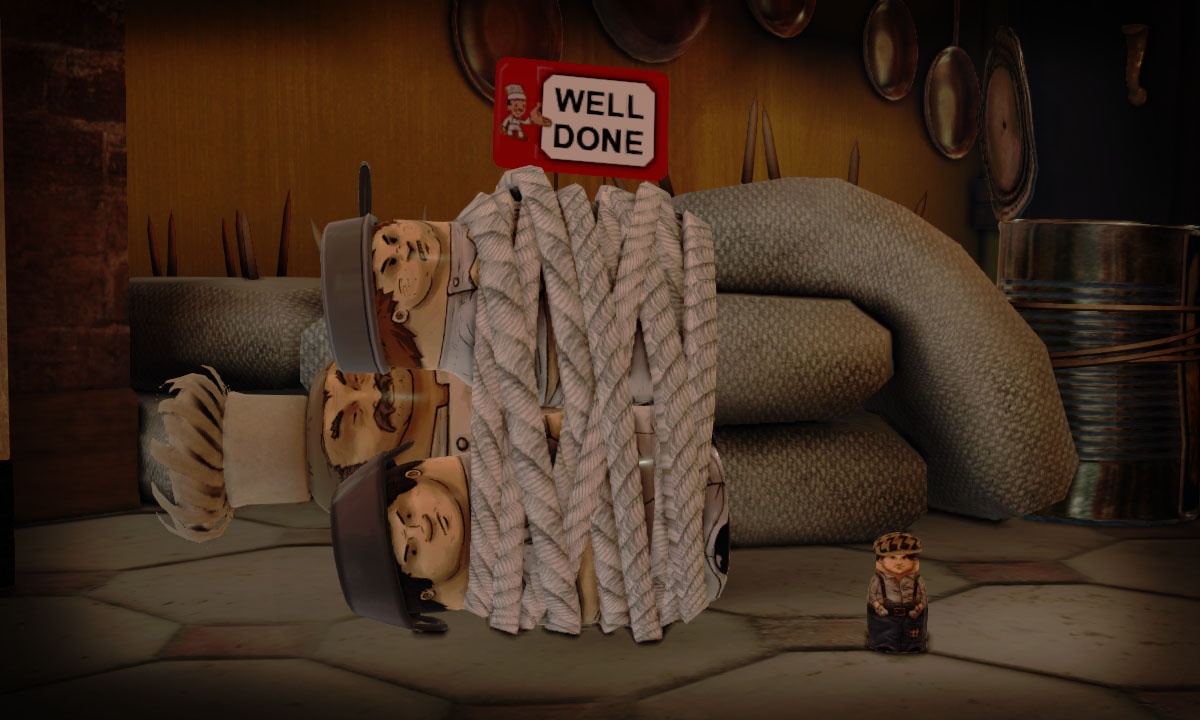
Being the smallest member of his community, Charlie has a unique talent that most others around him would be shocked to know. He can control other dolls. Well, he can stack into them anyway and then use their own unique talents around the world Charlie finds himself in while on his quest to free his family. Whether needing to take over a mechanic in order to access ventilation ducts, a fire chief in order to put out a fire, or a boxer to smash some heads with a proper uppercut, the puzzles laid before you are all rather straightforward and will require a minimum of effort for you to figure you out. The only hard part you’ll find is making sure you have the right size doll in your control to stack into the next size up.

This simple gameplay mechanic is really the entire premise of the game as you’ll work your way through some beautifully designed levels inspired by the time period like train stations, cruise ships, and zeppelins. Also fitting of the time period, and since babushka dolls don’t talk, the cut scenes are done in the silent film style where you cut to a grainy full screen of text before continuing the scene. Add in the player piano themes and although there is no voice acting whatsoever, the audio is still good, if not great.

The biggest downside of Stacking though is that the game is too short. Sure, there are plenty of collectibles and alternate ways to complete mission objectives if you’re looking to pad your achievements or trophies, but if you’re just looking for a varied gameplay experience and deep plot, then this is not the game for you, especially considering the $14.99 PSN and 1200 Microsoft point price tag that comes with Stacking. The only reason why the game doesn’t start to feel tedious is because it should only take you two or three hours to beat the entire story.

Although with just as much humor and polish as previous Double Fine titles, Stacking just doesn’t have enough content to warrant such a large price tag for this downloadable game. Without a glitch to be found and with a premise that was as inventive as this one, I wish I could just sing the praises about Stacking, but at the end of the day the game is too short, simple, and just not as fun or as addictive as it could be. Since it is technically very sound, if you’re still curious about Stacking, I would recommend waiting for it to go on sale or be included as some sort of downloadable game deal before making this a part of your collection.

Ratings based on a scale of 1 to 10 with 10 being the best.

Graphics: 10.0: Although the character designs are as simple as can be, the world of Stacking comes off without a glitch and the perspective change as you move into larger and smaller dolls is seamless. I can’t think of how Double Fine could have made this world they crafted come to life any better.

Audio: 8.0: It may have been inventive to use the silent movie style for the cut scenes, but I really would have preferred voice actors. Aside from this, the classic piano themes and “click-clack” SFX as you enter and exit various dolls work perfectly.

Plot/Plot Develoment: 7.0: A very basic and predictable plot that does the job, but is really nothing more than a vehicle for the concept of Stacking.

Gameplay: 6.0: Innovative and unique, the core gameplay of Stacking, although glitchless, does become very repetitive over the short time you’ll be playing this game. Combine this with simple puzzles and you have an interesting experience that just fails to impress beyond the initial few moments.

Replay Value: 6.0: There may be several ways to complete each puzzle and a variety of collectibles to find on each level, but most are so simple to solve that even if you come back to finish the game, it shouldn’t take you more than five hours to get to 100% and there isn’t enough here to make you play through the game again.

Overall (not an average): 6.5: Stacking is a very polished downloadable game, but considering the lack of content you get for the $15 price tag and I’d wait until this game went on sale before seeing this as a truly worthwhile purchase.


Originally Published: February 27, 2011, on my StrongProtector account on GiantBomb.com

Growing up, I always dreamed of being a superhero. I wore a blue blanket around my neck as a cape and ran around the house vanquishing invisible enemies with what I perceived as martial arts, but that my parents probably thought might be closer to some kind of interpretive dance (I’ve always been a very uncoordinated individual). So, it makes some sense that the only MMORPGs I ever had any real interest in were the ones that let me make my own superhero.

Great MMORPGs are supposed to be able to suck you in and make you want to keep playing and building up your character and keep influencing the universe you find yourself in (and keep paying the monthly subscription fee), but I got bored with City of Heroes after a while and the same happened with Champions Online.

DC Universe Online was supposed to be different though. Over the four-plus years of development and delays we had to endure, we kept being told how it was going to change the world of MMORPGs, how it was going to be different, and how it was going to appeal more to people like me who weren’t into collecting rat pelts and beating up on smaller foes constantly in order to just level up once in the hopes of advancing past the next mission.

Well, after weeks of near non-stop research, where I sacrificed contact with the outside world, and also with my razor (see picture), I have come to this conclusion: DCU Online is easily the most fun, engrossing, and enjoyable superhero MMORPG I’ve ever played. But after playing it non-stop for a month, I don’t see any reason to extend my subscription beyond the free 30 days the game comes with.

The game opens with Brainiac putting into motion his master plan, his end game that will finally eradicate the heroes and villains who have always stood in his way and that will give him absolute control of the Earth. And he will succeed. Furious over missing the threat right under his nose and letting his obsession with Superman get the best of him, Lex Luthor from the future builds a time machine that allows him to temporarily travel back to the Justice League Watchtower before Brainiac launches his attack. Future Luthor has brought back with him Exobytes, little nanobots that Brainiac used to download the DNA and powers of Earth’s heroes and upload into his robot army for the final push of his conquest. Luthor releases these Exobytes into the atmosphere, thus creating millions of new heroes in the hopes it can change his present and our future as he is ripped back to his own time.

It is here that you can then create your own hero or villain. First, you have to choose a server offered and I normally wouldn’t even mention this, but as a comic book fan, I took a little extra joy in seeing each one named after a classic DC storyline, whether “The Killing Joke”, “Final Crisis”, “Justice” or the many others. Now, if you want to jump right into the action after this, you can choose from one of 15 hero/villain presets, but if you’re like me and want a more personal touch, then you can choose from hundreds of various combinations, with more that you can earn over the course of your playing time.

Either way, you can choose from one of six “mentor” types who will influence your safe house and mission layout. If you choose to be a hero that follows Batman, for example, you’ll face more of his villains like Scarecrow and Bane. On the other side of the coin, if you choose to be a villain that follows the Joker, you’ll face off mostly against the Bat Family.

I created one hero and one villain to start. The hero I made is a tech-ninja who sports a sweet black mage hat named Strong Protector and who is a dedicated brawler. The villain I created is a dual-pistol wielding army reject named Ray Rage. Someone is now going to use this information to probably lay out a psych profile for me. Anyway, I stuck with the more realistic hero powers, but ice, nature, fire, psychic, and dark magic abilities are all at your disposal as well when creating your own personal characters.

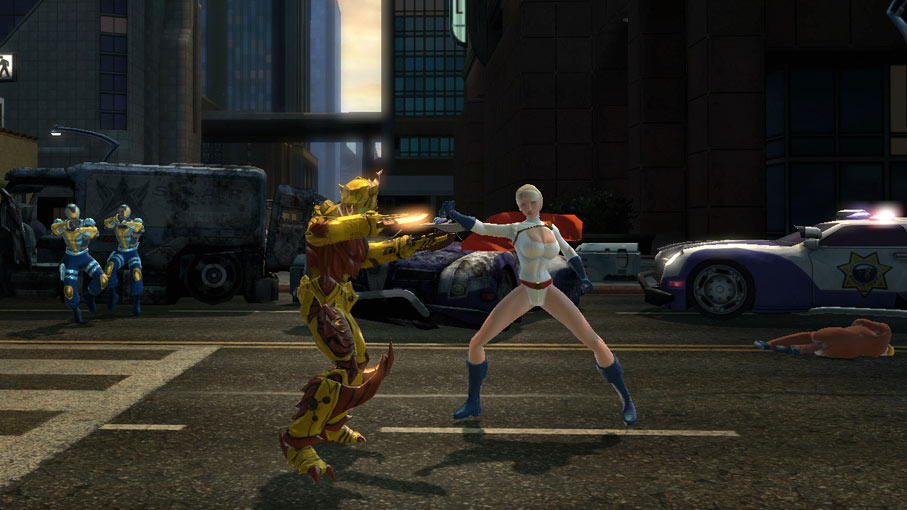
The instant appeal of DCU Online doesn’t lie in the fact that you can create your own hero or villain though because it’s been done before. The appeal lies in the fact that you are playing in an established universe with over 70 years of history to it. You’re jumping right into Gotham’s East End to cause havoc with the Joker for the GCPD and stop Huntress from putting pressure on your mob allies or maybe you’d rather jump into Metropolis’ Chinatown with Superman and need to stop the Hive from stealing mystical artifacts.

The concept clearly is enough to get my blood pumping, but how does the game actually stand up once you get into Metropolis, the Watchtower, or various other areas in the DC Universe? The best way to describe it would probably be a mixed bag.

The scope of the world you find yourself fighting in is absolutely massive and obviously being able to support thousands upon thousands of people online at once takes its toll on the aesthetics of the game, but that’s really no excuse for the amount of visual glitches you’ll find in DCUO. Much of the world is very slow loading and there are holes everywhere. Thank goodness there is a warp option in the menu otherwise I’d still be falling through an invisible hole that was in the middle of the Metropolis boardwalk. The graphics do look great though during the story cut scenes or the small comic style vignettes you earn after defeating every hero or villain you face.

The audio is spear-headed by tremendous voice acting from former DC Universe animation veterans like Adam Baldwin and James Marstens (Superman and Lex Luthor from Superman: Doomsday) and of course Kevin Conroy and Mark Hamill (Batman and the Joker from Batman: The Animated Series and countless other DC animation projects), but I was surprised at how generic the music was. It kept sounding like you’d hear the beginnings of Danny Elfman’s Batman theme in Gotham or John Williams’s Superman theme in Metropolis, and then it would just taper off. Would it have been too much to ask to bash heads to the music that many comic book fans have come to associate with their favorite heroes?

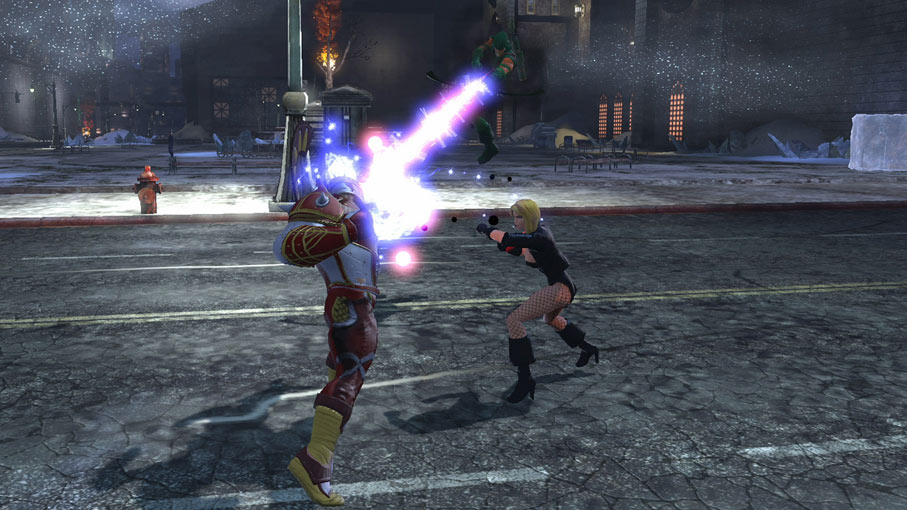
Where DC Universe Online really shines is in the simple controls and mechanics. Unlike most other MMORPGs, the action is completely responsive to your button commands like a traditional action-game instead of the random or turn-based styling that is more accustomed to this kind of game. This allows for players to have a much stronger say in what happens in a fight instead of relying on making the right choices when leveling up and hoping for the right digital role of the dice behind the scenes.

The leveling up has also been streamlined compared to most MMORPGs as you only decide on what new powers you can learn or new fighting styles to acquire. Your health, defense, attack power, speed, and other more traditional attributes increase at a fixed pace, which can be augmented via finding various types of gear from fallen foes, with the best goodies obviously being dropped by the super villains you take out.

Also, instead of having to go back and knock out a plethora of weaker enemies as you progress in order to level up, DC Universe Online successfully has eliminated the rat pelt collecting and has you level up at a much more consistent pace no matter what level you may be. You deserve a reward for bringing Doctor Psycho, Giganta, Harley Quinn, or any of the other countless villains in the DCU to justice no matter what your level is so whether you’re Level 5 or Level 25, you’re going up a level if you beat a villain.

The big problem right now with DC Universe Online is that you can actually get through most of everything you can do in the game in the free month that you get with it. Sure, you could stick around to test your mettle against other created characters in the small or large scale PvP Raid and Arena instances or join up in Legends mode and play as your favorite hero and villains in some classic goal oriented multiplayer, but there isn’t enough for you to buy a monthly subscription until the level cap is increased and some new villains and missions are added. Of course, you could just try out other mentors and powers for the main game as well and create a small army of characters if you really fall head over heels for this game.

When all is said and done, DC Universe Online is a solid, but not spectacular MMORPG unless you really love the DC Universe and their characters, like myself. If so, then this game is definitely worth a purchase, just make sure not to start your free 30 days until you know you can get some solid gaming time in, because even the most diehard of DC fans will probably be ready to hang up their cape after a month.

Ratings are based on a scale of 1 to 10 with 10 being the best.

Graphics: 7.0: In it’s defense, you’re going to have a lot of visual glitches in a world the size of what DC Universe is set in. A big knock against it though is this game has been in development for nearly five years when it was finally released so I was pretty ticked when I fell through the middle of Metropolis’ boardwalk for what seemed like forever and I have to SOE out on it.

Audio: 7.0: I loved the voice actors featured in the game and the SFX are something you would expect in any comic book game, but you couldn’t get the rights from Warner Bros. for some licensed music? I want the Danny Elfman theme for a Batman protégé character damnit!

Plot/Plot Development: 10.0: Great original comic book plot that fits perfectly into the DC Universe and just like many of the comics the game is based off of, if done properly, it will never truly end, but continue to evolve along with the game’s community.

Gameplay: 8.0: A bevy of super powers available to you early on and an easy leveling up system that didn’t have you running around collecting rat pelts was a nice change to your standard MMORPG. Despite this, much like the graphics, there were a lot of glitches and slow response times to your command inputs due to lag and it became irritating at times.

Replay Value: 7.0: An engaging and original comic book plot that will always change and evolve is a tremendous concept, but I will never understand the willingness to pay a $15 monthly charge for any video game that costs $60 to begin with. Unless this all you plan on playing for a good long while, you can probably get your entire superhero fix in the free month that comes with the game.

Overall (not an average): 7.5: As much good as there is in this game, there are still a lot of problems that I’m sure will be fixed over time, but as it is now keeps it from being elite and definitely not worth a monthly subscription fee. Find a spot on the calendar when there won’t be a lot of good games coming out, buy this with the free month, and then be done with it until it gets some sweet expansion pack.

Originally Published: February 27, 2011, on my StrongProtector profile on GiantBomb.com

Often in games, shadows are nothing more than minor details we look at when deciding how good the graphics are. But what if the entire story of a game revolved around these barely acknowledged details?

Lost in Shadow from Hudson Entertainment begins at the top of a mighty tower that stretches far beyond the clouds. There, someone who looks like a cheap Darth Vader wannabe strikes a boy in chains with a sword and the boy’s shadow slips away. The cloaked figure then takes the shadow and flings it as far as he can from the top of the tower. The shadow, after landing, longs to be whole, and must now manipulate light in order to ride the shadows of his surroundings back up to the top of the massive tower and find out why the cloaked figure would do such a thing as separate a boy from his shadow.

I remember playing a demo of Lost in Shadow at the 2010 New York ComicCon and I absolutely fell in love with that early concept. Of course, I only had the opportunity to play the handful of tutorial levels, but it was enough to get me excited about this game, which makes it even tougher for me now to see it end up wallowing in mediocrity.

The concept of Lost in Shadow is a great one and turns your typical platformer on its head. Only with the assistance of a little fairy friend that helps lost shadows called a Spangle, can you interact with the real world and move around loose pipes, steel girders, and the light sources in the room in order to help lay out the shadow path that will allow you to climb up to the next floor of the tower. On top of this, you must also collect three Monitor Eyes per level that will allow you to remove shadow barriers at the end of each floor that are trying to keep you from advancing further. This pushes you to not only try to move through each level, but explore it thoroughly as you do so as it is the only way to find the Monitor Eyes.

It wouldn’t be much of a game though if you were just moving around the environment and constantly climbing. No, the shadows of horrific creatures like giant spiders and lizards, shadow turrets, and other traps line the tower’s floors and will require you to find a weapon to help vanquish these terrors as you continue your quest for unification.

Unfortunately, there really isn’t much to this game once you get past the first ten floors and learn the concepts you’ll use throughout the game because you’ll start to realize there is a pattern. That repeats for another 60 floors. Although the concept of Lost in Shadow is very original, the gameplay and level design is actually very uninspired.

You’ll find yourself having to solve the same puzzles and traps over and over again that by the time you even move halfway up the tower, you might just give up due to boredom. The game will probably only take most gamers about ten hours to beat, but it becomes such a chore to constantly have to repeat yourself, that it will feel like you’re putting in a lot more time. Never mind the fetch quests dropped on you later in the game that force you to then backtrack throughout the tower.

If you’re a completionist, you’ll want to pull your hair out by the time you’re done with Lost in Shadow as you’ll think you’re finally getting close to finishing and them some other inane and repetitive task is given to you and you’ll just end up screaming “ARE YOU KIDDING ME?!” Okay, so I admit I’m a bit of angry gamer, but Lost in Shadow will test the patience of even the most hardcore gamers out there.

And it’s not just the gameplay that is dull and uninspired. The graphics for the game are a mixed bag. The handful of cutscenes throughout the game are nicely done and the shadow effects are great especially considering they make up the game’s entire concept, but the level backgrounds are just bland with the same handful of tones used throughout most of the game. It gets really tiresome to just look at the same green, blue, and yellow walls over and over. Combine this with the steampunk wet dream inspired foreground of rustic steam pipes and silver gears and there is nothing that really screams out visually in Lost in Shadow.

The graphics aren’t nearly as bad as the sound though. No voice acting whatsoever and the same monotonous theme that plays throughout all the game’s levels will probably give you a headache by the time you’re only a couple of hours in. The only thing that had less effort go into it than the sound for this game was the level area names like “Factory” followed up shortly thereafter by… “2nd Factory”.

One saving grace at least for Lost in Shadow is that the controls are pretty tight. Your shadow seems to sail on certain jumps and then fall short on others and the game can be a little finicky when it comes to performing actions like moving blocks or pulling levers, but for the most part everything seems to operate as it should. It’s just the fact that you have to perform the same motions with no variety whatsoever over and over again in the game’s 70-plus levels that will wear on you.

When all is said and done, Lost in Shadow was a terrific concept that hoped that would be enough to make it a great game. Too many cut corners though combined with a lot of unnecessary and repetitive levels makes this one of the more painful 10 hour games I’ve ever played. If your curiosity gets the better of you, then maybe Lost in Shadow is worth a rental, but I’d think twice before I added this permanently to my collection, even with it only being a budget title priced at $39.99.

Ratings are based on a scale of 1 to 10 with 10 being the best.

Graphics: 6.5: The bland colors get repetitive after a while and there is really nothing that jumps out about the steampunk designs of this 2.5D world, but since most of the game is done in shadows and bland colors anyway, it’s not that big a deal.

Sound: 4.0: No voice acting whatsoever coupled with 70-plus levels of the same instrumental music repeated over and over again will drive you absolutely insane.

Plot/Plot Development: 7.0: An original idea can only carry you so far. The game is so drawn out over the repetitive levels that although the beginning of the game is very intriguing, you’ll lose interest too much over time. Bonus points for trying something different though.

Gameplay: 5.0: A very simple puzzle platformer with the enemies thrown in seeming more like an after thought. The controls are very tight, but the puzzles are so repetitive you might fall asleep.

Replay Value: 1.0: Any game that you can walk away from and be happy never playing again or finishing is rare for me, but I wish I didn’t have to finish this game for a review. I want most of the ten hours I put into this game back.

Overall (not an average): 5.0: An original idea can only take a game so far and although the concept for Lost in Shadow was indeed special, so many other cut corners really take this down to the point where even as a budget title I cannot recommend this beyond a cheap rental if your curiosity gets the better of you.


Originally Published: February 27, 2011, on my StrongProtector profile on GiantBomb.com

While growing up, I passed on playing the original Bionic Commando for the NES. Money was tight, there wasn’t as much media covering video games to help us make informed decisions, and I was only three years old. But I had always heard later on just how awesome it was to use a grappling hook to get around and shoot pseudo-Nazis and felt I missed out.

Of course, 20 years later I would get my chance when the original Bionic Commando would be remade as a 2.5 D port named Bionic Commando Rearmed. Then, Capcom published a 3D action-platformer Bionic Commando that was supposed to take place 10 years after Nathan “Rad” Spencer’s original adventure and saw the story take a drastic turn into a post-apocalyptic conspiracy theory driven world with very little explanation, but had some sweet new elements, like grenade launchers and the ability to actually jump.

Finally, Capcom and developer Fatshark, who took over for developer GRIN who had started the work on this game before folding in 2009, decided that they needed to fill in the chronological gap between those two titles and see what they could do if they combined the most popular elements from both games. And so I present to you Bionic Commando Rearmed 2 and let me tell you, it brings a lot more to the table than just a sweet porno mustache for Rad.

The plot is similar to the original Bionic Commando, but instead of going after pseudo-Nazis and Generalissimo Killt, you are going after a Fidel Castro type named General Sabio who is threatening to bomb the FSA from his just off-shore island nation of Papagaya. The FSA sends in decorated war veteran (and Ed Harris look-alike) Colonel Buebaker, but he quickly disappears and so a team of bionics, spear-headed by Spencer, is sent in to retrieve the Colonel and defuse the missile crisis.

General Sabio is far more brilliant than Killt ever was though and aside from just employing some tanks and goons in jumpsuits, Sabio also has a variety of flying drones, tanks that can climb up walls, and some special jungle themed robots that will cause havoc for Spencer and his crew.

And speaking of jungle themes, the look of Rearmed 2 is much brighter than in the original. The first Rearmed was limited in its level design and color palette because it was taking so much from the original Bionic Commando. With Rearmed 2 being its own special adventure, I’m sure the idea to drop Spencer onto a tropical island wasn’t a mistake. From the dull, bland colors of prisons and robot factories, to dank mines, lush jungles, and snow covered peaks, I started having flashbacks to my SNES days and the original Donkey Kong Country because of the great variety of landscapes you have to traverse and how much they just seem to jump off the screen.

If familiar with the Bionic Commando series then the audio won’t surprise you as much as the graphics. Many of the themes from Rearmed and the 2009 3D Bionic Commando return with a few tweaks and keeping with the tradition of its Rearmed predecessor, there are almost no voiceovers whatsoever besides a few exclamations from fallen foes.

The biggest difference between Rearmed 1 and Rearmed 2 though comes in the gameplay. The basic mechanics are still there like using your grappling hook to get around and you have a variety of guns to take down your foes. But now included is a feature from the 3D Bionic Commando and that is the ability to jump.

Now, many diehards of the original game took up arms when they heard of this development for this new side-scroller in the series, and it does make it feel a bit more like a traditional platformer, but it really is a plus because it allowed for a larger variety of puzzles and scenarios to put Nathan into that may have been limited otherwise. And the diehard purists out there need not fear. If after playing through the game once you are still not convinced a jump ability is for the best, you can unlock a “no jump” mode that allows Nathan to move through the game in his old-school swing only style.

Aside from this, to go along with old school collectibles like Yashichis, Nathan also sees new upgrades to his arm like a grenade launcher that fits into his shoulder or ammo regeneration that, much like the 3D Bionic Commando, he can collect either initially or by revisiting levels later on. There is also the inclusion of his “Death from Above” maneuver that is great for breaking through weak floors or wiping out several foes at once.

There is also a completely new ability called Bio Vision that acts much like Samus’s scanners from Metroid Prime where you can pause the game and scan the world around you to find out information like what weapons barriers are weak against and clues on how to take down bosses.

My biggest complaint with Rearmed 2 is that they took away a lot of the staple elements from the original game like the overhead map where you could choose what path you take and instead have laid out a linear path where beating one level leads right into the next one. Also, the ceiling view mini-levels that would start when you bumped into an enemy truck have been removed completely. Although not the most memorable aspects of the original Bionic Commando, the ceiling-view mini-levels were a nice break from the meat and potatoes side-scrolling levels and were a solid attempt at mixing up the gameplay.

When all is said and done, Bionic Commando Rearmed 2 takes elements from its predecessors, but is really its own game more than just a carbon copy of either one. The physics with the grappling hook are very tight and the puzzles, bosses, and level design hark back to a simpler, yet more difficult time in platform gaming. The jump feature will irritate purists, but overall was a necessary evolution for this franchise and although the gameplay is now very linear, there are twice as many levels as in Rearmed 1 making the single player campaign nearly a 10 hour experience. Add in local co-op multiplayer, the return and expansion of the challenge rooms, and online leaderboards for speed runs for each level and Bionic Commando Rearmed 2 is well worth its $15 price tag.

Ratings are based on a scale of 1 to 10 with 10 being the best.

Graphics: 9.0: Continuing with the same style as the first Rearmed, the 2.5D world that Nathan finds himself in is far more colorful and diverse compared to the world based off the original Bionic Commando. This vibrant style is a pleasure for the eyes and only loses a point due to the simple picture inserts used instead of cut scenes.

Sound: 7.0: Although some brilliant new songs flesh out the soundtrack that features a revamped version of the original Bionic Commando themes, a lack of voice acting and repetitive screams of pain from dying foes is definitely a downpoint.

Plot/Plot Development: 8.5: Paying homage to the original Bionic Commando which was modeled after Nazi Germany, Bionic Commando: Rearmed 2 did a brilliant job modeling itself after Fidel Castro’s Cuba. This also made the villains somewhat predictable though in just what they would try to do unfortunately. At least the game did a great job of bridging the gap between the original Bionic Commando and the 2009 3D platformer release.

Gameplay: 7.5: Although there are some great additions to the series like finally being able to jump (even if purists out there were grinding their teeth about it) and some new weapons was something to help keep this from being a straight rip off of the first Rearmed. Unfortunately, some of the swinging glitches and some brand new ones caused by the jumping tend to crop up and makes the platforming even more difficult than it needs to be. Throw in the linearity implemented in this new game’s level selection and the gameplay isn’t as strong as most would like.

Replay Value: 8.0: A lack of a versus mode is unfortunate, but with dozens of collectibles scattered around each world, co-op available in the story mode, the return of the challenge modes, and a variety of difficulty levels makes this have some very solid replay value for a downloadable title.

Overall (not an average): 8.0: For the amount of content you get for the price tag on Bionic Commando: Rearmed 2, this is a great game, but it does lack the polish you would like from a completed game and that keeps this from reaching elite status. If you are a fan of the Bionic Commando series though, this is an easy purchase.


Originally Published: February 26, 2011, on PlayerAffinity.com and Original-Gamer.com

Most of us single guys out there (and maybe even some of us with significant others) saw only one significance with February 14th this year: Pitchers and Catchers are officially reported. And with the crack of the bat and the smell of fresh cut grass soon to be once again bombarding our senses, we know that baseball season is right around the corner.

Something else that’s right around the corner that also comes as a harbinger of the upcoming glorious baseball season is Sony adding another chapter to their premiere baseball series MLB The Show.

MLB 11 The Show will hit store shelves on March 8th, 2011, and so as spring training really starts to get underway, I had a chance to talk with Jason Villa, the Senior Producer for MLB 11 The Show, about just what will separate this year’s version from previous incarnations and just who The Show predicts will win it all this year!

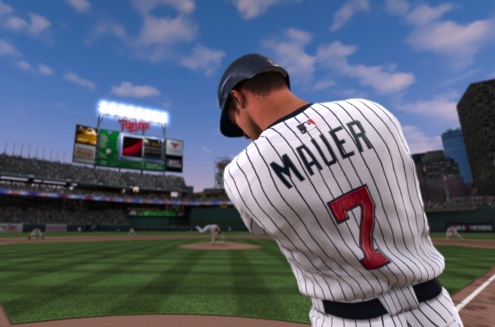
Ray Carsillo: The first thing most people notice with a game is the game cover. There’s always a lot of hype surrounding the cover athletes for sports games, but The Show broke the tradition of having a different cover athlete every year with this year’s return of Joe Mauer after gracing last year’s cover. Joe is clearly an elite player in the game, but what made you want to bring him back again?

Jason Villa: Well, to your point, Joe Mauer continues to be a driving force in Major League Baseball as the premier all around player in the game. Year in and year out, MLB The Show delivers the best baseball gameplay experience available, truly in a class of its own, so I could not think of a more worthy ambassador to once again represent the highest rated, best selling baseball video game franchise of all time.

RC: The first of the new features I want to delve into is the new Co-op mode. Baseball is probably the most individualistic of the team sports as the game revolves around the very base match-up of the pitcher vs. the hitter. How was it that you were able to integrate a co-op mode and explain how it works?

JV: Yes, I agree that the one-on-one element between the pitcher and the batter is probably the most important element of the game. If you have a Roy Halladay on the mound, sometimes you wonder if the fielders are even going to bother bringing their gloves with them out to their positions. But when you have a sport like baseball where only one team averaged a winning margin of over 1 run a game (Yankees +1.02), there is something to be said for the little things that come from good teamwork. A well timed hit and run, sacrificing a runner into scoring position, or hitting your cutoff man and him making a strong relay throw could really make a difference in a game. While our regular exhibition, season, and Road to the Show modes focus on what the individual can do, Co-op stresses the importance of playing more of a team game.

Co-op is set up to allow you to play 2 players vs 2 players, 2 players vs 1 player, or 2 players vs the CPU. When you first select to play Co-op, you will be given a variety of player control options. Defensively, you choose who will handle the outfielders, the infielders, the catcher, and the pitcher. With the pitcher, you have an option to alternate, meaning you will switch control each inning between the two teammates. Offensively, you also have the choice to give all the hitting to one teammate or alternate each at-bat. When you alternate batters, whichever teammate is not at-bat, will be responsible for controlling the base runners if there are any. At the beginning of each at-bat, a Player Control OSD will appear from the scoreboard in case you need a quick reminder of who is responsible for what. Although, we love to give everyone the ability to customize the control to their liking, we have defaulted the options to a way that best promotes the focus of playing as teammates. Without defaults, both teammates will be responsible for different parts of a relay throw from the outfield. Both teammates will be responsible for different parts of a sacrifice or a hit and run. Co-op adds a new level of realism that exists in baseball by making more than one person responsible for making smart decisions on a single play. It also adds a new level of trash talk as well when your partner fails to deliver. Hopefully it doesn’t ruin friendships.

RC: Baseball video games do a great job of eliminating a lot of the inherit downtime that occurs in the game, but are you afraid of co-op players getting bored incase there are three ground ball outs in an inning and they’re playing the outfield or they choose to play as the 4, 5, 7, and 8 hitters in a line-up and their friend starts the game off by going down 1-2-3?

JV: When we initially started designing this mode, we considered this question a lot. This is how the idea of alternating came about. Instead of allowing the user to choose specific batters to control in the lineup, choosing to alternate means if you are not batting, then you are on-deck. You will never have to wait more than one batter to participate. And even more importantly, if you are on-deck, you are controlling the base runners so you may still be busy. As for fielding, we divided up the responsibilities as much as we could while still trying to keep the user from feeling uninvolved. But you are right, there is only so much we can do. If the pitcher dominates, the fielders aren’t going to see much action. But that is baseball. Fortunately, that option to alternate the pitching helps with this as well.

One cool element that you might not be aware of is that we have given the users the ability to “call off” a teammate. Let’s say that there is a shallow fly ball to left field and the SS is chasing it down. If your teammate in LF is within range and has a play on the ball, he can take control of the fielding responsibility with a simple button press. We set it up to work how it works in real baseball. Infielders can call of the pitcher. Outfielders can call off the infielders, but not the other way around. Just another smaller detail that makes the game feel more realistic. It is going to be pretty tough to feel bored unless you change the settings to exclude one teammate from doing things. But with the default settings, everyone is going to have plenty of work to do.

RC: Moving away from the co-op, if you’re like me, you don’t want to be weighed down by your friends and will probably be playing more games versus people or the computer by yourself. For some of us Show veterans though, the control scheme this go around has changed and now features the Pure Analog Control System and is supposed to provide the most accurate experience to date. Tell us how the Pure Analog Control System works and just what aspects of the game we can see this pinpoint accuracy in.
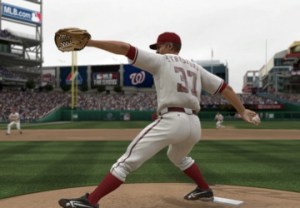
JV: Pure Analog Pitching allows users to control pitch height, location, and velocity with the right analog stick. Pulling down on the right analog stick begins the pitcher’s delivery as a ball icon moves gradually downward towards a yellow line that represents your ideal pitch height. Time it such that you push the stick upward at precisely the time the ball icon hits this yellow line. Inside-outside pitch location is a result of the direction you push the right analog stick up. How hard you flick the right stick up will determine how much effort the pitcher will put into the throw. Your timing, accuracy, and speed are all taken into account when delivering a pitch with Pure Analog Pitching.

To use the new Pure Analog Hitting system, simply pull back on the R-stick to stride and push forward in the direction of the incoming pitch to drive through the ball. Be sure to time your stride just as the pitcher releases the ball, a poorly timed stride will result in a less powerful swing. Don’t try to hold you’re stride back just waiting for the pitch – you’ll loose power! Time it like a real swing and begin your stride as the pitcher’s getting ready to deliver! Getting that solid hit has never been so rewarding!

Pure Analog Throwing offers a new way to experience fielding in The Show, as you can now control both the accuracy and power behind your throws. Push the analog stick towards any base to release your throw, or hold L1 while pushing the stick in any direction to throw the ball from the outfield to the cutoff man. Holding the stick longer will put a little extra mustard on the ball, but make sure to keep your throws accurate by pushing the analog stick in a straight line. Keep in mind that you can adjust Analog Throwing difficulty to make your experience more enjoyable. With a little practice, you’ll be filling up your trophy cabinet with gold gloves in no time!

RC: Speaking of the controls, MLB The Show 11 is compatible with the PS Move controller, but only in the HR Derby mode. Why limit the Move to only the Derby mode?

JV: The PS Move is going to be a big part of our plans going forward, but it will take some time to make sure it works the best it can within all areas of gameplay (batting, pitching, fielding, base running) and at the high level that we expect from our features. For this year, however, we were only able to include Move functionally with Home Run Derby.

RC: A returning feature and a staple of the series, Road to the Show, comes with a complete facelift, which is saying something considering how it is already one of the most in-depth experience simulators out there. What new features did you add this year to Road to the Show while also maintaining a balance with the authenticity and detail that the mode is known for?

JV: We started out this year’s design by looking at what we had already done with the mode, and what areas we felt maybe were lacking or needed the full facelift. After analyzing the mode, we determined one area that needed a tweak was the create player process. We’ve heard lots of community suggestions regarding creating more realistic player abilities right out of the gate. This was the overall goal we had when creating the new interactive create player sliders. We evaluated the types of skills player posses, and determined that most skills come at a price to another. This was the approach we took for the new sliders. So if you want to create a power hitter, your sacrifice comes from your initial contact abilities. Or for pitchers, establishing yourself as a control pitcher comes as a sacrifice to your initial movement. While we created this new system, we also kept in some of the old elements that limit your abilities based on position as well. So if you want to create a fast catcher, he’ll be exactly that, not necessarily a fast player. Of course all areas are still trainable so even though you picked to be a power hitter, if you work on your contact over time, you can be a double threat.

From there we examined the advancement goal process and found that improvements were needed more-so than a facelift. We’ve altered our evaluation logic to now compare your stats versus the players around you. In the past, you were evaluated separately, but now you will be in full competition to the players around you. This opens up the ability to fast track to the MLB if you overachieve in an organization that may be lacking in your position, while it also means you can lose your spot if an up and coming player is playing at a higher level than you. Along with this addition, we’ve also adjusted our expectations to be more in-line with your abilities. The goals themselves are still challenging, but we’ve modified our expectations based on data from real players. Your target attribute levels are completely in-line with your real-life counterparts.

The last big change in the mode is how we award training points. We’ve completely remodeled this area by creating a new Performance Evaluator system. This system analyzes your plate appearances, or batters faced, and then grades you based on a number of factors. The system looks at how many pitches you saw (or threw), the type contact of the hit, and the play result to then award you a grade and training points. Not only does it summarize the at-bat, but we also evaluate things during that at-bat to determine areas you excel or fall short in. We evaluate your swing timing, pitch recognition ability, percentage of strikes versus balls thrown, etc… and use that data to then trigger trainings. The training modes themselves have been overhauled as well to now focus on specific areas to improve on. As mentioned before, we trigger specific training types based on areas of the game you need to improve on. These trainings include contact, plate discipline, pitch location, specific pitch type trainings, a few others. The trainings also have levels of difficulty where you will start at level 1 and progress through the levels as you achieve the target success ratings.

A few smaller changes that add to the facelift of the mode include: New minor league playing time logic that focuses on developing your player. This means as a position player, the majority of your appearances will be starting and playing the whole game. Manager interactions have been updated to refine the logic for what is available and when, as well as the types of results you get should you initiate an interaction. A new playing time screen appears before each appearance to give you the ability to decide if you want to play that game or not. This screen lets you know if you are starting that day or not, and if not, it tells you the situation you are being brought into giving you the choice to play or sim that game. Finally, we removed the goals you would be given during the course of the game as simply these were just too obvious. You will no longer be told to take a strike, or drive the runner in. We felt these situations were just too obvious and disrupted the flow of the game.

RC: Another returning feature that will probably get a lot of diehard fans’ revved up is the return of the online leagues and this has also gotten an upgrade. Talk about what all those pseudo-commissioners will be able to tinker with in the revamped Online League.

JV: This year, we’ve finally been able to add and tighten up the loose ends we’ve been wanting to for years. Just to run down a quick list… New Create League process (with more customization), Leagues and Divisions (both able to be named), custom division amounts and sizes, ability to use a custom roster in leagues, CPU controlled teams (to fill up and play vacant spots), user management (to move users from divisions to others, set teams, etc..), Role Management (to give other users commish rights), ability to Reset and Simulate games, ability to change sliders and league settings throughout the league, and an all New Schedule Generator.

RC: Continuing with the online features, there is also a new mode called Challenge of the Week, that just in the title sounds a lot like the Left 4 Dead 2 Mutations. What exactly does the Challenge of the Week entail and give us a couple of examples of what players will have to do?

JV: Challenge of the week is designed to be a pick up and play, fast paced arcade batting skills challenge. The entire mode centers around a scoring system that rewards quality hits and increases in difficulty with each consecutive success. There is a Bonus system where users can gain momentum and/or point boosts for achieving them within a given time frame, the Bonuses change for each new challenge and are a key piece for success in Challenge of the Week. Each weekly challenge will be based on real events in the previous week of Baseball. For example, let’s say in the 2nd week of the season, Strasburg throws his first perfect game and he does so facing the Mets. In another game of the Nats/Mets series, Wright hits for the cycle. The next week you might see Strasburg face Wright with Bonuses for “cycle like” performance.

RC: What are some of the rewards players can get by completing these challenges? Is there a bank system that keeps tracks of how many challenges you complete? Are certain challenges worth more than others?

JV: The Challenge of the Week “weekly” prizes range from autographed balls/bats/jerseys to trips to a ML game of your choice. We also have a Monthly and two Grand Prize winners. Monthly winners are the combined total of a 4 week period, and the two Grand Prize winners are the totals of the 12 weekly scores. Our goal is to have each challenge VERY close in points each and every week.

RC: Now, something The Show has always been head and shoulders above the competition with has been the A.I. that it features, from Umpire Personalities, to proper situation intelligence from the CPU. This has also led to The Show making some great predictions for the season ahead. So, with spring training right around the corner, does The Show say the Philadelphia Phillies will be as good this year as they seem to be on paper and if not, then who is going to win it all?

JV: In all of my simulations, there are few surprises… Surprise 1: The Dodgers win the west / wild card around 70% of the time. Surprise 2: The White Sox are in the playoffs 80% of the time. Surprise 3: Ok, maybe this isn’t a surprise, but the Red Sox are GOOD. Philly beatin’ good!

RC: As a Yankees fan, that wasn’t what I was hoping to hear. Thanks to Jason Villa for taking the time to answer my questions. MLB 11 The Show will be available as a Sony exclusive for baseball fans everywhere on March 8, 2011.

Originally Published: February 26, 2011, on my StrongProtector account on GiantBomb.com

They may not be able to hear you scream in space, but I need to start this review by apologizing to my neighbors, because here on Earth I think most of my apartment complex heard my piercing wails of fright while playing Dead Space 2. And although not the longest single player campaign, my gameplay experience was spread across several more days than usual for me because I could only make any significant progress while the sun was up.

Now that I’ve thoroughly embarrassed myself and admitted how much of a wuss I am, let’s look at the next chapter of a series that, if it hasn’t already knocked Resident Evil off its “king of survival horror” perch, it surely has with this masterpiece.

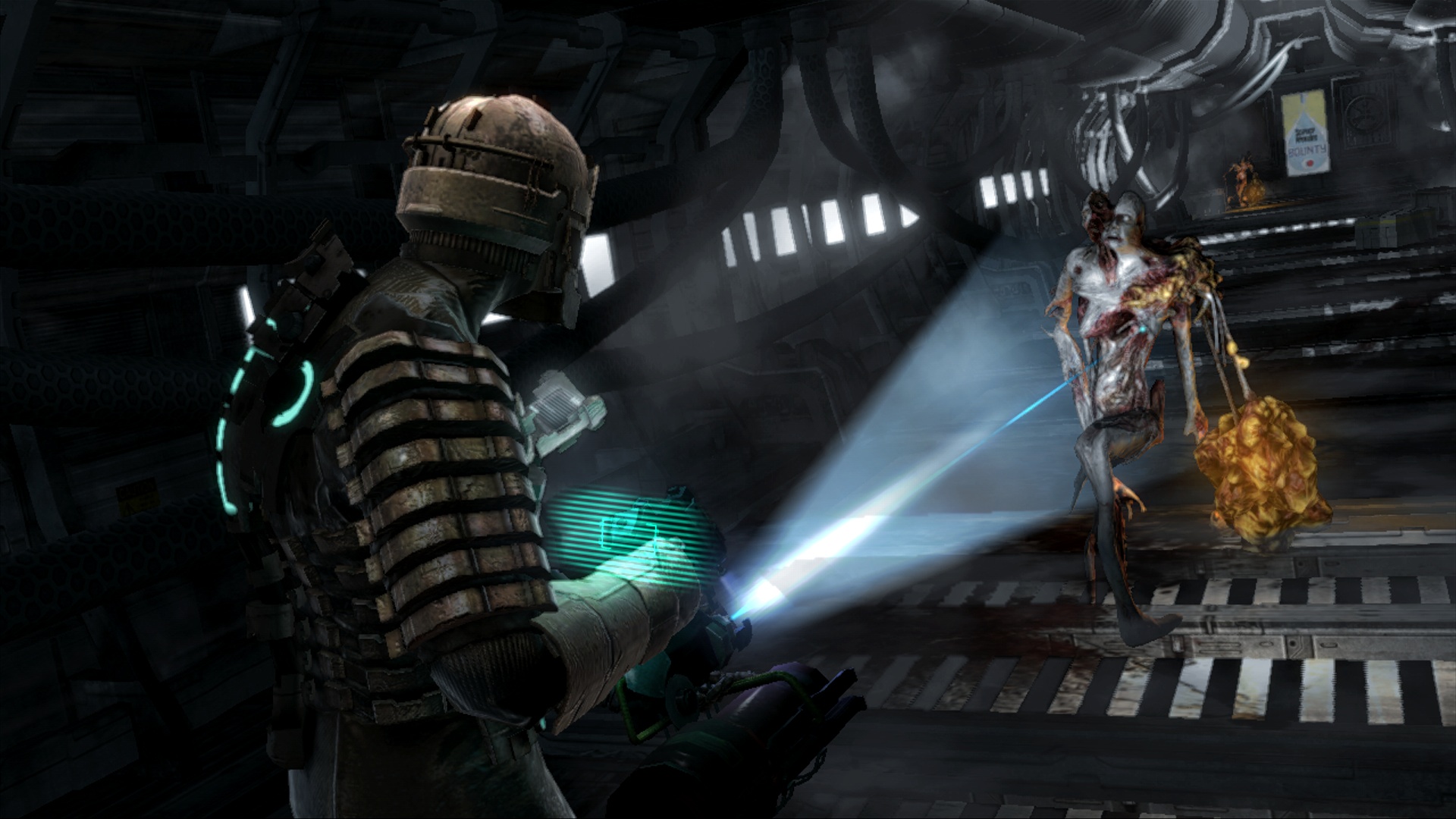
Dead Space 2, developed by Visceral Games and published by EA, takes place three years after the end of the first game and Issac Clarke, our unlikely engineer protagonist from Dead Space 1, finds himself aboard the Sprawl, a space metropolis built into a large shard of what’s left of Titan, one of the moons of Saturn. Of course, we as the player know where Issac is, but he’s as confused as can be because when the game opens up he is strapped down to a gurney and in a straightjacket. Only amidst the chaos caused by some very familiar looking creatures can our hero free himself and start to make sense of the situation he currently finds himself in. A situation in which Issac will find that he must not only confront the horrors of a new Necromorph threat, but also the deep scars left on his psyche from the Ishimura incident of the first game.

From the opening cut scene and sequence, which may be the most intense first 15 minutes ever in a game, to Issac muttering swears under his breath as he curb stomps fallen Necromorphs, Dead Space 2 is one of the most engrossing gaming experiences you can find. This game simply reeks of atmosphere and the painstaking detail that went into each level and experience you come across is evidence of that. From the distorted shadows thrown against the cold steel walls by flickering lights that make your heart feel like its going to jump out of your chest to the sound of dragging claws and inhuman screams in the ventilation ducts that make your skin crawl, there wasn’t a moment in this game that didn’t have my pulse pounding. And to complete the full immersion into the game, Dead Space 2 has some chilling mood setting music and great voice acting from everyone involved, whether Issac himself or the dozens of audio logs you find scattered across the Sprawl that help fill in the details of what has transpired over the past three years.

These details are really where the horror comes from. Man’s most base fears come from what he can’t understand and the unknown, and you become so immersed in Dead Space 2 due to the tremendous detail in this game that, even though it’s done in the third-person perspective, you feel like you’re in Issac’s shoes as you round every corner and explore each nook and cranny of the now desolate and abandoned metropolis you find yourself navigating.

But atmosphere and looks alone do not a great game make. No, what puts Dead Space 2 into an elite class is that it combines that great storytelling and atmosphere with creative gameplay, tight controls, awesome weapons, and some unreal monsters. Not only do a lot of the standard Necromorphs from Dead Space 1 return like your tri-tentacled babies and razorfist regulars, but since this is a sequel and you have to follow the unwritten rule of going bigger and better and now there are monstrous brutes, pre-pubescent packs of marauders, and my personal new favorite, the Stalkers. The Stalkers look and act like the raptors from Jurassic Park as they always attack in packs and use bait and run tactics. The only other thing you would need when they appear is Bob Peck whispering “clever girl” whenever they decide to pounce.

New enemies though mean new weapons to help dispatch them as well. You have some old favorites returning like the Line Gun, the Flamethrower, and the Ripper that simply mow down all who come in their path, but now you also have new goodies like the Javelin Gun. The Javelin Gun is exactly what it sounds like, it’s a gun that shoots spears and is a testament to the physics system of Dead Space 2 as you can send Necromorphs flying across rooms and impale them against the wall like frogs from your high school biology class.

A big upgrade between Dead Space 1 and 2 is the larger variety of experiences you encounter, especially in terms of the zero gravity situations. Whereas in the first Dead Space, there were a lot of zero gravity rooms that you would traverse by aiming and leaping from surface to surface, now your suit has thrusters attached to it which gives you the feel of actual 360 degree zero gravity combat as you move around aiming at Necromorphs who just love launching themselves at you like undead missiles. There are also new environmental hazard situations to maneuver through as well as full level segments in deep space as you work your way through various areas in and around the Sprawl.

The biggest addition to this chapter of Dead Space though is of course the inclusion of a multiplayer that seems to be heavily inspired by the Left 4 Dead series. Lacking a traditional versus or deathmatch mode, the multiplayer consists of two teams of four players each, one team comprised of a variety of Necromorphs and the other a team of humans. The humans are tasked with completing a series of objectives as quickly as possible while the Necromorphs must work together and take advantage of their ability to utilize their surroundings like crawling in ventilation ducts to prevent the humans from finishing their objectives. As you continue to play, there is a leveling up system that comes into effect that will allow you to purchase new weapons and their secondary fire abilities. Unfortunately, the lack of mode variety and small teams means that this multiplayer is nowhere near as dynamic as it needs to be and feels as if it was a late add-on to an absolutely stellar single player campaign.

Of course the more things change, the more they stay the same. Dead Space 2 has the same controls as the first game and is one of the smoothest third-person shooting experiences you’ll find. The static camera glued to Issac’s hip might take some getting used to, but is necessary due to the return of your HUD being displayed on your back showing your stasis, health, and oxygen levels as you travel around the Sprawl and face off against the Necromorph threat. You can still carry four weapons at a time and can upgrade only the items you’re carrying at benches scattered about the Sprawl as you put Issac’s engineering skills to the test. The game is also very linear and this may turn off some fans, but considering how much this game will make you jump, it is probably better for those out there with heart conditions that there aren’t more dark corners to explore. There are also five difficulty modes, with the Hardcore mode only being unlocked after beating the game the first time, ensuring that you completionists and achievement whores out there will need at least two playthroughs to get everything in this game.

When all is said and done, Dead Space 2 is everything you want in a sequel. Bigger and better weapons and enemies, it brilliantly forwards a compelling story arc started in the first game, and pulls you into the experience to the point that you feel as if you’re in the main character’s shoes. The only person I would not recommend this game to is someone who hasn’t played the first game due to it being referenced on many occasions and so to them I say go buy both Dead Space 1 and 2 right now.

Ratings are based on a scale of 1 to 10 with 10 being the best.

Graphics: 9.5: A few minor glitches here and there with dead Necromorph bodies is really the only problem I could see with the look of the game, otherwise this is simply brilliant looking.

Audio: 10.0: What makes Dead Space 2 so creepy is the fact that you may not see enemies for long stretches of levels. But you can always hear them. Everywhere. And this combined with some great voice acting by all involved makes the audio simply top notch.

Gameplay: 8.5: Some would say the gameplay gets a little repetitive by the time you work your way through the game’s 15 chapters, but there were always enough thrills to keep my mind off that. My only real complaint about the gameplay is that I wish it was longer since you’ll probably blow through your first playthrough of the game in a dozen or so hours and with so many new and great experiences added to this sequel, it was sad to see it end so quickly.

Plot/Plot Development: 10.0: A perfect combination of forwarding the story from the first game while also spinning a uniquely entertaining and thrilling tale of it’s own, Dead Space 2 is the epitome of what you’re looking for in a sequel’s plot.

Replay Value: 7.0: The new multiplayer system was really disappointing with only eight players allowed at once and only one mode of play. It seemed cobbled together at the last minute and although does work on many levels, isn’t entertaining enough to bring you back for more when other AAA titles hit the market. At least for all the fellow achievement and trophy whores out there, the game will require at least two playthroughs for you to get everything if you’re insane enough to take a go at Hardcore mode.

Overall (not an average): 9.0: You want every sequel to be bigger and better than the previous and on every level Dead Space 2 delivers that. The multiplayer seemed unnecessary after seeing how it was implemented and I’d have rather of had two or three more story chapters. Despite this, Dead Space 2 is a must have for any third-person shooter fans out there, although I recommend playing the first game in order to truly appreciate just how great this game is.


Originally Published: February 24, 2010, on youtube.com/RCars4885

Many of you are aware that I just moved back home to New Jersey and most people take that time to look at things as they pack them up. Some look at picture albums, I look at old tapes. Back in August I interviewed Peter Molyneux in anticipation of Fable 3 and for length purposes, had to cut out a segment where we talked about Milo and Kinect. Now, we’ve taken what hit the cutting room floor and decided to share it with you. Edited by Taylor Tallscott.

Originally Published: February 2, 2011, on youtube.com/CGRUndertow

As my final review for CGR, I looked at House of the Dead: Overkill for the Nintendo Wii from SEGA.

Originally Published: February 1, 2011, on youtube.com/CGRUndertow

As a part of CGR Undertow, I reviewed Marvel Ultimate Alliance 2 for the Xbox 360.