Tag Archive: xbox 360


Originally Published: 9/22/11 on EGMNOW.com

Stay on target…

The Ace Combat franchise has seen a lot of change in recent years and Assault Horizon looks to continue this necessary evolution of the series in order to keep it relevant in a market flooded by various kinds of wartime shooters. Where Joint Assault paved the way for the series to find roots in the real world, Assault Horizon looks to find a way to let the series flourish there by improving the A.I. and adding new mechanics that could increase the game’s accessibility to a whole new audience. Of course, being the first game in the series to be multi-platform doesn’t hurt either.

I had a chance to jump into the first few campaign missions for Assault Horizon and anyone who has played this franchise before is definitely in for a shock to their system. You’re immediately thrown into a fighter jet cockpit over a major metropolitan area in a sink or swim kind of tutorial where you’re very likely to get shot down if you don’t pick up on the controls quickly enough. The major purpose of this though is to introduce everyone to the new “Dogfight Mode”, an attempt at preventing the most effective way of shooting down enemies being a game of chicken like in some previous Ace Combat games, which had led to repetitive and dull game play at times. What Dogfight Mode does is when you get to optimal engaging distance, it allows you to lock in behind an enemy and assists the player in sticking to an enemy’s rear to try and get that perfect lock-on for a homing missile or to shred them apart with machine guns. Mind you, to prevent the game from being too easy, this also leaves you open for another enemy to settle in behind you for a missile lock as well if you fly too predictably.

With this new mode comes a drastic increase to enemy A.I. as well to prevent the ‘missile spamming’ also seen in previous games in the franchise as some of your tougher opponents will easily shake off your missile locks. This will force you into either surprising them with some special maneuvers like barrel rolls or using the Dogfight Mode and riding their tail. Of course, trying to get that close to these enemy aces will put you at risk of falling into their sights though and having them shoot you down before you can get into Dogfight Mode and that adds a new nuance of strategy.

Even with all these drastic improvements to air combat that should allow players of all skill levels to pick up and play this game though, the game play feels like it could get repetitive if you stayed in the cockpit of an F-18 for the whole game. To fight this, Assault Horizon finds a way to mix in a compelling story woven through some solid cinema scenes while also giving you tremendous mission variety. After only a handful of missions we were thrown into a Black Hawk helicopter as a door gunner, moved into the pilot seat of another copter, and cleared the path for some guys on the ground via an AC-130’s cannons. And of course a couple of traditional missions in fighter jets. With all of these different missions being set in real world locations in a possible near future. For the first time being able to fly helicopters and various other aircraft may provide just the twist and variety this series has needed for a long time to rejuvenate it and really grab the attention of arcade flight fans. I know I’m excited to grab my flight helmet and see just how far Ace Combat: Assault Horizon can go.

PARTING SHOTS: We were able to only get a few missions in and yet we had a larger variety of experiences than in probably all the previous Ace Combat games combined. The big question will be can the game keep up that variety over the course of the full campaign before the experiences we saw become repetitive in their own rights and can the story hold it all together.

Are you folks excited for Ace Combat: Assault Horizon? Are you fans of the new direction this game is taking or already missing the old-school mechanics? Is this something that can reach new heights or will it be crushed by the mid-October competition it will be up against? Let us know with comments below!

Will you hoist Lord Stanley’s Cup?

In many northern latitudes, folks are anticipating that first cool breeze in the fall—the one that signifies that the seasons have finally changed, and with it, the sports landscape. That feeling that tells you that, finally, it’s time for hockey again. But in case you can’t wait another month or so, EA Sports is looking to give you your hockey fix a little early with NHL 12.

As always, this season sees plenty of changes, but what’s interesting is that the little tweaks are probably just as big as the overall additions. Not to say that those should be taken lightly, either, though. New modes like NHL Legends—where you can draft a legendary player like Wayne Gretzky or Ray Bourque to your real-life favorite team and play as them like you would in Be a Pro—is a nice addition if you’ve got a childhood hero you want to take back out on the ice. Of course, it might be a little shocking at first to see someone like Jeremy Roenick on the New York Rangers or Chris Chelios on the Tampa Bay Lightning, but this is your chance to see what might’ve happened if your favorite player had donned your favorite team’s sweater.

And speaking of Be a Pro, that’s seen some additions as well. The inclusion of the Canadian Hockey League allows you to play in the CHL for four seasons if you wish, which adds a bit of an RPG feel as your coach assigns you tasks each game in order to progress through your respective organization. Of course, if you don’t want to put in the time and effort to work your way up the minor-league ranks, Be a Pro features a new wrinkle where you can select your favorite current player and play with them already on your big-league club. They still get tasks from the coach, though, and because they’re already in the pros, more’s expected from them—so doing poorly could get them sent to the minors!

Beyond these new modes, though, I didn’t know a hockey game could feel so good until I got my hands on NHL 12. The puck physics have become so realistic that you’d think you were watching an actual game as shots knuckle, deflect off players, or ricochet around the boards. And with the improved AI of all computer-controlled players, you’ll rarely see someone out of position—everyone plays their role, just like they do in the real game. On top of this, NHL 12 offers the ability to hit and interfere with goalies, giving you more influence in the crease than ever before. And you know what that means: goalie fights! Throw in breaking glass, checking guys into the bench, knocking off helmets after bone-crunching checks, or shrugging off checks from smaller players, retired numbers, and even the ability to stage the Winter Classic, and you can’t help but feel satisfied with most every aspect of NHL 12.

Aside from these tweaks to improve the offline modes, another fan favorite that’s been overhauled is the online Hockey Ultimate League. Multiple lineups, stars of the week based on live player stats, a versus mode featuring you and a buddy’s Hockey League teams, and much more have been added to make this month-by-month feature even more addictive for those wannabe GMs out there.

Really, my only complaints with NHL 12 arose in Season or Be a GM when the game didn’t recognize that the Rangers’ first two regular-season games were in Europe—and that the stats were so skewed that the Rangers’ offense was a 100. I love the Rangers, but even through the Broadway Blue–tinted glasses of a fan, I don’t see how adding Brad Richards and getting some guys healthy propels the team so far past last year’s squad.

When all’s said and done, though, EA Sports has gone above and beyond in this year’s effort to give us the best videogame hockey experience yet, and NHL 12 should be more than enough to keep hockey fans satiated all year round.

Summary: NHL 12 is the most complete hockey sim to date, and the effort shows from the smallest puck bounces to brand-new game modes.

  • The Good: Improved puck physics and AI
  • The Bad: Horribly inaccurate player ratings
  • The Ugly: NHL Legends in uniforms they don’t belong in

SCORE: 9.0

Originally Published: August 30, 2011, on EGMNOW.COM

I had a chance to sit down with Infinity Ward’s Creative Strategist Robert Bowling and talk a bit about the multiplayer strike packages for Call of Duty: Modern Warfare 3. To check out my full interview with Robert, head to EGMNOW.com or check out EGMi on the iPad and look for Issue 251.5. And for new trailers and more videos from me and the rest of the EGM crew, be sure to check out EGMNOW on Youtube! Multiplayer trailer footage provided by Activision.

Originally Published: September 6, 2011, on EGMMAG.com

The Good: The first real “hardcore” game on the Kinect
The Bad: The lack of ever feeling in real danger, fatigue from playing too long
The Ugly: The macabre clockwork zombies you’ll face by the dozens

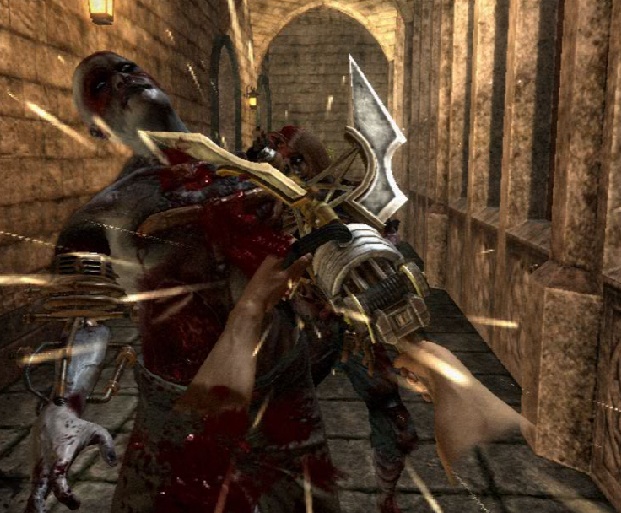
Rise of Nightmares is being touted as the first “hardcore” game for the Kinect as it focuses more on a single player narrative experience instead of the party or fitness games we’ve seen to date. You play as Josh, an American tourist on vacation in Romania, trying to put his marriage back together with his wife. While taking a train through the countryside, you and your wife get into another argument and she storms off towards the dining car. After some time, you pursue her, but when you finally catch up, the unimaginable is waiting for him. A Frankenstein like-monster has your wife in his arms and as you begin to give chase, the train derails and is flung into a river. When you come to, you and the other survivors come across a mansion in the woods and your instincts say that whatever that thing was, it took your wife here.

Rise of Nightmares may break ground as the first “hardcore” Kinect game, but I feel it is more limited by the technology than empowered by it. If you really want to set the mood and try to give yourself a scare by turning off the lights while playing, you can’t because then the Kinect can’t see you and you can’t progress so whether you like it or not, all the lights in the room have to stay on.

Then comes the combat. There are no guns in the game so you have to get up close and personal with nearly every foe you face. And while it does feel satisfying to punch a zombie out with brass knuckles, bash what’s left of their brains in with a lead pipe, or dismember them with a bloody chainsaw, because of all the movement that is involved with setting yourself up for the kill, the game’s A.I. is beyond simple to prevent frustration with the Kinect controls. In turn, this nullifies the fear factor because you never feel like your character is in any real danger most of the time when the zombies shuffle onto the screen. Many zombies will simply shamble right into the path of whatever weapon you are wielding and the larger challenge comes in keeping your real-life stamina up than in mowing down the constant stream of proverbial cannon fodder.

And this leads us to the fatigue factor. Although the movement and combat controls are simplified and picked up rather well for the most part once you get used to them, like shifting your shoulders to turn around, sticking one leg out to walk, and various quick time inspired events like ducking or climbing, you may become too tired to devote a long amount of time to the game per play session. I played for three hours the first time I put the disc in and didn’t realize till afterward that since movement is only controlled by one leg, that what became my pivot leg’s knee had locked up from putting my weight on it constantly for much of the game as I explored the castle grounds.

Despite what are really just minor annoyances though, the game is actually a solid experience overall. You could write off the “shambling” of the zombies to their uniquely written macabre clockwork origins, even if they aren’t that threatening, and the plot is engaging enough, with just enough cheesy B-horror movie voice acting, to make you want to push on with the story and find out the mysteries lurking in the castle. There are also some very satisfying moments sprinkled in like digging through a fresh cadaver or fishing through a blood filled toilet for items, or luring zombies into some of the mansion’s traps like giant rotating blades or electrified water. It’s just at the end of the day, although different from any other gaming experience I’ve ever had because of the Kinect controls, I can’t help but feel that I would have preferred having a traditional controller in my hand during a lot of it. Still, if you’re looking to get some more use out of your Kinect, this is a fine example of the potential for this device if developers turn themselves away from the cheesy party and exercise games and really focus on giving you a gaming experience.

Score: 7.0

Originally Published: September 6, 2011, on EGMMAG.com

THE BUZZ: Turn 10, the developer for Microsoft’s Forza franchise, has teamed up with 343 Industries to provide a unique experience in Forza 4. A special Halo 4 Warthog Easter egg will be featured in Forza 4’s brand new Autovista mode, which allows gamers to get a detailed look at some of the game’s super cars, and will provide fans of both franchises a chance to get up close and personal with the iconic all-terrain vehicle like never before.

WHAT WE KNOW: Turn 10 head Dan Greenawalt made sure to point out that this was an Easter egg meaning only the most hardcore of Forza 4 drivers would likely have a shot at unlocking the Warthog in the Kinect compatible Autovista mode. And considering you can’t drive the vehicle in the game (it would get smoked off the line as its top speed is only 78 MPH, but I wonder if a Ferrari could out run the bullets from its mini-turret), only the mightiest of mechanics might even be interested in going for it. An extra special addition to the Warthog Easter egg will be Cortana providing never before heard commentary as you explore the inner and outer workings of the vehicle.

WHAT IT MEANS: It’s not unheard of for a company to cross-promote with exclusive franchises, but I think it is actually a plus that the Warthog is not a drivable vehicle because when you cross promote too much, you might turn off the audience that is only interested in the primary franchise, in this case Forza 4, to begin with.

Originally Published: August 30, 2011, on EGMNOW.COM

THE BUZZ: Customer Ryan Graves, citing improper charges to many of Microsoft’s Xbox Live Gold Member accounts, has filed a class-action lawsuit against the company for “an award of appropriate equitable relief.”

WHAT WE KNOW: Graves claims that he let his Xbox Live Gold Membership expire in January; in March, he renewed his subscription with a different debit card. When he received his bank statements the following month, he found that Microsoft had double-charged him for Xbox Live. When he called Microsoft to have one of the charges removed, believing it to be a mistake, he was told that both charges were legitimate. One was for his new subscription, while the other was for the original he’d let expire—and Microsoft refused him a refund. Graves’ class-action suit demands retribution for himself and others who’ve been double-charged, and it further states that Microsoft is in breach of contract with its users and in violation of the Electronic Funds Transfer Act.

EGM’S TAKE: There’s no way to know exactly how many customers have been affected beyond Graves—or who may be joining him in this lawsuit. But if Microsoft’s forced to refund money to these individuals at $60 a person, with over 30 million Xbox Live users as of January 2011, it would only take 0.1% of the current Xbox Live audience to cost Microsoft millions—never mind the legal fees.

Originally Published: August 30, 2011, on EGMNOW.COM

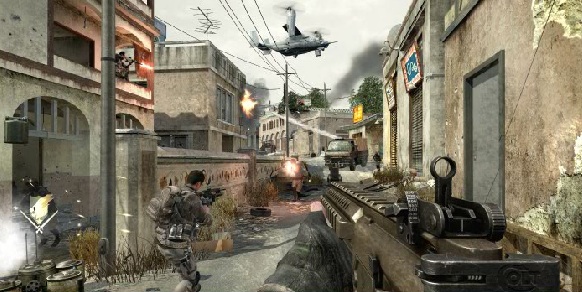
Call of Duty: Modern Warfare 3 creative strategist Robert Bowling faces one of his biggest challenges—revamping the series’ multiplayer offerings.
RC: One of the key aspects that’s made Call of Duty a smash hit is the multiplayer aspect, and you guys have pulled out all the stops in order to expand on this, including a new killstreak system where the player can choose either an Assault, Support, or Specialist path of upgrades. Tell us about the decision to incorporate specialized killstreaks to fit different players’ styles, and how you hope this may level the battlefield for the more objective-based player.

Robert Bowling: Well, the inspiration for all the different strike packages was looking directly at the feedback we’re getting from the 30 million people playing our game. Looking at the player trends that have been happening as we’ve moved from Call of Duty 4, when we first introduced killstreaks to how the dynamic then changed in Modern Warfare 2—and then how we want that dynamic to change even further in Modern Warfare 3. A lot of it’s going back to the more gun-focused gameplay of Call of Duty 4, but with what we’ve learned from the killstreak system is that, inherently, it’s all focused on getting kills. We’ve got millions and millions of players who all play so differently, but they’re not being rewarded, incentive-wise, for being good at the game in other ways—and that was the big driving factor for introducing custom strike packages, because we wanted to open up how you’re rewarded with killstreak rewards. We want to let you be in control in the type of killstreak rewards you have and give you the tools to be a better objective player and a better team player, rather than always trying to be the best team deathmatch player.

And that carries over through more than just the killstreaks. Capturing objectives, capturing a flag, capturing domination points, and blowing up a bomb site should all add to your rewards. So, regardless of what strike package you have, that now gets you one tick closer to unlocking your next killstreak reward. In addition to that, you can now focus your entire killstreak rewards on things that have nothing to do with getting you more kills—and that was the whole mentality behind giving you tools that allow you focus on things other than killing.

RC: Another new multiplayer aspect is the Spec Ops: Survival Mode. Tell us about what you’ve done with your take on what boils down to Horde mode.

RB: Well, Spec Ops: Survival Mode is really taking the traditional wave-based gameplay and putting the Modern Warfare twist on it. So, we’re bringing in all the stuff that people love from multiplayer—matchmaking, progressive ranking, killstreaks, weapon unlocks, weapon attachment systems, gear and equipment from multiplayer—and bringing all that and putting it into a much different arena in a co-op environment against AI enemies. And the benefit of the infinite-wave thing is that we can constantly be throwing different experiences at the player—so, you’re seeing enemies you’re not seeing anywhere else. You’re seeing kamikaze dogs, kamikaze infantry, chemical agents, juggernauts, juggernauts with riot shields, enemy air support—it’s such a different experience, and what I love about it is that it blurs the lines between what’s a competitive multiplayer experience and co-op multiplayer experience, and it makes experiences that were typically only reserved for that super-hardcore-competitive multiplayer guy accessible to the single-player guy. Now you have the opportunity to call in some awesome chopper gun and to be raining death down from above, or maybe you’re just not a competitive multiplayer guy, so you never got to experience that before, but now you can have that in a much different environment.

RC: Moving to the franchise as a whole, we all know that Sledgehammer and Infinity Ward are working jointly on this title. What difficulties have arisen, if any, from having two different development studios working on the same title?

RB: Early on, it’s all about logistics. So, the biggest challenge was, logistically, how do we have two teams work on such a massive experience? And so we sat down and we made the decision to be a very flat organization—to not divide the game and be like, “OK, we’ll take this, and you do that, and you just do your thing, and we’ll do ours.”. That would’ve never worked. So, what we did was focus on playing off each other’s strengths and weaknesses—and everyone has input on everything in the game. So, we’re really working as one giant team rather than dividing things up among each other. So, we’d be more like, “Your guy is really great at this; he should work with our guy on this aspect” on the same level and build up from that organically. From there, logistically, it was about setting up video-conferencing systems, setting up ways to communicate on the fly, as we would with the guy two offices down from me. And then, from a creative standpoint, sitting down and having open, honest conversations about what direction we want to go. I mean, I knew that going into it, we’re a very passionate team with very core design philosophies, and we knew what we wanted Modern Warfare 3 to be. But it was refreshing to have Sledgehammer come in with such a fresh perspective, because they brought in things and directions that we may never have gone in and brought in experiences we’ve never had before.

RC: Speaking of other experiences, do you guys ever look at other shooters out there for inspiration? Do you ever see a perk or a weapon in another game and go, “That’d be really awesome in our game”?

RB: We take inspiration from everywhere, not only in our own genre. I love when we take inspiration from things outside of our genre. Look at what RPGs are doing, and look at what MMOs are doing—specifically in regards to things like progressive rank and XP and how you reward players. We take inspiration from all that stuff, and it’s important that when you do that, you make sure you only take the core mechanic and make it work for the kind of experience that we’re looking to deliver. But, yeah, that happens all the time, and it’s great when you can do that.

RC: Let’s talk about the single-player—at this point, we’ve all seen the E3 2011 footage of the attack on New York City. Call of Duty historically takes place all over the globe, though. What goes into deciding where the games’ missions take place, and what kind of research do you do? In terms of the plot, why New York City now under attack?

RB: Well, a lot of the story and locations are dictated organically by where the story’s going and how the conflict’s escalating. Modern Warfare 3 is a payoff to this growing momentum of conflict that’s been starting since Call of Duty 4. So, in Modern Warfare 2, the state of the world changed when the invasion of the U.S. happened. That was just the beginning. The attack on Washington, D.C. was just the beginning of the turning of that type of war. And it just organically escalated up the eastern seaboard to New York, which is another major city, because the Russian navy ‘s blockaded New York by this time in Modern Warfare 3, because this is a full-on invasion. This is a military invasion by the Russian army—this isn’t some sub-splinter of a group. This is the Russian nation attacking America, and this will be pulling in other major nations and cities into this conflict, as would actually happen if America were attacked.

So, it’s really looking at how the war’s escalating, and what I love about it this time is that we’re leaving these very traditional conflict areas, and for the first ever in Call of Duty, what we started with at the end of MW2 was pulling it into the heart of these major cities, bringing the conflict to these iconic places, rather than nondescript desert town you’d expect wars to be fought in. Now you’re fighting in Paris, London, and these major cities in Germany and Africa. So, it’s really changed organically and the research that goes into that is painstaking. Because you look at like fighting in London, and we ask ourselves, “Where would we fight in London?” We have to figure out where it would not only make sense for the story, but also where it’s going to be very impactful for the player. So, we’re looking at Canary Wharf in London, and then you go into reference and pull each reference you can and look at Google Maps and get the layouts and the buildings. And then you take that—once you get it as authentic as possible—and you put it through a gameplay filter of “OK, this is authentic, but now how do we make it fun?” Because authentic’s great, but fun is king. And that’s when you start looking at player routes and cover points and sight lines and start crafting it for gameplay.

RC: From a technology standpoint, you guys have been working with the IW engine for a while now. Was there anything you were able to add into MW3 that you weren’t able to do before but now can because of the familiarity you have with the tech?

RB: Definitely. The big focus with moving into these new environments and these much bigger cities is that the length and the scale of the levels in the single-player that you’re fighting in now are so much bigger than we’ve ever done before. So, a lot of that on the back end required a lot of tech work—and, thanks to the fact that we’ve been building steppingstones. In Modern Warfare 2, we made a good leap from Call of Duty 4 in terms of just visual graphics with our streaming technology that allowed us to make that leap. And in Modern Warfare 3, we’ve done even more work with that now that we’ve mastered that streaming technology and found other ways that we can enhance what we’re streaming in, when we’re streaming it, and how we can optimize that to get to that scale, to get to that size, and still maintain that super-smooth 60 frames per second with tight controls, which is what sells the Call of Duty franchise. That’s what sells—the tight gunplay. And, at the end of the day, that’s what matters most.

RC: It wouldn’t be a first-person military shooter without plenty of weapons. So, what kinds of new goodies can players look forward to in Modern Warfare 3?

RB: Well, we’ve added a lot of really cool weapons. A ton of weapons overall, especially in multiplayer. There’s stuff that isn’t even out yet, and that’s the great thing of being at the scale that we’re at now, where we’ll actually have weapons manufacturers contact us and be like, “Hey, we have this new prototype that’ll be out in the field in a few years, but we think it would be great for your game,” and we can go look at it, or they’ll bring it to us, nd we’ll check it out. One of my favorites is the XM25 grenade launcher, which is something only Delta operators are using in the field right now. It’s a grenade launcher that “lasers” a target—like, say, someone’s behind a concrete barrier or in a doorway or window or something, and you can laser that barrier, and it’ll calculate the distance, program it into the explosive round, and when you fire it, the round is programmed to explode one meter past that distance. So, you can actually shoot it through the window, and not until after it gets through the window will it explode and take out anyone who’s hiding behind it. That’s something Delta operators are using now, and that’s something we’re going to have in multiplayer and single-player, but we balanced them very differently between the two, because single-player’s all about having fun, while multiplayer’s about having fun but having to be balanced with everything else in the game.

RC: You mentioned Delta operators before. How closely do you work with military personnel in order to give an authentic feel to the game’s combat?

RB: We work very closely when it comes to being authentic in terms of the gear that you’re using and the weapons and they operate and how they look. But, more importantly than anything, is that fun always comes first. So we do want to be as authentic and as real as possible, but we will pull back from that realism in order to be more fun and to make it actually enjoyable to have all that stuff. So we’ll sit with them from a story standpoint and say, “Hey, here’s a scenario we’re cooking up for the story. How would you approach that?” A good example is talking to our active military guys who work with Delta and saying like, “Scenario: Russian sub in a New York harbor. You are responsible for disabling the sub. What would you do?” And then we’d say what we were thinking and our gut reaction to the situation. “Plant a charge here and blow a breach in.” And then they come in and say, “Oh, no—you wouldn’t do that. You’d be afraid of disabling this, and that would force it to come above. And then you could breach it from above without having to be underwater.” And that directly influences the gameplay—like in the E3 trailer, when the SEALs assault the sub.

RC: Call of Duty seems to come across as a “guy’s guy” kind of game. But you have a surprisingly strong female audience as well. What would you attribute that to? And do you ever see Call of Duty including female soldiers as protagonists or allowing players to chose female characters in multiplayer?

RB: I’d attribute it to the fact that we’re extremely accessible to every type of playstyle. We have females in our community that are amazing at the game in every aspect, but then you also notice trends between female gamers and male gamers. Female gamers are typically more focused on teamplay and that support role and not being self-focused or lone-wolfing. They also communicate better in terms of garnering Dom points and capturing objectives. So, I think the fact that we—especially with Modern Warfare 3—cater to different playstyles and reward them has even greater appeal now to all types of audiences.

As for female protagonists, I think anything’s possible in the future. We’ve had some female characters in the past—we had a chopper gunner pilot in Call of Duty 4 who was female. So, I think anything’s possible. We really let the story dictate the characters for us, and so far, we’ve had female roles in there at different points.

RC: Finally, the controversy over violent videogames reemerged after the recent terror attack in Oslo, Norway; the perpetrator of these attacks claimed that he “trained” with Call of Duty. This has led to the franchise being pulled from some store shelves in Norway. How do you guys respond to something like that, and do you see it affecting the series either in the long- or short-term?

RB: We don’t see it affecting us from a creative standpoint, because we’re creating a fictional game with a fictional storyline that takes place completely outside of any real-world scenarios. The universe that our games live in is very unique in that sense. But our focus has always been—and will always be—on making games that are meant for entertainment, that are meant for the right audience, and making sure that we’re following and respecting all the rating guidelines that are out there and making sure that everyone can make an informed decision and that they know what the content of the game is well before purchase. We want to make sure that we’re respecting that, and that we’re open and transparent about that.

Originally Published: August 9, 2011, on EGMNOW.COM

Publisher: Halfbrick Studios
Developer: Halfbrick Studios
Platforms: XBLA

Release: 08.10.11

Players: Singe Player, 2-player local vs and co-op multiplayer, online leaderboards

ESRB Rating: E – Everyone

The Good: Just as much fun as the iPhone app…
The Bad: …for the same amount of time and ten times the price
The Ugly: Me after sweating from ferociously chopping in my living room for a couple of hours

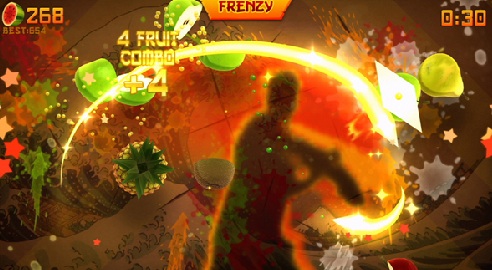
Even though it may come across as a simple game, the release of Fruit Ninja Kinect carries a lot of weight with it. Being part of the Xbox Summer of Arcade garners that the game needs to be a certain level of quality. It’s the first downloadable Kinect game made and many Kinect owners are hoping this will begin a push to see more software finally start to support the device again. And it could deal with the ire of fans of the original game for smart phones if it doesn’t translate well to motion controls. So how would a game originally designed for a touch screen feel when not touching anything at all? Pretty damn good.

Anyone who has played the original Fruit Ninja will instantly be able to jump right into this game. After only a couple of sessions in the perfectly ported Arcade, Classic, or Zen mode you’ll be swinging your arms as proficiently as you swiped your fingers across a touch screen. The only problem players may find with the controls comes when you are swinging upward because when you bring your arms back to your sides, the game will sometimes pick that up as a downward slice and cut into something you never intended to. After a couple rounds prematurely shortened due to this though and you’ll learn to compensate as the original game overall translates very well to the Kinect. The game may actually translate a little too well.

After only an hour of play, I had matched or broken the high scores I had in the smart phone app and found myself bored with the game. Would I play it again at some point? Maybe, especially if I had a friend coming over for the local versus or co-op modes, which is the only real difference between this and some smart phone versions out there. But, swinging your arms instead of swiping your fingers just isn’t enough to sell me on this game at this price if I’m playing by myself. I could just pick up my phone or iPad, and do the same exact thing as on the TV screen with a lot less effort and for one-tenth the price. Bright, colorful, easy to pick up, and initially fun to play, Fruit Ninja Kinect is a solidly built game. But with such fast dissipating appeal and minimal replay-ability I don’t see why you’d pick this up when you can get virtually the same experience for a lot cheaper on your smart phones.

Score: 6.5

Originally Published: August 2, 2011, on EGMNOW.COM

Publisher: Microsoft Studios
Developer: Shadow Planet Productions
Platforms: XBLA

Release: 08.03.11

The Good: Old school exploration and backtracking similar to Metroid
The Bad: Constantly referring back to your map and weapon wheel breaks pace of game play
The Ugly: Monstrous, screen-filling shadow creatures bent on your destruction

Cut from the mold of old-school action games like Metroid, Insanely Twisted Shadow Planet proves that fun, simple, yet engrossing game play can trump all the special effects and cut scenes of other games most any day of the week. In fact, the story of Insanely Twisted Shadow Planet can be summed up thusly: You’re an alien with a spaceship. Your home world has been invaded by a plague like shadow creature. Kill it.

And that’s all you really need as you pilot your way through a maze-like massive world with varying climates and themes and you blast away at parasitic creatures spawned from the master shadow monster. And blast away at these creatures you shall as you’ll earn an assortment of various weapons from standard missiles, blasters, and scanners, to more unique weapons like buzz saws and barrier shields. Of course, each new weapon will only make you want to explore even more as each will not only help you take down certain foes, but also open up new door ways that were once blocked off to you. Rewards ranging from concept art and more of the game’s back-story to armor and blaster power-ups await you if you choose to explore the entire map available.

The only downside that comes from having a large assortment of weapons and a map of where to explore is that you find yourself constantly referring back to the map to see where to go next, or even with four assignable hot keys, needing to go to the weapon wheel to change weapons. This tends to break the pace of game play and will slow down the experience for all the completionists out there.

Despite this minor complaint, Insanely Twisted Shadow Planet is a wonderfully addicting old-school romp that uses simple, tried and tested techniques to pull off a winner. The limited color palette works perfectly for the theme of the game and it helps put your sensory emphasis on the mood-setting music as you blast away in classic underdog style with your tiny ship against an entire world. Throw in an actually compelling 2-4 player co-op/versus mode called “Lantern Run” where you and up to three friends must work together to solve puzzles and escape the encroaching Lantern Monster, all the while competing for the high score, and Insanely Twisted Shadow Planet is another more than worthy entry into Xbox’s Summer of Arcade.

Score: 9.5/10

Originally Published: June 14, 2011, on Youtube.com/Rcars4885

I come to you once again with your weekly geek fix. This week I review L.A. Noire from Rockstar. My hot chick pick of the week is Carrie Keagan and this week’s theme is New Beginnings Pt. 3 from L.A. Noire.