Tag Archive: call of duty


Back in Black

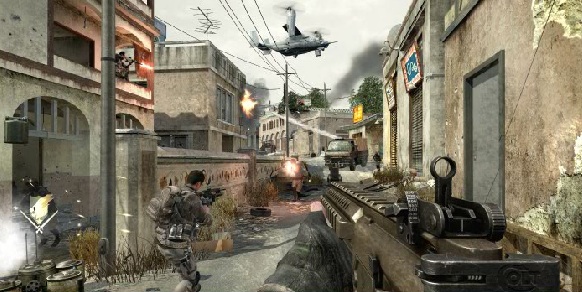
The original Call of Duty: Black Ops took a risk with the franchise by inserting players into a new conflict for the series—The Cold War—and changing up its storytelling mechanic to where most of the game actually takes place via flashbacks. Much like the rest of the franchise though, Black Ops was a huge success, and the new characters introduced resonated with gamers everywhere. So where could Treyarch go from here with their next chapter in the Call of Duty franchise? Well, if the original Black Ops was a change of pace, then Black Ops 2 looks to take the franchise and turn it on its head (in a good way).

The story of Black Ops 2 looks to take place in two main conflicts—the first of which is The Cold War of the 1980s. With talks of Iran, Afghanistan, and Ronald Reagan’s STAR WARS program permeating the culture of the time, you will once again work with Alex Mason and Frank Woods. Yes, Woods is alive and well (and being played by James C. Burns again) as we find that Mason’s unstable mental state had him believe Woods was dead in order to carry out his Manchurian Candidate mission. In the game play demo we saw, we briefly were introduced to what Black Ops 2’s Afghanistan would look like—along with being graced by Woods’ distinct attitude as Mason and Woods rode on horseback (with realistic horse movements as Treyarch went as far as to mo-cap some thoroughbreds) through the Afghanistan desert, working in the best interest of the time for the United States.

The other conflict will not take place in the past or even modern times—but in the future of 2025. There, you will play as Alex Mason’s son, David, who has followed in his father’s footsteps as an ass-kicking soldier supreme who has to stop a ghost from his father’s past—Raul Menendez—from ruining America’s future.

“While playing the game, you’ll see through the eyes of Alex and Frank how this monster is created in the first Cold War,” explains Black Ops 2 Director Dave Anthony.  “Then, in 2025, while playing as David, you see him again and you actually experience what this monster is capable of. While working with David Goyer [writer of Batman Begins, The Dark Knight] on pushing the story and re-writing the rules on the story telling aspect of Call of Duty, the first place we really looked was the villain himself. We wanted to create a human being—not a two-dimensional character. The best reference I can probably give you is if you look at a TV show like The Sopranos, where the main character of the show—Tony—is a villain. He is a cold-blooded murderer; he does things we in our right minds would never do. But, you find subtle layers of understanding of who he is as a human being. You find yourself empathizing with him on many different levels—it puts you in a real conflict. So we have that side of Raul Menendez, and working with David Goyer on this—the man who wrote Heath Ledger’s Joker—you can imagine how far Menendez will go. It’s been very exciting because we’ve been working on this character non-stop for 18 months and I can say that Raul Menendez will be a very memorable character for you.”

Continuing with the two conflicts aspect of the game, Black Ops 2 is really centered around two things: Player choice and parallels (beyond just the father-son relationship of Alex and David and a villain’s past and present). And it wouldn’t be a Call of Duty game if there wasn’t a conflict with global ramifications throughout. So, the first big parallel is that—much like how the 1980s were about oil and stopping the spread of communism—the Cold War of the future looks to be similar.

Doing extensive research and bringing experts on future warfare in like P.W. Singer of the Senior Fellow Brookings Institute (to add to Call of Duty’s go-to-guys on warfare Lt. Col. Hank Keirsey and Col. Oliver North), Black Ops 2’s geo-political conflict revolves around REEs—Rare Earth Elements. REEs are important because they power the laptop you might be reading this on, the iPhone you use to call your friends to talk about this preview with, or the flatscreen TV you’ll end up playing Black Ops 2 on—and 95% of the world’s REEs are currently mined in China. Electronics manufacturers are at the mercy of the world’s most populous country, and a country which could cripple the economies of many other countries if they so choose because of it. The demo we saw of Black Ops 2 hints that they might do exactly that, as REEs make everyone forget all about oil.

In terms of player choice, there are now branching paths in the middle of chapters—similar to what you might see in Gears of War, where you can choose to go down different paths with your character and see the same conflict from different angles. The example we were shown was where David could choose to take a sniping position on an L.A. freeway and cover his troops as they moved through some rubble below, or lead the charge himself and take the lead. Same conflict, two completely different points of view—an element which could give some great replay value to the campaign.

The most thrilling new aspect of Black Ops 2 may be the technology though, both in-game as well as the stuff that actually powers that game. In terms of gameplay, the demo we saw had David firing a sniper rifle with specially-charged bullets which could actually fire through concrete as thick as L.A. freeway support columns. And, we knew where to fire those specially-charged bullets because of the special X-ray-like scope attached to the gun. As David then wove his way through Los Angeles—the target for one of Menendez’s attacks—he took control of a small squad of Quad-rotor drones that he commanded through an area in a fashion similar to how Commander Shepard commanded his team in Mass Effect 3.

But you aren’t the only one in control of fantastic technology like spy drones outfitted with weapons as Menendez and his group obviously know a thing or two about hacking government equipment. Aside from these aerial drones, there were also ground drones called C.L.A.W.s that reminded me of AT-ATs from The Empire Strikes Back—another loose parallel to Reagan’s STAR WARS plan perhaps? So, aside from terrorists, David now had to contend with these unmanned drones that are more deadly accurate than a human could hope to be. And, because they don’t think like humans, they have a completely different A.I. pattern for you to contend with.

Another gameplay parallel we saw—and this one was more in line with the Black Ops series itself—was David having to fly what was referred to as an FA-38 VTOL (vertical take-off and landing). That such a plane could exist in 2025 is possible due to fact that the military is currently testing an F-35B VTOL manufactured by Lockheed Martin. Once airborne, David must shoot down a series of drones and the task itself that might remind some players of the Vietnam helicopter mission with Alex and Frank from the first game. That entire sequence though ended up playing out completely differently, as you might imagine the differences between a 1960s helicopter and a futuristic super-jet. 

Going back to the technology behind the game, I think players will be surprised at what Treyarch is getting out of their engine this time around: Their goal is 60 frames per second, and PC quality graphics on a console. A high bar to set indeed, but I would love to see if the team can pull it off. What we did see though was a pair of incomplete multiplayer maps dubbed “Aftermath” (urban area) and “Yemen” (rural area) that really showed us what they were trying to do to reach those goals, as different parts of the maps were in different stages. More complete parts had “reveal mapping”—a technology new to the series—which gives crevasses and cracks in the ground or walls a more sensitive, detailed, and realistic-looking texture to them. We also saw examples of brand new lighting schemes and particle effect, which included bounce lighting and self-shadowing to really emphasize the realistic qualities of light that are being added to locations.  I think the most impressive thing about these maps were how different they looked compared to anything we’ve seen before in the Call of Duty multiplayer.

“You’ll notice a lot of the areas you walk through are very distinct and unique spaces on the maps,” says Dan Bunting, Director of Online for Black Ops 2. “In ‘Aftermath’, I started in an empty parking lot and then moved into a parking garage, went into a destroyed street, through a fire escape tunnel, and ended up in a hotel lobby. We intentionally do this. Its important to us as designers that we design maps that are easy to understand and that players have a sense of space. As soon as they spawn in, they know where they are. They need to be able to call out to their teammates things like ‘There’s a flag carrier in the lobby!’, for example. It’s not just about communication though, it’s about how the maps flow. There’s always a learning curve when you first start off on a new map and we want to decrease that as much as possible. The fastest way to learn is by having very distinct spaces.”

Clearly, it wouldn’t be Call of Duty without its multiplayer—and it wouldn’t be Treyarch if the “Zombies” mode didn’t return. Thankfully, fans everywhere will enjoy shooting zombies once again, as that mode has been confirmed for Black Ops 2. The folks at Treyarch didn’t want to go into much detail beyond that, but Game Design Director David Vonderhaar did give us some interesting tidbits on what the team is aiming to do with multiplayer overall.

“When we knew for sure where we were going with the time period, and what the game was supposed to be like, it actually opened our eyes up to thinking very critically about challenging what assumptions we had been making about how this game should work, extending the systems that we have, and just what cows are sacred. Did the game have to work the same way it did last time just because it’s a sequel? We asked ourselves this and with many of the game’s core systems like create-a-class and kill streaks, we pulled all these things back to where they started from and asked why do we have this particular perk that acts in this particular way? Are they good? Are they bad? And we really just focused in on three key things on the design side. First, we wanted to create a healthy amount of balance. Like with the Ghost perk. It prevents you from being seen by UAVs. But that’s something that is just on/off. You can’t tune something that is just on/off. So we needed to put ourselves in the best position to where this content is tunable. Then we looked at progression.  Going from when you first pop that disc in to what for many people becomes 40, 60, even 80 hours of game play time. But most importantly, we focused in to make sure that players had the most diverse amount of game play. We challenged ourselves when it came to game play style and as long as we could keep coming up with counters for the most insane game play style then we’re confident we’d create this wide range of game play that appeals to the largest range of people possible.”

Of course, what better way to provide gameplay diversity than with a brand new mode? Strike Force Campaign is a mode that has some real-time strategy elements to it, where you can jump into the shoes of any character or drone on the field, or pull back to a satellite-like image where you can point out posts and command your troops to move where you want them to. And—depending on how well you do or do not do—the following missions and mission options could be drastically different. Again, strong player choice and replayability is being offered here, and Strike Force being its own special campaign adds a lot more meat to the game as a whole as it hits an entirely new demographic with the real-time strategy aspect.

All in all, I do not think I could have been more blown away by the demo we saw and the effort that Treyarch is pouring into this title in every possible aspect. And honestly, this is the most excited I’ve been for a Call of Duty game since the first Modern Warfare. From the parallel moments in history to the new player choices, game modes, and fantastic looking futuristic weaponry and combat, Call of Duty: Black Ops 2 is something that all gamers, not just fans of the franchise, should be keeping their eyes on as its November release steadily approaches.

Originally Published: August 30, 2011, on EGMNOW.COM

I had a chance to sit down with Infinity Ward’s Creative Strategist Robert Bowling and talk a bit about the multiplayer strike packages for Call of Duty: Modern Warfare 3. To check out my full interview with Robert, head to EGMNOW.com or check out EGMi on the iPad and look for Issue 251.5. And for new trailers and more videos from me and the rest of the EGM crew, be sure to check out EGMNOW on Youtube! Multiplayer trailer footage provided by Activision.

Originally Published: August 30, 2011, on EGMNOW.COM

Call of Duty: Modern Warfare 3 creative strategist Robert Bowling faces one of his biggest challenges—revamping the series’ multiplayer offerings.

RC: One of the key aspects that’s made Call of Duty a smash hit is the multiplayer aspect, and you guys have pulled out all the stops in order to expand on this, including a new killstreak system where the player can choose either an Assault, Support, or Specialist path of upgrades. Tell us about the decision to incorporate specialized killstreaks to fit different players’ styles, and how you hope this may level the battlefield for the more objective-based player.

Robert Bowling: Well, the inspiration for all the different strike packages was looking directly at the feedback we’re getting from the 30 million people playing our game. Looking at the player trends that have been happening as we’ve moved from Call of Duty 4, when we first introduced killstreaks to how the dynamic then changed in Modern Warfare 2—and then how we want that dynamic to change even further in Modern Warfare 3. A lot of it’s going back to the more gun-focused gameplay of Call of Duty 4, but with what we’ve learned from the killstreak system is that, inherently, it’s all focused on getting kills. We’ve got millions and millions of players who all play so differently, but they’re not being rewarded, incentive-wise, for being good at the game in other ways—and that was the big driving factor for introducing custom strike packages, because we wanted to open up how you’re rewarded with killstreak rewards. We want to let you be in control in the type of killstreak rewards you have and give you the tools to be a better objective player and a better team player, rather than always trying to be the best team deathmatch player.

And that carries over through more than just the killstreaks. Capturing objectives, capturing a flag, capturing domination points, and blowing up a bomb site should all add to your rewards. So, regardless of what strike package you have, that now gets you one tick closer to unlocking your next killstreak reward. In addition to that, you can now focus your entire killstreak rewards on things that have nothing to do with getting you more kills—and that was the whole mentality behind giving you tools that allow you focus on things other than killing.

RC: Another new multiplayer aspect is the Spec Ops: Survival Mode. Tell us about what you’ve done with your take on what boils down to Horde mode.

RB: Well, Spec Ops: Survival Mode is really taking the traditional wave-based gameplay and putting the Modern Warfare twist on it. So, we’re bringing in all the stuff that people love from multiplayer—matchmaking, progressive ranking, killstreaks, weapon unlocks, weapon attachment systems, gear and equipment from multiplayer—and bringing all that and putting it into a much different arena in a co-op environment against AI enemies. And the benefit of the infinite-wave thing is that we can constantly be throwing different experiences at the player—so, you’re seeing enemies you’re not seeing anywhere else. You’re seeing kamikaze dogs, kamikaze infantry, chemical agents, juggernauts, juggernauts with riot shields, enemy air support—it’s such a different experience, and what I love about it is that it blurs the lines between what’s a competitive multiplayer experience and co-op multiplayer experience, and it makes experiences that were typically only reserved for that super-hardcore-competitive multiplayer guy accessible to the single-player guy. Now you have the opportunity to call in some awesome chopper gun and to be raining death down from above, or maybe you’re just not a competitive multiplayer guy, so you never got to experience that before, but now you can have that in a much different environment.

RC: Moving to the franchise as a whole, we all know that Sledgehammer and Infinity Ward are working jointly on this title. What difficulties have arisen, if any, from having two different development studios working on the same title?

RB: Early on, it’s all about logistics. So, the biggest challenge was, logistically, how do we have two teams work on such a massive experience? And so we sat down and we made the decision to be a very flat organization—to not divide the game and be like, “OK, we’ll take this, and you do that, and you just do your thing, and we’ll do ours.”. That would’ve never worked. So, what we did was focus on playing off each other’s strengths and weaknesses—and everyone has input on everything in the game. So, we’re really working as one giant team rather than dividing things up among each other. So, we’d be more like, “Your guy is really great at this; he should work with our guy on this aspect” on the same level and build up from that organically. From there, logistically, it was about setting up video-conferencing systems, setting up ways to communicate on the fly, as we would with the guy two offices down from me. And then, from a creative standpoint, sitting down and having open, honest conversations about what direction we want to go. I mean, I knew that going into it, we’re a very passionate team with very core design philosophies, and we knew what we wanted Modern Warfare 3 to be. But it was refreshing to have Sledgehammer come in with such a fresh perspective, because they brought in things and directions that we may never have gone in and brought in experiences we’ve never had before.

RC: Speaking of other experiences, do you guys ever look at other shooters out there for inspiration? Do you ever see a perk or a weapon in another game and go, “That’d be really awesome in our game”?

RB: We take inspiration from everywhere, not only in our own genre. I love when we take inspiration from things outside of our genre. Look at what RPGs are doing, and look at what MMOs are doing—specifically in regards to things like progressive rank and XP and how you reward players. We take inspiration from all that stuff, and it’s important that when you do that, you make sure you only take the core mechanic and make it work for the kind of experience that we’re looking to deliver. But, yeah, that happens all the time, and it’s great when you can do that.

RC: Let’s talk about the single-player—at this point, we’ve all seen the E3 2011 footage of the attack on New York City. Call of Duty historically takes place all over the globe, though. What goes into deciding where the games’ missions take place, and what kind of research do you do? In terms of the plot, why New York City now under attack?

RB: Well, a lot of the story and locations are dictated organically by where the story’s going and how the conflict’s escalating. Modern Warfare 3 is a payoff to this growing momentum of conflict that’s been starting since Call of Duty 4. So, in Modern Warfare 2, the state of the world changed when the invasion of the U.S. happened. That was just the beginning. The attack on Washington, D.C. was just the beginning of the turning of that type of war. And it just organically escalated up the eastern seaboard to New York, which is another major city, because the Russian navy ‘s blockaded New York by this time in Modern Warfare 3, because this is a full-on invasion. This is a military invasion by the Russian army—this isn’t some sub-splinter of a group. This is the Russian nation attacking America, and this will be pulling in other major nations and cities into this conflict, as would actually happen if America were attacked.

So, it’s really looking at how the war’s escalating, and what I love about it this time is that we’re leaving these very traditional conflict areas, and for the first ever in Call of Duty, what we started with at the end of MW2 was pulling it into the heart of these major cities, bringing the conflict to these iconic places, rather than nondescript desert town you’d expect wars to be fought in. Now you’re fighting in Paris, London, and these major cities in Germany and Africa. So, it’s really changed organically and the research that goes into that is painstaking. Because you look at like fighting in London, and we ask ourselves, “Where would we fight in London?” We have to figure out where it would not only make sense for the story, but also where it’s going to be very impactful for the player. So, we’re looking at Canary Wharf in London, and then you go into reference and pull each reference you can and look at Google Maps and get the layouts and the buildings. And then you take that—once you get it as authentic as possible—and you put it through a gameplay filter of “OK, this is authentic, but now how do we make it fun?” Because authentic’s great, but fun is king. And that’s when you start looking at player routes and cover points and sight lines and start crafting it for gameplay.

RC: From a technology standpoint, you guys have been working with the IW engine for a while now. Was there anything you were able to add into MW3 that you weren’t able to do before but now can because of the familiarity you have with the tech?

RB: Definitely. The big focus with moving into these new environments and these much bigger cities is that the length and the scale of the levels in the single-player that you’re fighting in now are so much bigger than we’ve ever done before. So, a lot of that on the back end required a lot of tech work—and, thanks to the fact that we’ve been building steppingstones. In Modern Warfare 2, we made a good leap from Call of Duty 4 in terms of just visual graphics with our streaming technology that allowed us to make that leap. And in Modern Warfare 3, we’ve done even more work with that now that we’ve mastered that streaming technology and found other ways that we can enhance what we’re streaming in, when we’re streaming it, and how we can optimize that to get to that scale, to get to that size, and still maintain that super-smooth 60 frames per second with tight controls, which is what sells the Call of Duty franchise. That’s what sells—the tight gunplay. And, at the end of the day, that’s what matters most.

RC: It wouldn’t be a first-person military shooter without plenty of weapons. So, what kinds of new goodies can players look forward to in Modern Warfare 3?

RB: Well, we’ve added a lot of really cool weapons. A ton of weapons overall, especially in multiplayer. There’s stuff that isn’t even out yet, and that’s the great thing of being at the scale that we’re at now, where we’ll actually have weapons manufacturers contact us and be like, “Hey, we have this new prototype that’ll be out in the field in a few years, but we think it would be great for your game,” and we can go look at it, or they’ll bring it to us, nd we’ll check it out. One of my favorites is the XM25 grenade launcher, which is something only Delta operators are using in the field right now. It’s a grenade launcher that “lasers” a target—like, say, someone’s behind a concrete barrier or in a doorway or window or something, and you can laser that barrier, and it’ll calculate the distance, program it into the explosive round, and when you fire it, the round is programmed to explode one meter past that distance. So, you can actually shoot it through the window, and not until after it gets through the window will it explode and take out anyone who’s hiding behind it. That’s something Delta operators are using now, and that’s something we’re going to have in multiplayer and single-player, but we balanced them very differently between the two, because single-player’s all about having fun, while multiplayer’s about having fun but having to be balanced with everything else in the game.

RC: You mentioned Delta operators before. How closely do you work with military personnel in order to give an authentic feel to the game’s combat?

RB: We work very closely when it comes to being authentic in terms of the gear that you’re using and the weapons and they operate and how they look. But, more importantly than anything, is that fun always comes first. So we do want to be as authentic and as real as possible, but we will pull back from that realism in order to be more fun and to make it actually enjoyable to have all that stuff. So we’ll sit with them from a story standpoint and say, “Hey, here’s a scenario we’re cooking up for the story. How would you approach that?” A good example is talking to our active military guys who work with Delta and saying like, “Scenario: Russian sub in a New York harbor. You are responsible for disabling the sub. What would you do?” And then we’d say what we were thinking and our gut reaction to the situation. “Plant a charge here and blow a breach in.” And then they come in and say, “Oh, no—you wouldn’t do that. You’d be afraid of disabling this, and that would force it to come above. And then you could breach it from above without having to be underwater.” And that directly influences the gameplay—like in the E3 trailer, when the SEALs assault the sub.

RC: Call of Duty seems to come across as a “guy’s guy” kind of game. But you have a surprisingly strong female audience as well. What would you attribute that to? And do you ever see Call of Duty including female soldiers as protagonists or allowing players to chose female characters in multiplayer?

RB: I’d attribute it to the fact that we’re extremely accessible to every type of playstyle. We have females in our community that are amazing at the game in every aspect, but then you also notice trends between female gamers and male gamers. Female gamers are typically more focused on teamplay and that support role and not being self-focused or lone-wolfing. They also communicate better in terms of garnering Dom points and capturing objectives. So, I think the fact that we—especially with Modern Warfare 3—cater to different playstyles and reward them has even greater appeal now to all types of audiences.

As for female protagonists, I think anything’s possible in the future. We’ve had some female characters in the past—we had a chopper gunner pilot in Call of Duty 4 who was female. So, I think anything’s possible. We really let the story dictate the characters for us, and so far, we’ve had female roles in there at different points.

RC: Finally, the controversy over violent videogames reemerged after the recent terror attack in Oslo, Norway; the perpetrator of these attacks claimed that he “trained” with Call of Duty. This has led to the franchise being pulled from some store shelves in Norway. How do you guys respond to something like that, and do you see it affecting the series either in the long- or short-term?

RB: We don’t see it affecting us from a creative standpoint, because we’re creating a fictional game with a fictional storyline that takes place completely outside of any real-world scenarios. The universe that our games live in is very unique in that sense. But our focus has always been—and will always be—on making games that are meant for entertainment, that are meant for the right audience, and making sure that we’re following and respecting all the rating guidelines that are out there and making sure that everyone can make an informed decision and that they know what the content of the game is well before purchase. We want to make sure that we’re respecting that, and that we’re open and transparent about that.

Originally Published: August 9, 2011, on EGMNOW.COM

One of the most charming and long lasting impressions that you take away from Comic-Con is the pure love and devotion that people are willing to show by pouring hours on end into costumes just to go gallivanting around the Con for a few days. Some put more thought and effort in than others and some simply relish the opportunity to show off some of their finer…ummm…assets, but no matter what the reason behind it, cos-playing is one of those things that define the Con and is proof positive as to why this is the pop culture extravaganza that it is. On that note, here are some of our favorites that we saw while roaming the show floor.

1. Castle Crashers: CHARGE! When released in 2008 as part of the Xbox Summer of Arcade that year, few knew the intense following the simple side-scroller beat ‘em up Castle Crashers would encourage and these two gentlemen here are proof positive why it was a hit.

2.Catwoman: Puuurrrfect in every way, this femme fatale is a comic book staple for over 70 years now and is a favorite for female Con-goers everywhere representing the strong independent woman mindset. The authentic bullwhip also works as a deterrent for those of us who ogle too long.

3.Ghostbusters: Who ya gonna call?! Probably not these guys. It wouldn’t be a Comic-Con though without staples like Slave Leias, Stormtroopers, or a fearless foursome in brown jumpsuits. Including prop ghost traps and proton packs, these guys (and lady) are ready to believe you.

4. Black Cat: If this is what Black Cat looks like, you might have to question Peter Parker’s tastes for sticking with Mary Jane all those years when he had this waiting for him for a long while. Although rather harmless looking, this feisty feline knows where to hurt you the most.

5. Portal: Lacking in characters to cos-play as, did not act as a deterrent this year for Portal fans. This group found a way to put everyone in a costume with Chele, a pair of portals, and even a very lovely Companion Cube. They all deserve some cake for their efforts.

6. CoD Sniper: As the world rushes by him, the quiet and calm sniper stays hidden in the brush, waiting patiently for his target to finally enter his sights. Holding my breath, I quickly squeezed the trigger when this Sniper wandered into my sights due to the great effort put into his costume.

7. Waldo: Where is he? Right here. And I found his girlfriend, too. I always was very good at those books. I wonder just how much they actually blended in though once they made it through the Con doors and mingled amongst the huge crowds.

8. Army of Two: You can tell cos-players take their craft seriously when you ask them for a picture and they strike a pose relevant to the characters they are portraying. Unfortunately for them, the Call of Duty Sniper from earlier is off camera ready to take them both out.

9. Female Assassin: A huge fan favorite this year was people dressed as Assassin’s Creed characters. The fan turnout was rewarded by Ubisoft as those who dressed as AC characters and attended their Saturday panel, like our female assassin here, were promised free autographed Signature Editions of Revelations when released.

10. Princess Peach: Not the most traditional Peach, but if this is what is always awaiting Mario, no wonder why he keeps going through eight castles for her and that Bowser won’t stop kidnapping her. If your choice was this girl or weird little mushroom people, well, is it really a choice then?

11. Street Fighter: Another group shot, these folks decided to take on the guise of several protagonists from the Street Fighter series including fan favorites like Chun-Li, Ryu, and Blanka. They sure let themselves go since Super Street Fighter IV was released though, haven’t they?

Back in December I had the chance to attend the 2010 SpikeTV VGAs and work the red carpet. It was here that I got a chance to speak with the man behind Call of Duty: Black Ops’s Sgt. Frank Woods, Mr. James C. Burns. We talked about how it was to voice a character who has quickly become somewhat iconic in the Call of Duty mythos and doing voiceover work in general.

Originally Published: November 25, 2010, on ClassicGameRoom.com and NationalLampoon.com

As a part of CGR Undertow, I reviewed the latest installment of the celebrated Call of Duty series, Black Ops. Take over as Alex Mason in the middle of the Cold War as you try to foil a Manchurian Candidate like plot in this first-person shooter.

The Best of E3

Originally Published: July 7, 2010, on Lundberg.me, Examiner.com, Original-Gamer.com, PlayerAffinity.com, and ESPNNewYork.com

I know that E3 was three weeks ago, but with the craziness of the World Cup, NBA Free Agency, and the approaching MLB All-Star break, to say we’ve been a little busy here at ESPN would be an understatement. But in our spare time, my expert cameraman/editor Jared Bodden and I, have been toiling away trying to finish these videos to show you some of the great games we saw at E3 and bring you some exclusive interviews with the people behind those games.

One of the most difficult things in this process has been whittling down what we felt were the most worthwhile games to look at, so we broke it down into four videos. The first video is a compilation featuring online and DLC games with the following three videos being a summary of the rest of the best from each day. For the games that we had to cut for the sake of time, I apologize tremendously. I also wish we could have given every game we did feature their own special video.

On that note, without further ado, below is the culmination of my three days at the L.A. Convention Center for E3 2010. I hope you all enjoy.

The first video was my online/DLC game special that features looks at the new Deadliest Warrior game from Spike Games that comes out next Tuesday, DCU Online from Sony Online Entertainment, QuickHit.com and their brand new NFL license, and Blacklight: Tango Down from Ignition Entertainment.

Our first day at E3 was a special day overall and had us see some spectacular looking games for consoles. Our video of Day 1 features Tron and Epic Mickey from Disney Entertainment, Castlevania: Lords of Shadow from Konami, and Test Drive Unlimited 2 from Atari.

On the second day of E3, console games and their peripherals were well represented once more as we looked at Vanquish from SEGA, Shaun White Skateboarding and Ghost Recon: Future Solider from Ubisoft, WWE All-Stars from THQ, and the new Wii Exercise Bike from Big Ben Interactive.

On the last day of E3, we had a chance to look at some of the most hyped games for consoles and some sweet accessories when we looked at Call of Duty: Black Ops and Spider-Man: Shattered Dimensions from Activision and some sweet products from Nyko and iGUGU.

Videos by Jared Bodden

-Ray Carsillo

Originally Published: June 18, 2010, on Examiner.com, PlayerAffinity.com, and Lundberg.me

On my last day at E3 I had a chance to check out some games from Activision and Ignition Entertainment and I created a montage of booth babes for your viewing enjoyment.

E3 – Monday, June 14th, 2010

Originally Published: June 15th, 2010, on PlayerAffinity.com and Examiner.com

I give my rundown and unique perspective on the Xbox 360 and Ubisoft pressers, and the Activision concert showing off DJ Hero 2, Tony Hawk Shred, and Call of Duty: Black Ops.